High-Density Dynamic Storage Systems
Explore our certified heavy-duty warehouse equipment, from automated pallet shuttles to high-gradient gravity roller tracks and modular industrial platforms.
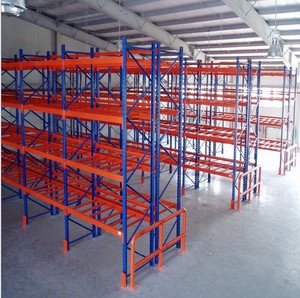
Heda HD-SR-02 Automated Pallet Runner Radio Shuttle Cold Storage Rack
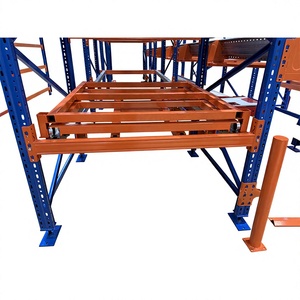
Factory Industrial Push Back Rack For High Density LIFO Warehouse Storage
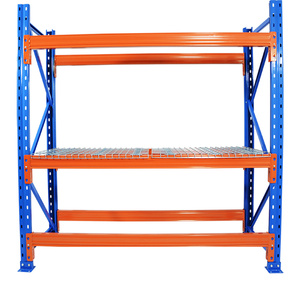
Heavy Duty Pallet Racks Redirack Teardrop Hole Storage Racking System
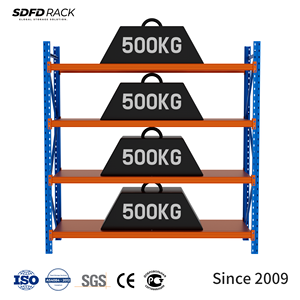
Custom 300-800kg Light Medium Heavy Duty Adjustable Long Span Shelving
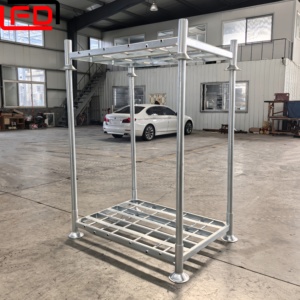
Hot-Dip Galvanized Stackable Metal Post Pallet Heavy Logistic Equipment

Industrial Warehouse Pallet Management Heavy Duty Steel Racking Frame
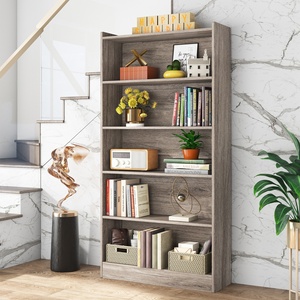
Industrial Modern Large Open 72 Inch Display Shelving Unit For Storage
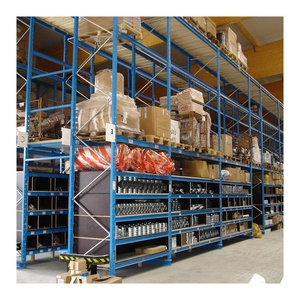
Certified Steel Warehouse Rack Heavy Duty Storage System Direct Manufacturer
Physics, Kinematics & Structural Architecture of Gravity Flow Racks
An authoritative operational blueprint on how dynamic gravity pallet racking minimizes warehouse cycle times, eliminates material handling bottlenecks, and cuts energy consumption to zero.
1. Mechanical Principles of Dynamic Pallet Flow
Gravity pallet flow racking (also known internationally as Pallet Flow or Dynamic Flow Racking) operates entirely on pure gravitational potential energy. The core infrastructure relies on inclined roller tracks integrated into rigid upright frames at a slope between 3% and 4% (approximately 1.7° to 2.3°). Unitized pallet loads are deposited into the loading face (charging side) of an aisle, then smoothly glide on cylindrical galvanised steel rollers toward the discharge face (picking end).
Unlike conventional static selective racking, which requires dedicated forklift travel aisles on both sides of every single storage row, gravity flow technology compresses 10 to 25 pallet positions into a continuous linear run. The system inherently guarantees strict FIFO (First-In, First-Out) stock rotation, making it the premier physical architecture for perishable foodstuffs, pharmaceuticals, fast-moving beverage distribution, and automated assembly line buffer lanes.
Centrifugal Brake Rollers
Direct internal mechanical gearings engage brake shoes when rotational velocity exceeds pre-set limits, damping runaway descent of heavy pallets without relying on pneumatic or electrical power supplies.
Load Separation Dampers
Automatic mechanical separators disengage the front picking pallet from the queue behind it. This relieves hydraulic back-pressure on the forklift fork during extraction, preventing structural tipping and load binding.
Self-Centering Entry Guides
Laser-formed lead-in flared guide plates align pallets symmetrically along the track centerline, preventing misaligned wooden or plastic runners from contacting lateral frame beams.
2. Technical Parameter Matrix: Flow Systems vs. Alternative Racking Systems
A rigorous comparative analysis indicates that Gravity Flow Racking yields the highest square-meter volumetric efficiency while totally eradicating cross-aisle forklift traffic conflicts.
| Racking Topology | Storage Density | FIFO Compliance | Forklift Travel Time | Energy Expense | Capital Cost Per Pallet |
|---|---|---|---|---|---|
| Gravity Pallet Flow | Up to 85% Volumetric | 100% Strict FIFO | Minimal (Separated Charging/Picking) | Zero (Gravity Driven) | Medium-High (Rapid ROI) |
| Standard Selective | 35% - 40% Low Density | Manual Management | High (Aisle Traversal per Pick) | Standard Forklift Fleet | Low Capital Base |
| Radio Shuttle System | 80% - 90% Ultra High | Flexible FIFO / LIFO | Very Low (Runner Automation) | Lithium Battery Recharging | High (Robotized Carrier) |
| Drive-In Racking | 65% - 75% High Density | Strict LIFO Only | High (Truck Enters Deep Channels) | Heavy Forklift Fuel/Wear | Moderate Capital Base |
Procurement & Technological Trends in Warehouse Storage (2025–2030)
How international supply chain leaders are transforming their capital expenditure strategies to navigate rising land prices, robotic integration, and sustainability imperatives.
AS/RS and AMR Co-Engineering
Future gravity racking installations are no longer purely manual operations. Modern procurement managers design roller tracks with robotic end-of-arm stops, enabling Autonomous Mobile Robots (AMRs) and Automated Storage and Retrieval Systems (AS/RS) cranes to deposit and retrieve pallets without human intervention.
Net-Zero & Passive Automation
With stringent global carbon regulations and rising industrial electricity costs, logistics facilities prioritize non-powered dynamic machinery. Gravity racking delivers high-throughput throughput speed without a kilowatt of electrical draw, drastically cutting greenhouse emissions.
Smart IoT Telemetry & Roller Monitoring
Emerging systems incorporate micro-piezoelectric sensors within roller bearings. As pallets transit, the rollers harvest kinetic energy to transmit real-time data regarding track health, speed variations, and temperature anomalies directly to cloud-based Warehouse Management Systems (WMS).
Nearshore Resiliency & Modular Standardization
Global procurement teams are moving away from proprietary, bespoke systems in favor of internationally certified (CE, ISO, RMI) modular components that can be quickly dismantled, expanded, or reconfigured across global cold-chain hubs as market demographics shift.
Why Tier-1 Global Enterprises Choose HEDA Shelves
Guangzhou Heda Shelves Co., Ltd. delivers engineered racking solutions with full end-to-end quality control, robust structural steel processing, and verified international compliance.
Precision 10-Stage Manufacturing Methodology
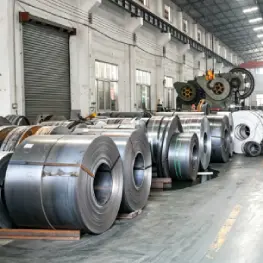
Every structural profile manufactured in our Guangzhou complex undergoes a tightly monitored 10-stage fabrication workflow to guarantee micron-level tolerances and superior corrosion resistance under harsh maritime and tropical conditions.
Raw Material QC
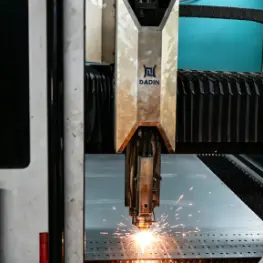
Laser & Shearing
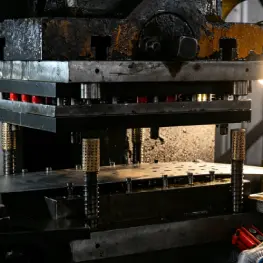
CNC Punching
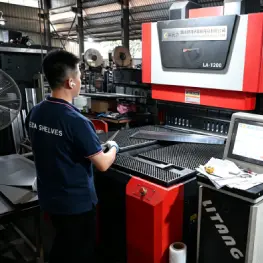
Cold Bending
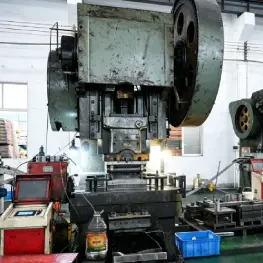
Roll Forming
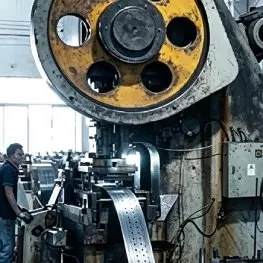
Deburr & Polish
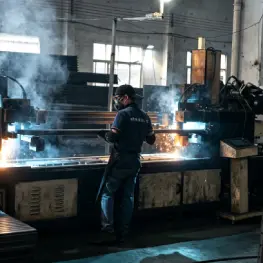
Robotic Welding
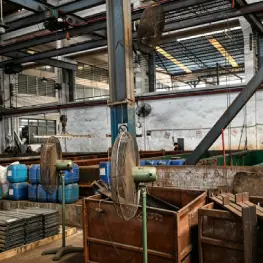
Pickle & Phosphate
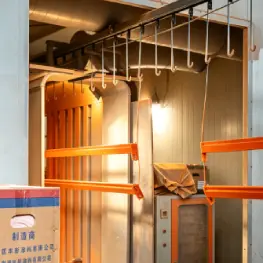
Powder Coating

Export Packing
Standard EN 15512 & CE Registration No. 2435-CPR-8605159 ensure all seismic, flexural, and dynamic ratings exceed European criteria.
Rigid certificate tracking No. 18624Q00169R0M covering all raw sheet thickness tests, weld seam penetration audits, and coating adhesion pulls.
Every project includes free 3D CAD modeling, custom roller gradient calculations based on customer pallet samples, and remote video installation support.
Frequently Asked Questions on Gravity Pallet Racking
Essential technical, financial, and logistical insights for plant managers, supply chain directors, and warehouse engineers.
What pallet types are compatible with gravity flow roller beds?
Standard wooden pallets (GMA 48x40, Euro 1200x800, Australian 1165x1165) with full bottom boards oriented parallel to the roller travel run best. For steel containers, plastic skids, or single-way softwood pallets with missing boards, continuous full-width steel rollers or heavy three-track roller configurations are engineered to prevent sagging and roller jamming.
How do centrifugal brake rollers safeguard fragile goods?
Centrifugal brake rollers contain an internal planetary gear and expanding friction brake shoes. When a descending pallet moves faster than 0.3 m/s, the centrifugal force expands the shoes against the internal roller housing, generating proportional resistance that holds the pallet to a safe walking pace without causing structural shock or destabilizing stretch wrap.
What happens if a pallet stalls midway along a deep lane?
Stalls typically occur due to cracked pallet boards or low-quality deflection. HEDA flow systems are equipped with manual release unjamming mechanisms at the picking face, and our heavy tracks allow standard 'plugging' (a forklift nudging the subsequent pallet) safely. Moreover, our engineers calculate pitch gradients precisely based on your measured deflection specs to stop stalls before they happen.
How does gravity racking withstand sub-zero cold chain freezers?
For cold storage units operating between -25°C and -40°C, components are hot-dip galvanized or treated with low-temperature epoxy powder coating. Roller bearings are packed with synthetic low-viscosity arctic-grade lubricants that resist freezing, preventing moisture-induced bearing seizure and sluggish roller motion.
What typical ROI payback period can warehouse managers anticipate?
Most distribution facilities recover their capital expenditure within 14 to 22 months. This accelerated payback is driven by a 30% reduction in forklift fleet size, up to 60% savings in operator transit hours, elimination of aisle lighting and HVAC cooling in condensed storage zones, and the reduction of product expiration losses under strict FIFO control.
What documentation and port handling do you provide for exporters?
We supply containerized export shipments globally with stamped structural engineering calculations, mill test certificates (MTC), CE Declaration of Performance, fumigation certificates for dunnage, and pre-sorted component labeling matched to CAD erection diagrams for rapid on-site assembly.
Ready to Optimize Your Warehouse With Engineered Gravity Pallet Racking?
Connect with our senior logistics structural engineers. Share your building layout, pallet dimensions, and SKU throughput targets for a complimentary 3D CAD design, load-bearing simulation, and competitive factory-direct quote.