Engineered FIFO Pallet Racking Systems
Explore our heavy-duty FIFO gravity flow racks, semi-automated radio shuttles, and precision dynamic storage solutions. Certified for extreme weight capacities, seamless pallet gliding, and foolproof inventory rotation.
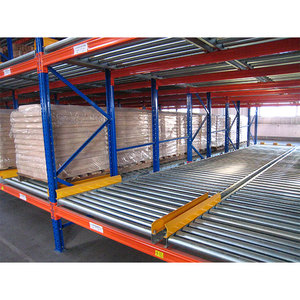
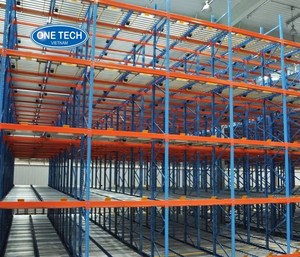
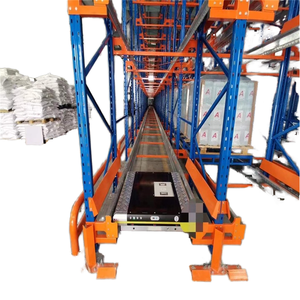
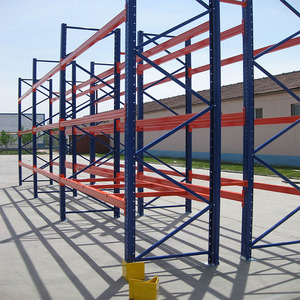
The Engineering Anatomy of True FIFO Dynamic Storage Systems
In contemporary cold storage, pharmaceutical warehousing, and high-velocity consumer goods distribution, inventory velocity, expiration management, and volumetric density dictate financial margins. A genuine First-In, First-Out (FIFO) pallet racking system resolves the fundamental operational conflict of traditional selective racking: excessive travel aisles consuming upwards of 60% of floor real estate.
By engineering dedicated charging (loading) and discharge (picking) faces on opposite ends of a contiguous racking block, FIFO systems enforce flawless stock rotation. Pallets loaded first are inevitably extracted first, eliminating obsolete batch hazards and preventing pallet aging in food ingredients, dairy reserves, biomedical containers, and chemical reagents.
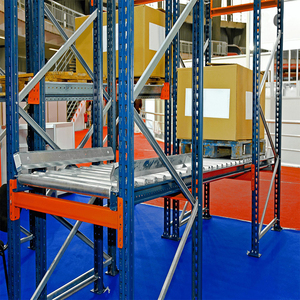
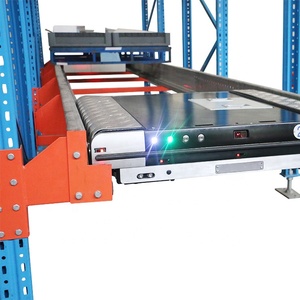
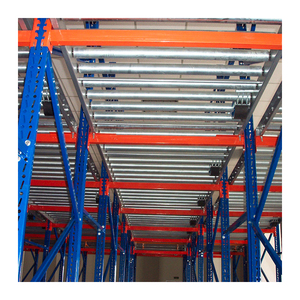
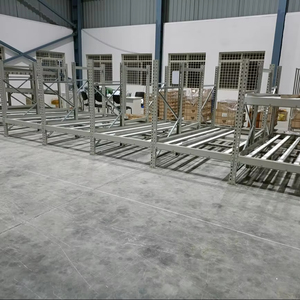
Dynamic FIFO systems rely on two foundational mechanical execution models: Gravity Pallet Flow Roller Tracks and Semi-Automated Deep-Lane Radio Shuttle Systems. In gravity systems, full steel frames support inclined roller tracks (sloped accurately between 2.5% and 3.5% or 1.5° to 2°). Utilizing Earth's gravitational force, pallets coast smoothly from the replenishment aisle toward the extraction face. Built-in speed controllers, centrifugal brake rollers, and load-separating release mechanisms ensure that pallets glide under controlled terminal velocity without violent collisions, maintaining safety regardless of varying pallet weights from 400 kg to 2000 kg.
| Racking Architecture | Access Methodology | Volumetric Storage Density | Inventory Rotation Protocol | Forklift Travel Requirement | Optimum Industry Application |
|---|---|---|---|---|---|
| Gravity Pallet Flow | Gravity roller incline (2.5%–3.5%) | 80% – 85% of cube volume | Strict Automatic FIFO | Perimeter aisles only (zero rack entry) | Food, Dairy, Pharmaceuticals, Fast FMCG |
| Automated Radio Shuttle | Electric battery shuttle on rails | 85% – 90% of cube volume | Programmable FIFO or LIFO | Dock transfer only; shuttles work lanes | Cold Rooms (-30°C), Deep Reserve, Bulk Raw |
| Standard Selective Rack | 100% individual beam selectivity | 35% – 45% of cube volume | Operator-dependent FIFO | Forklifts traverse every inner aisle | Multi-SKU slow parts, random order-picking |
| Drive-In / Drive-Through | Cantilevered rail lane entry | 65% – 75% of cube volume | LIFO (Drive-In) / FIFO (Drive-Thru) | Forklifts enter inside the steel frame | Uniform seasonal bulk, non-perishable goods |
Future Procurement Trends in High-Density FIFO Storage
Global supply chain volatility, surging urban warehousing land rents, and aggressive ESG mandates are fundamentally altering how multinational procurement directors source heavy-duty warehouse racking.
AGV & AMR Autonomous Interfacing
Traditional racking relied strictly on manual counterbalanced or reach forklifts. Forward-looking procurement specifications now mandate robotic readiness. FIFO flow lanes and shuttle charging docks are engineered with optical docking targets, laser alignment reflectors, and widened chamfered guides for autonomous guided vehicles (AGVs).
- Precision ground clearances for AMR undercarriage transit
- Integrated PLC communication between shuttles and fleet software
- Zero-tolerance beam deflection parameters (1/250 vs legacy 1/200)
High-Yield Metallurgy & Structural Safety
Global logistics facilities are moving into taller buildings (12m to 24m clear ceiling heights). Procurement teams are standardizing on certified European standard Q235B and Q355B high-tensile structural cold-rolled steel, verified under EN 15512 and FEM 10.2.02 codes to resist seismic shear forces.
- Baseplates engineered for high-energy seismic absorption
- Heavy wrap-around upright column protectors as standard
- Traceable steel mill certificates accompanying every shipping container
Eco-Efficient, Zero-Emission Warehousing
With operational energy representing the primary variable expense in temperature-controlled warehouses, dynamic gravity flow racking represents the ultimate zero-energy storage system. Running entirely on gravity with zero electrical motors inside the racking matrix, it reduces carbon footprint and fire insurance premiums.
- Zero kilowatt-hour power consumption across gravity tracks
- Ultra-durable, heavy-metal-free electrostatic powder coatings
- Ultra-dense layouts reducing required refrigeration cube space by 40%
Technological Evolution: From Mechanical Gravity to Intelligent Dynamic Systems
The manufacturing and design of FIFO racking systems have shifted from basic metal forming to highly specialized dynamic engineering. Key developmental vectors define current cutting-edge production:
1. Damped Magnetic Eddy-Current Braking Rollers: In conventional gravity tracks, mechanical friction brake rollers employ internal spring gears that wear over time, generating micro-particles and requiring replacement every few years. Modern high-spec export systems feature non-contact eddy current magnetic brake rollers. As steel pallets move faster over the roller, magnetic resistance scales proportionally without friction, ensuring infinite mechanical lifespan, silent deceleration, and cleanroom compatibility.
2. Automated End-of-Lane Pallet Separators: The most significant risk in high-density gravity storage is "line pressure." When 15 pallets resting on an incline press against the lead pallet at the picking face, the total pressure can exceed 20,000 kg, making it hazardous or impossible for a forklift operator to safely extract the front load. State-of-the-art FIFO racks incorporate automatic mechanical safety separators that decouple the second pallet from the first until the front pallet is completely lifted off the rack, reducing extraction force to zero.
3. Deep-Cold Metallurgy Resilience: In quick-freeze blast chillers and frozen distribution hubs operating continuously at -25°C to -30°C, ordinary carbon steel suffers ductile-to-brittle transition risk. Advanced cold-chain FIFO racks utilize micro-alloyed steel formulations with calibrated manganese content and shot-blast hot-dip galvanization or specialized low-bake polyurethane coatings that eliminate micro-cracking and structural embrittlement under prolonged sub-zero loads.
Guangzhou HEDA Shelves: Engineering Integrity & Global Footprint
Operating since 2001, Guangzhou Heda Shelves Co., Ltd. stands among China's premier racking designers, manufacturers, and turnkey exporters, combining an expansive 30,000 m² heavy manufacturing facility with strict ISO 9001:2015 and CE certification standards.
Our turnkey capabilities bridge the gap between architectural layout planning and on-site container discharge. With a production team of over 300 skilled engineers, robotic welders, and logistics managers, we maintain a robust monthly manufacturing capacity exceeding 30,000 tons. Every structural frame, connector, beam clip, and roller channel is fully designed and produced in-house under an unbroken traceability chain.
Our 10-Stage High-Precision Manufacturing Process
Raw Material QC
Certified high-grade Q235B and Q355B prime steel coils checked for tensile strength, elongation, and chemical purity.
Precision CNC Slitting
Laser and CNC continuous slitters cut sheet metal with +/- 0.1mm dimensional precision across length and width.
Automated Punching
Continuous heavy mechanical punches generate standardized 50mm / 75mm pitch holes with zero cumulative error.
Continuous Roll Forming
Multi-stand continuous roll forming lines bend complex structural profiles to maximize load-bearing cross-sections.
Cold Profile Straightening
Stress-relief passes eliminate residual tension, guaranteeing upright columns with zero axial twist or camber.
Robotic Edge Polishing
Automated deburring machines remove flash and sharp edges, preventing coating delamination and operator injury.
Robotic CO2 Welding
High-penetration robotic welders join beam connectors and bracket flanges with uniform deep-weld seams.
7-Step Chemical Pretreatment
Immersion pickling, acid descaling, water rinse, neutralization, and hot phosphating guarantee maximum paint adhesion.
Electrostatic Coating
Automatic GEMA electrostatic spray guns coat parts with heavy epoxy-polyester powder, followed by 200°C curing.
Container Optimization
Export bundle wrapping with wooden pallets, corner guards, and steel strapping designed to maximize 40HQ cube filling.
Frequently Asked Questions: Global Industrial Procurement
Critical engineering considerations, shipping realities, and operational factors answered directly by our chief structural engineers.
What is the fundamental engineering difference between FIFO Pallet Flow and LIFO Push-Back Racking?
The distinction lies in lane accessibility and stock sequence. In a FIFO Pallet Flow rack, separate aisles are dedicated to loading and picking. Pallets travel dynamically along full-lane roller beds from the replenishment side to the exit side, strictly enforcing date-based rotation. In a Push-Back system, carts nested on inclined rails are accessed from a single aisle; each loaded pallet pushes back the pallets behind it. When a pallet is unloaded, gravity rolls the subsequent pallet forward into the pick face. Push-Back is natively Last-In, First-Out (LIFO), whereas Pallet Flow guarantees absolute First-In, First-Out (FIFO) turnover.
How does Guangzhou HEDA Shelves prevent pallet runaway speeds and collisions in long gravity lanes?
In deep gravity flow lanes (from 3 to 20+ pallets deep), runaway acceleration is governed through strategically positioned centrifugal brake rollers and speed controllers. Integrated directly into the roller track at uniform distances (typically every one to two pallet lengths), these internal planetary gears engage when rotation speed exceeds calibrated limits. The heavier or faster the pallet moves, the higher the braking resistance applied. At the picking face, heavy-duty mechanical ramp stops and spring-cushioned end-stops bring the pallet to an imperceptible, cushioned halt without cargo displacement.
Can weak, non-standard, or defective wooden pallets run on FIFO Gravity Flow roller tracks?
Gravity flow requires stable, continuous contact between the pallet bottom and roller tracks. Standard GMA wooden pallets, Euro-pallets (EPAL), and plastic runners with 3 or 5 full bottom skids run exceptionally well. Damaged pallets with broken bottom deckboards or missing skids can jam between rollers. For facilities handling mixed or lower-grade pallets, we configure multi-track full-width cylindrical rollers instead of narrow dual-wheel skate tracks, or integrate reusable slave pallet trays that cradle non-conforming loads through the flow system safely.
What documentation and certifications are supplied with containerized export shipments?
Every industrial export project executed by HEDA Shelves includes verified European CE Declaration of Conformity under standard EN 15512, Factory Quality Management ISO 9001:2015 certification (Registration No. 18624Q00169R0M), RoHS metallurgical test reports, Mill Test Certificates (MTC) proving steel chemical composition and tensile strength, full Bill of Materials (BOM), custom load rating warning placards for the rack bays, and 3D step-by-step CAD structural assembly blueprints.
How are international ocean freight costs and shipping container packing optimized?
Because structural racking components are heavy and bulky, unoptimized packing wastes significant container volume, inflating landed per-pallet costs. Our logistics engineering team uses customized 3D packing simulation algorithms to bundle upright frames, cross-beams, and roller tracks. High-tensile steel frames are nested and banded with steel strapping, while vulnerable components such as brake rollers and shuttle electronics are housed in fumigated, moisture-sealed plywood crates with desiccant packs. Standard 40HQ containers achieve over 95% volumetric and weight utilization, landing directly at major hubs such as Nhava Sheva, Mundra, Chattogram, Colombo, Hamburg, Rotterdam, and Los Angeles.
How does temperature affect FIFO rack functionality in cold storage facilities down to -30°C?
Cold storage creates significant challenges: roller grease solidifies, steel can suffer low-temperature embrittlement, and condensation leads to corrosion during defrost cycles. For sub-zero installations, we specify low-temperature synthetic lubricants inside all roller bearings to prevent binding, construct frames using impact-tested Q355B steel, and apply minimum 80-micron hot-dip galvanized or specialized epoxy powder coatings. This prevents oxidation and ensures continuous free-wheeling rotation at freezing temperatures.
What lead time is standard for a custom-engineered 5,000-pallet position FIFO warehouse?
Following receipt of your warehouse architectural drawings and pallet specification profile, our engineering team provides a complete 2D CAD layout, 3D rendering, and structural quotation within 24 to 48 hours. Upon order confirmation, manufacturing takes approximately 20 to 30 calendar days across our 30,000 m² plant. Shipping transit times vary by destination port (typically 12–25 days for regional maritime routes), allowing rapid project turnaround.
Accelerate Your Warehouse Capacity with Turnkey FIFO Engineering
Send our senior engineering team your warehouse dimensions, pallet dimensions, maximum unit loads, and target SKU velocity. We will generate a complimentary 2D CAD layout, 3D structural simulation, and quotation within 24 hours.