Direct-from-Factory Cantilever & Heavy Storage Racks
Precision-formed roll-formed and heavy hot-rolled structural I-beam cantilever systems designed to European (EN 15512, FEM 10.2.02) and American (ANSI MH16.1) industrial standards. Explore our core configurations below.
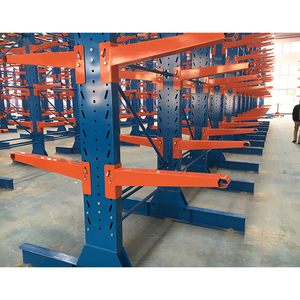
Adjustable Equipment Supply Chain Storage Racking Cantilever Rack for Warehouse Management
- Pitch Interval: 100mm / 140mm
- Arm Capacity: 300 - 1,200 kg/arm
- Structural Profile: C-Profile Roll-Formed
- Anti-Corrosion: Electrostatic Epoxy
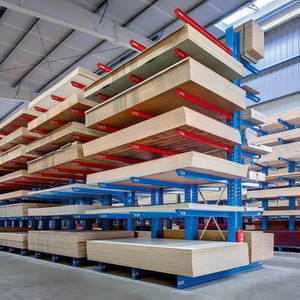
Nesrack Double Sided Rack Galvanizing Warehouse Cantilever Racking for Rebar
- Design Type: Double-Sided Freestanding
- Zinc Thickness: ≥ 85 μm (ISO 1461)
- Ideal For: Rebar & Outdoor Yards
- Deflection Ratio: 1/250 Under Full UDL
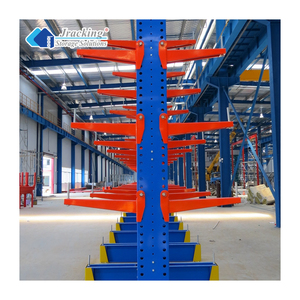
Jracking Structural Heavy Duty Portable Powder Coated Cantilever Rack For Long Materials
- Load Range: 1,000 - 3,500 kg/arm
- Column Beam: Hot-Rolled H-Beams
- Pivot Arm: Impact-Release Lock
- Application: Heavy Billets & Coils
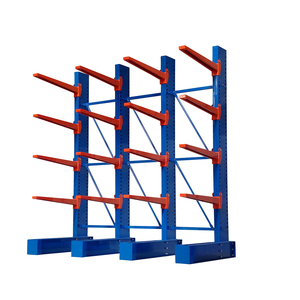
Industry Warehouse Steel Structural Pipe Rack Cantilever Rack for Pipe / Lumber Storage
- Arm Retention: Removable End-Stop Pins
- Column Height: Up to 12,000 mm
- Material: Certified Q235B / Q355B
- Custom Decking: Steel Grating Available
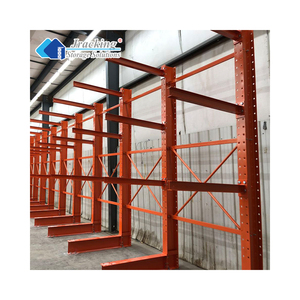
Jracking Customized Warehouse Storage Racks Rust-Resistant Light Duty Cantilever Rack For Plastic Pipes Storage
- Capacity: 100 - 400 kg/arm
- Weight Profile: Ultra-Light High Tensile
- Arm Angles: 2° Upward Deflection Offset
- Target Stock: PVC, Conduit, Extrusions
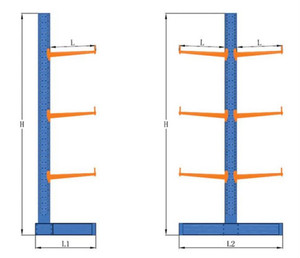
Jracking CE Certified Warehouse Storage Shelving Rack Adjustable Heavy-Duty Cantilever Rack for Steel Profile Storage
- Compliance: CE No. 2435-CPR-8605159
- Arm Lengths: 600mm to 1,800mm
- Base Anchoring: Multi-Hole Seismic Base
- Load Range: Heavy Profile Bars & Channels
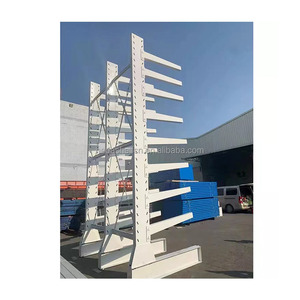
Industrial Rack Shelving Single Sided Heavy Duty Cantilever Racking System Cantilever Racks for Sale
- Placement: Wall Boundary & Narrow Aisle
- Safety Factor: 1.5 - 1.67 Yield Reserve
- Base Length: Balanced Arm + 150mm Overhang
- Bracing System: Diagonal Cross-Bracing Towers
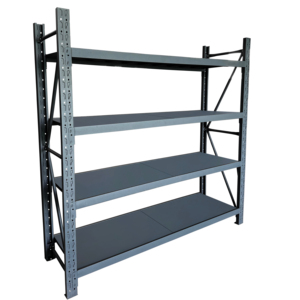
Warehouse Long Span Racking Steel Storage Racks Display Garage Shelves
- Hybrid Utility: Manual Hand-Picking + Bulk
- Beam Levels: Step-Beams with Steel Decks
- Deck Capacity: 300 - 800 kg/tier UDL
- Versatility: Parts, Cartons, Bundled Stock
1. Structural Engineering Fundamentals: Roll-Formed vs. Hot-Rolled Cantilever Racks
Cantilever racking is mathematically distinct from conventional selective pallet racking. While pallet racks transfer vertical gravity loads uniformly across closed horizontal frame trusses, cantilever systems rely entirely on unbraced forward-projecting cantilever arms anchored to vertical columns subject to severe combined bending and axial compression ($P-M$ interaction). For warehouse engineering consultants and global procurement managers evaluating Chinese manufacturers, choosing between cold roll-formed sheet steel and heavy hot-rolled structural steel sections determines total project capital cost, lifecycle durability, and safe floor-space density.
Engineering Rule of Thumb: For light to medium duty applications handling uniform distributed loads (UDL) up to 800 kg per arm (e.g., plastic extrusions, conduit, electrical trunking, lightweight timber), roll-formed C-profiles manufactured from high-yield Q235B cold-rolled steel deliver optimized cost efficiency and 100mm pin-pitch adjustability. For heavy metallurgical manufacturing, steel tubing yards, structural rebar bundles, and sheet metal storage exceeding 1,000 kg to 4,000 kg per arm, hot-rolled structural I-beams (IPE, HEA, or custom Chinese national standard WF shapes in Q355B/ASTM A572 Gr 50) are mandatory to mitigate permanent plastic deformation from lateral forklift impact.
1.1 Deflection Ratios and Elastic Limit Criteria
According to European standard EN 15512 and FEM 10.2.02 (Design of Cantilever Racking), the allowable vertical elastic deflection of the arm tip under full uniform service load ($\delta$) must not exceed $L/200$ to $L/250$, where $L$ is the clear projection length of the arm. Furthermore, tier-1 Chinese factories engineer arms with an integrated upward manufacturing camber angle of 1.5° to 2.5°. This pre-set tilt neutralizes gravitational sagging when loaded, preventing long cylindrical stock (such as steel tubes, oil pipes, or copper rods) from rolling forward off the arm edges.
| Design Parameter | Cold Roll-Formed System | Hot-Rolled Structural I-Beam System | Procurement Selection Standard |
|---|---|---|---|
| Steel Substrate Grade | Q235B Cold-Rolled Strip Steel (Yield $f_y \ge 235 \text{ MPa}$) | Q355B Hot-Rolled Structural Steel (Yield $f_y \ge 355 \text{ MPa}$) | Q355B recommended for high seismic or outdoor load zones |
| Arm Capacity Range (UDL) | 150 kg – 900 kg per arm | 1,000 kg – 4,500+ kg per arm | Match to forklift dynamic capacity & bundle weight |
| Column Profile Design | Roll-formed C-Channel back-to-back welded | Solid Hot-Rolled IPE, HEA, or H-Beam Sections | Structural columns eliminate localized web buckling |
| Arm-to-Column Connection | Pinned wedge-connector with safety lock-pin | High-strength Grade 8.8 / 10.9 structural bolts or pivot pins | Pivot arms rotate upward when struck by forks, preventing tear |
| Impact Resistance Class | Moderate – suitable for reach trucks & side-loaders | Extreme – withstands counterbalanced forklift yard duty | Industrial lumber yards & rebar centers require hot-rolled |
| Corrosion Protection | Thermosetting electrostatic polyester powder (60-80 μm) | Hot-dip galvanized (ISO 1461, 85-110 μm) or Powder Coat | Hot-dip galvanizing mandatory for open yards & port humidity |
1.2 Dynamic Pivot Arm Engineering: Impact Energy Dissipation
A frequent cause of catastrophic warehouse rack failure during long-profile storage handling is the upward vertical impact exerted by forklift masts during retrieval. When an operator accidentally raises forks under a rigid, unyielding welded cantilever arm, the moment arm transfers immense torsion to the column web, causing local buckling or anchor sheared failure.
Top-tier Chinese cantilever factories implement articulated pivot arm mechanisms. Rather than welding the arm rigid to its bracket, the arm is secured via heavy-duty alloy shear pins through precision-bored column flanges. When subjected to accidental upward fork pressure, the arm pivots freely upward around its axis, immediately dissipating kinetic impact energy without transferring destructive bending moments to the main tower or dislodging adjacent loaded storage tiers.
2. Inside Guangzhou Heda Shelves Co., Ltd.: 25+ Years of Structural Innovation
Founded in 2001, Guangzhou Heda Shelves Co., Ltd. has evolved into one of China's premier heavy industrial storage equipment manufacturers. Operating across a modernized 30,000 m² production footprint with over 300 experienced engineers, structural detailers, and certified welders, HEDA Shelves maintains a production velocity delivering over 30,000 metric tons of custom-engineered warehouse racking monthly to more than 120 countries worldwide.
Unlike trading middlemen or small regional fabricators that outsource crucial process steps, HEDA maintains total closed-loop internal fabrication control. From coil slitting and automated CNC multi-axis punch presses to robotic welding cells, continuous twelve-tank chemical pretreatment, and automated electrostatic powder coating lines, every single beam, arm, column base, and bracing strut is fabricated under strict ISO 9001:2015 quality assurance protocols.
Direct Manufacturing Scale & Engineering Credentials
When sourcing containerized industrial cantilever systems from China, tier-1 capacity ensures on-time shipment, structural steel traceability, and tight dimensional tolerances for rapid on-site assembly.
Comprehensive 10-Stage Precision Manufacturing Workflow
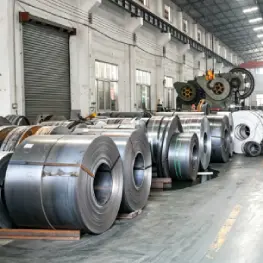
Prime Steel Coils
Certified Q235B and Q355B raw structural coils audited for yield tensile performance and thickness consistency.
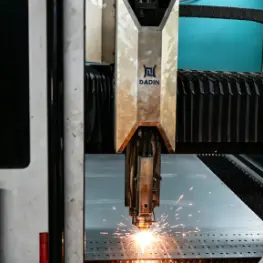
Precision Steel Cutting
High-tolerance automated cutting lines ensure length variation within ±0.5mm across extended 12m column heights.
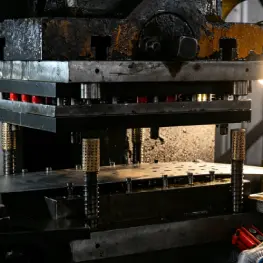
CNC Column Punching
Continuous automated progressive punching produces uniform 100mm/140mm pitch holes for flexible cantilever arm adjustment.
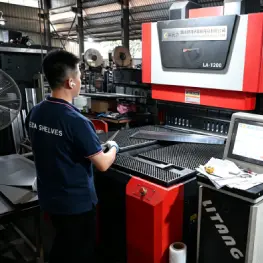
Continuous Cold Forming
Multi-roller forming trains cold-work steel profiles to elevate section rigidity without micro-cracking structural radii.
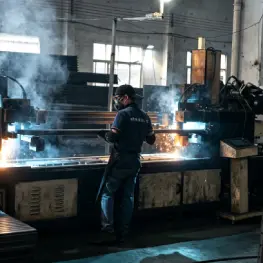
Submerged & Shielded Welding
Robotic multi-pass MIG welding guarantees deep weld penetration on cantilever arm saddles, base plates, and tower bracing clips.
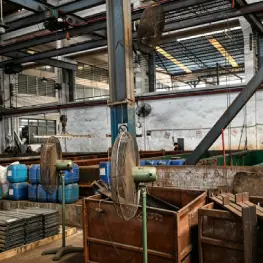
Pickling & Phosphating
Multi-stage immersion cleaning strips mill scale and oil, depositing an iron phosphate substrate for superior paint bonding.
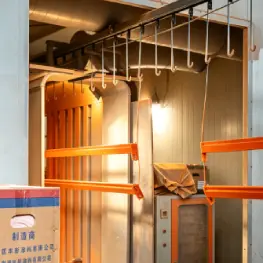
Electrostatic Coating
Solvent-free polyester powder applied at 80 kV and cured in 200°C baking tunnels creates hard, abrasion-proof arm surfaces.
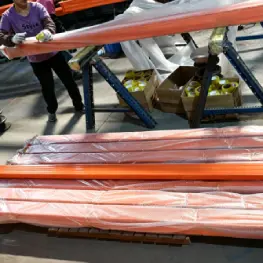
Container Bundling QC
High-density export packaging with heavy-duty corner dunnage preserves coating integrity during trans-oceanic container transport.
Emerging Sourcing & Engineering Procurement Trends
How international supply chain leaders, warehouse operators, and structural specifiers are evolving their procurement criteria for heavy cantilever storage systems.
Multidirectional VNA & AGV Integration
Conventional cantilever warehouse layouts require broad 4.5m to 6.0m aisles to accommodate long stock maneuvered by standard counterbalanced forklifts. The trend is moving rapidly toward Very Narrow Aisle (VNA) multidirectional sideloaders and guided Autonomous Guided Vehicles (AGVs).
- Aisle width reduced down to 2.2m – 2.6m, doubling warehouse cubic storage capacity.
- Bottom guide rails integrated directly into cantilever base outriggers.
Duplex Anti-Corrosion Systems for Coastal Logistics
With major logistics and heavy industrial clusters developing across high-humidity coastal zones (India, Middle East, Southeast Asia, South America), standard internal powder coatings fail within 24 to 36 months under marine salt-spray exposure.
- Shift toward Hot-Dip Galvanizing (HDG) per ISO 1461 (>85 μm zinc barrier).
- High-durability Duplex Coating: HDG substrate + Architectural Epoxy Powder Topcoat.
Automated Stacker Crane Cantilever ASRS
High-volume metal distribution service centers handling bars, profiles, and plate cassettes are converting static cantilever racks into fully automated Automated Storage and Retrieval Systems (ASRS).
- Vertical structural rack towers exceeding 20m height tied directly to building cladding.
- Telescopic shuttle forks handling specialized cradle cassettes up to 5 tons.
International Certifications & Structural Safety Standards
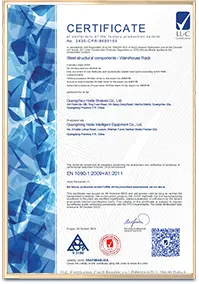
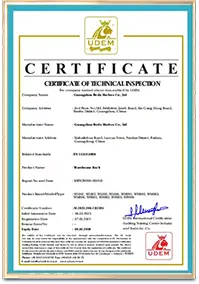
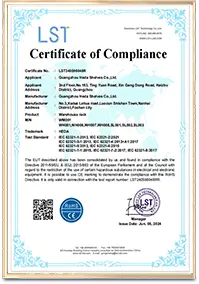
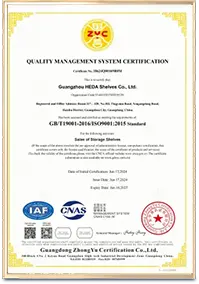
When importing industrial storage racks, international project engineers require third-party structural calculations and verified European/American standard compliance. Guangzhou Heda Shelves Co., Ltd. maintains active certifications with unique registration numbers open for audit:
-
CE Declaration of Conformity Registration No. 2435-CPR-8605159 • EN 1090-1 / EN 15512 Execution Class
-
ISO 9001:2015 Quality Management Certificate No. 18624Q00169R0M • Continuous Process Audits (Valid thru 2027-06)
-
RoHS Heavy Metal Free Compliance Certified non-toxic, eco-compliant powder coatings for cleanroom & food logistics
Frequently Asked Questions by Industrial Sourcing Teams
Key technical and logistical questions asked by warehouse managers, structural engineers, and global procurement agents sourcing cantilever systems from China.
Ready to Engineer Your Industrial Cantilever Storage System?
Consult directly with Guangzhou Heda Shelves' senior structural engineers. Get a comprehensive warehouse layout, finite element load deflection analysis, and factory-direct price quotation within 24 hours.
- Free 2D/3D CAD Layout & Simulation
- CE & ISO 9001 Certified Factory Direct
- Global Ocean Container Freight Coordination