Heavy-Duty Pallet Racking Portfolio
Engineered with Q235B cold-rolled structural steel, electrostatic powder coating, and precision roll-formed geometries to ensure optimal volumetric density and European safety standard compliance.
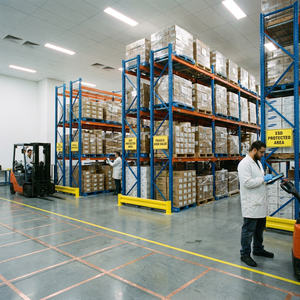
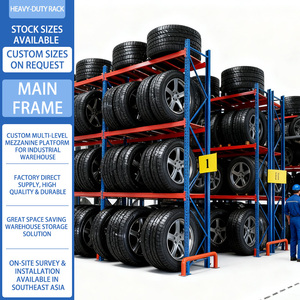
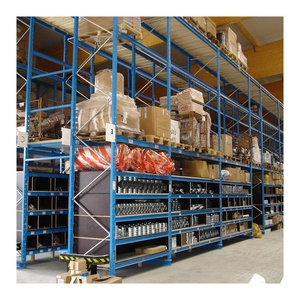
Strategic Procurement Shift: Why Global Supply Chains Source From Top Chinese Racking Factories
Over the past two decades, warehouse infrastructure procurement has evolved from localized steel trading to a highly specialized discipline anchored in structural mechanics, metallurgy, and automated material handling integrations. Industrial operators across North America, Europe, the Middle East, Southeast Asia, and South Asia are confronting escalating industrial land lease costs, demanding higher volumetric clearance (12 to 36 meters) and extreme floor load tolerances. In this macro context, top-tier Chinese racking manufacturers like Guangzhou HEDA Shelves Co., Ltd. (operating since 2001) have consolidated substantial competitive advantages. This is achieved not merely through economies of scale, but via complete vertical integration—from the primary slitting and continuous cold-roll forming of high-yield Q235B and Q355B coils to CNC automated punching, robotic robotic-welding cells, multi-stage chemical pre-treatment, and high-polymer electrostatic powder coating.
Importing racking components direct from verified Chinese manufacturing hubs delivers a measurable reduction in capital expenditure (often 30% to 52% lower landed cost per pallet location compared to Western Europe or domestic North American suppliers), while meeting or exceeding international safety standards. With verifiable credentials such as CE Certification (No. 2435-CPR-8605159) and ISO 9001:2015 Quality Management (No. 18624Q00169R0M), Chinese racking exporters deliver engineering documentation that satisfies strict third-party jurisdictional audits, FEM 10.2.02 racking design codes, RMI specifications, and local seismic design regulations.
Future Purchasing Trends in Heavy Warehouse Storage
How logistics directors, project engineering EPCs, and 3PL operators are reshaping their Request for Proposal (RFP) parameters.
Parametric Digital-Twin Engineering
Purchasing teams no longer accept static 2D DWG files. The baseline expectation mandates comprehensive 3D Building Information Modeling (BIM) files (Revit/IFC) detailing anchor-point shearing forces, finite-element structural deflection analysis (FEM), and slab load distributions prior to PO placement.
High-Yield Micro-Alloy Steel
Procurement is actively shifting away from heavy, unoptimized standard gauge metals toward cold-formed high-strength micro-alloyed steels (such as Q355B and specialized micro-carbon profiles). This minimizes dead-weight loads on concrete slabs while preserving identical rated load capacities up to 4,500 kg per beam level.
Hybrid Automation Adaptation
To guard against labor volatility, procurement managers demand "Automation-Ready" selective and drive-in frameworks. Profiles are pre-punched with optical target channels and guide-rail brackets to seamlessly integrate Automated Guided Vehicles (AGV), Autonomous Mobile Robots (AMR), and radio shuttles later.
Lifecycle Galvanizing & ESG Pretreatment
Environmental standards and harsh environments (e.g., coastal microclimates, tropical monsoon ports, low-temperature cold rooms) require non-toxic, zero-VOC electrostatic powder finishes combined with hot-dip galvanization for sub-zero freezer reliability down to -30°C.
Evolutionary Trajectories in Structural Racking Engineering
How cutting-edge manufacturing processes replace outdated generic warehousing fabrications.
Complex Multi-Bend Upright Geometries
Traditional omega profiles with simple 4-fold configurations are replaced by advanced 8-fold and 12-fold roll-formed vertical columns. Each continuous fold introduces additional work hardening, which substantially raises the radius of gyration, torsional rigidity, and resistance to lateral buckling under severe seismic loading conditions.
Precision Interlocking Beam Connectors
Welded end-connectors now utilize 4-claw to 5-claw stamped cold-rolled steel designs with automated safety locking pins. The proprietary locking interface forms an exceptionally stiff semi-rigid frame node, transferring vertical shear stress directly into column centers without initiating beam web peeling.
Fully Integrated Seismic Base Assemblies
In accordance with IBC 2024 and Eurocode 8 structural seismic directives, standard base plates have evolved into engineered ductile dissipation assemblies. Using chemical resin anchors embedded in tension zones and heavy-duty corner stiffeners, the connection retains dynamic elasticity during lateral ground acceleration events.
Structural Comparison Matrix: Storage Architectures
Performance indicators to guide logistics facility planning and ROI calculations.
| Racking Configuration | Direct Access Ratio | Space Utilization | Typical Lift Equipment | FIFO / LIFO Mode | Ideal Industry Segments |
|---|---|---|---|---|---|
| Selective Pallet Racking | 100% Immediate | 40% – 50% | Standard Counterbalance, Reach | Both Supported | Retail Distribution, Multi-SKU 3PL, FMCG |
| Double Deep Racking | 50% Direct | 60% – 65% | Pantograph / Deep Reach Truck | Predominantly LIFO | Cold Storage, Manufacturing Buffer, Dry Goods |
| Drive-In / Drive-Through | Lane Indexed | 70% – 80% | Narrow Counterbalance Truck | LIFO (Drive-In) / FIFO | Beverage Bottling, High-Volume Single SKU |
| Radio Shuttle System | Lane Automated | 80% – 88% | Standard Lift Truck + Shuttle | Fully Switchable | Deep Cold Stores (-25°C), Pharmaceutical, Meat |
| Pallet Gravity Flow | Face Access | 75% – 85% | Standard Counterbalance / Reach | Strict FIFO | Perishables, Dairy, Time-Sensitive Compounds |
| Heavy Cantilever Racking | 100% Unobstructed | Variable (Arm Level) | Side Loader, Multi-Directional | Custom Batched | Steel Pipes, Structural Timber, Extrusions |
Engineering Strengths: Guangzhou HEDA Shelves Co., Ltd.
Why Tier-1 logistics conglomerates and EPC contractors establish direct supply lines with our Guangzhou manufacturing base.
25+ Years Industrial Hegemony
Founded in 2001, Guangzhou HEDA Shelves Co., Ltd. has accumulated over two decades of technical expertise, having executed more than 10,000 major warehouse storage installations worldwide.
Massive Scale: 30,000 m² Facility
Our heavy manufacturing infrastructure spans a modern 30,000-square-meter facility with 300+ technical personnel and a continuous production output exceeding 30,000 metric tons per month.
Free 3D & CAD Layout Design
Our project team provides comprehensive CAD floorplans, 3D photorealistic renderings, and dynamic capacity simulation within 24 business hours—completely free of obligation.
Audited CE & ISO Credentials
Every beam, upright, and frame is backed by authentic, verifiable compliance: CE Certification (No. 2435-CPR-8605159), ISO 9001:2015 Quality Registration, and RoHS chemical certifications.
10-Stage Precision Manufacturing Workflow
Inside our Guangzhou facility: from raw coil inspection to container-optimized export packaging.
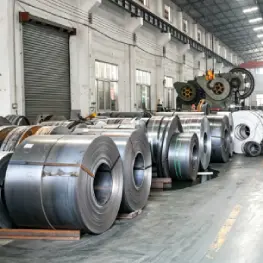
Raw Materials
Certified prime Q235B steel coils metallurgically audited upon entry.
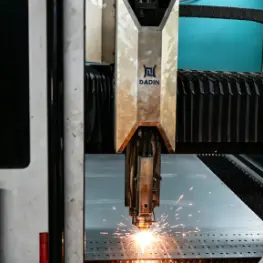
Precision Cutting
Automated slitting and high-tolerance CNC length shearing.
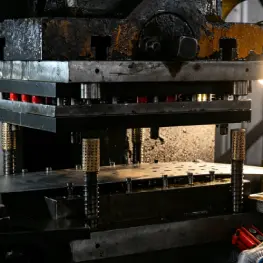
Column Punching
High-speed continuous mechanical punching with 50/75mm pitch.
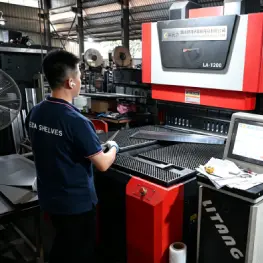
Cold Bending
Progressive work-hardening forming to optimize yield strength.
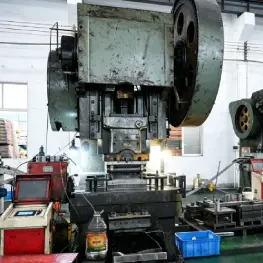
Profile Roll Forming
Multi-roller forming lines shaping uprights and double-C beams.
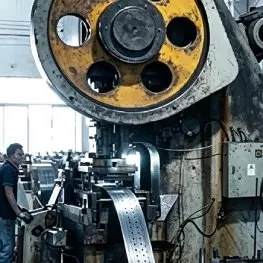
Polishing & Deburr
Automated edge grinding ensures safe handling and clean paint bonds.
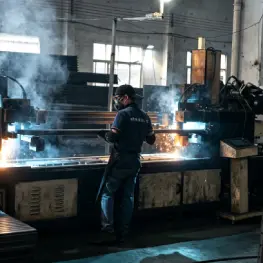
Robotic Welding
CO2 gas-shielded robotic arms weld beam connectors with zero voids.
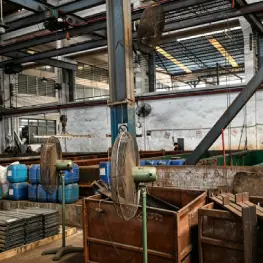
Pickling & Phosphate
Complete chemical bath degreasing for extreme coastal protection.
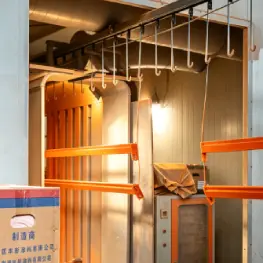
Powder Coating
Electrostatic dry powder cured in 200°C tunnels for scratch resistance.
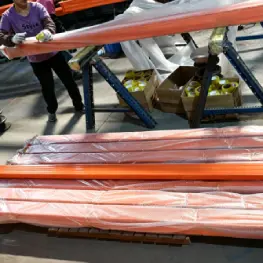
QC & Bundling
Ultrasonic thickness gauge testing, barcode tags, and ocean bundling.
Frequently Asked Questions on Importing Racking from China
Direct answers to questions regarding engineering compliance, freight, surface protection, and floor slabs.
How do you safeguard against maritime corrosion during ocean freight transit?
Ocean container transit exposes steel to saline maritime atmospheres and rapid condensation (container rain). At HEDA Shelves, all raw steel undergoes a thorough multi-stage chemical pretreatment—including hot acid pickling and immersion zinc phosphating—before being coated with high-adhesion thermosetting epoxy-polyester powder. For components positioned in extreme coastal warehouses, offshore logistics zones, or cold storage freezers, we provide continuous hot-dip galvanizing with a minimum coating thickness of 65 to 85 microns, conforming to ISO 1461 standards.
What parameters are mandatory for an accurate racking layout design?
To design an optimized warehouse layout and calculate dynamic structural calculations within 24 hours, our engineering department requires: (1) Architectural warehouse CAD floorplan indicating clear height under hook, dock door positions, column grid spacing, and fire suppression risers; (2) Concrete slab specification (thickness, compressive strength, rebar mesh layout); (3) Pallet dimensions (W x D x H, including overhang) and gross weight per unit; (4) Total active SKU count and required turnover velocity; (5) Forklift make, mast model, collapsed height, turning radius (Ast), and maximum lift ceiling.
How does HEDA Shelves verify load capacity safety factors?
Our structural designs are verified via physical compression testing, continuous frame shear deflection testing, and finite-element modeling conforming strictly to FEM 10.2.02, RMI, and EN 15512 safety codes. The nominal load capacity is calculated with a safety factor of 1.5 to 1.95 against ultimate yield stress. Every export shipment includes full load signboards (specifying maximum beam tier loads, bay load limits, and permissible deflection limits of L/200), providing total legal clarity for logistics operators and insurance underwriters.
Can local installation teams install HEDA heavy racking without direct supervision?
Yes. Every overseas container shipment is packed systematically with high-durability color-coded component tagging and matched piece lists. We furnish fully dimensioned assembly blueprints, 3D exploded structural schematics, anchor-torque specification sheets, and video installation guides. For mega distribution projects and complex multi-tier mezzanine floors, HEDA Shelves can dispatch senior bilingual project engineers on-site to direct erection, laser leveling, anchor pull-testing, and final sign-off.
How do you maximize container cubing to reduce landed shipping costs?
Freight economics represent a substantial factor in total project cost. Our specialized shipping teams utilize parametric packing algorithms to bundle upright frames, interlocking box beams, row spacers, and wire decks into optimized bundles. Uprights are nested to maximize weight limits within standard 40HQ ocean containers (reaching 26 to 28 tons depending on shipping line allowances), while minimizing dead volumetric space. This careful bundling ensures damage-free unloading via counterbalance fork slips upon arrival at destination ports.
What are the standard international trade terms and lead times?
Standard lead times for standard 5 to 15 container orders range between 15 and 25 working days from technical drawing confirmation and deposit clearance. We support global trade terms including FOB (Guangzhou / Shenzhen / Foshan), CIF, CFR, and DDU/DDP delivery routes. Flexible payment solutions include confirmed Letter of Credit (L/C) at sight and structured T/T milestones aligned with production inspection stages.