[email protected] Serving India · Bangladesh · Pakistan · Sri Lanka · Nepal
English (South Asia)
EN 15512 Certified · Factory Direct · ISO 9001:2015 Verified

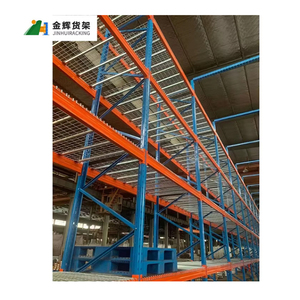
CE Certified Pallet Rack Supply Supplier & Exporters

Engineered for structural safety, high seismic tolerance, and container-optimized sea freight. Discover Guangzhou Heda Shelves Co., Ltd.'s factory-direct heavy-duty storage infrastructure backed by CE CPR 305/2011 compliance and over 25 years of metallurgical excellence.

Export-Grade Inventory

Featured Industrial Pallet Racking & High-Density Storage Systems

Rigidly calculated to Eurocode EN 15512 limit states and fabricated from cold-rolled Q235B/Q355B structural steel. Each system provides documented load deflection ratios below L/200, integrated locking safety pins, and hot pickling/phosphating surface treatments.

Racking System Classification Structural Steel Grade Maximum Payload / Level Deflection Limit Criterion CE & International Standards Optimal Application Scenario
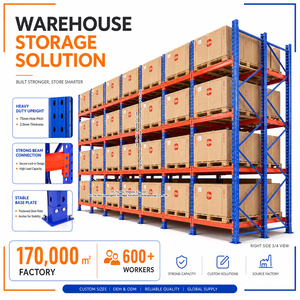
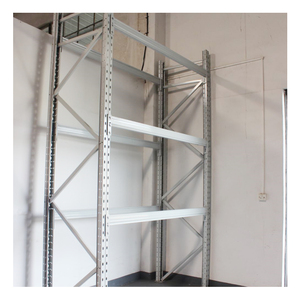
Selective Pallet Racking Q235B / Q355B (EN 10025) 1,000 – 4,500 kg ≤ L/200 (EN 15512) EN 15512, EN 15620, ISO 9001 FMCG, 3PL logistics, multi-SKU retail fulfillment
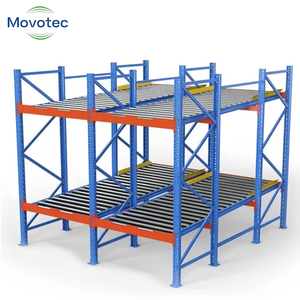
Gravity Roller Flow Racks Q355B High-Yield Steel 500 – 1,500 kg / pallet ≤ L/250 dynamic slope EN 15512, FEM 10.2.02, CE Perishable food, pharmaceuticals, batch expiry control
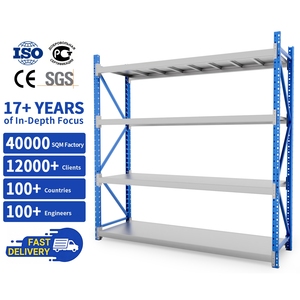
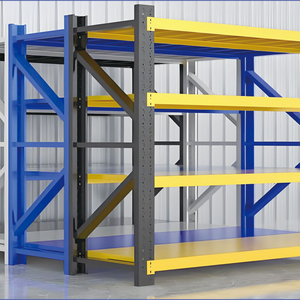
Industrial Long Span Shelving Cold-Formed Strip Steel 300 – 800 kg / shelf ≤ L/200 static EN 15635, RoHS compliant Spare parts, automotive e-commerce, carton picking
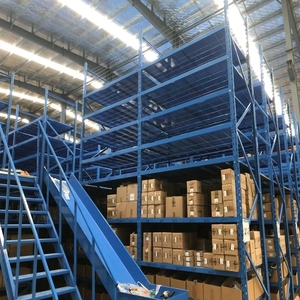
Rack-Supported Mezzanines Heavy C/Z Purlin & Omega 300 – 1,000 kg / m² ≤ L/300 floor deflection Eurocode 3 (EN 1993), CE CPR Apparel sorting, vertical consolidation, picking towers
Strategic Sourcing Analysis

Future Procurement Trends in Industrial Storage & Pallet Racking (2026–2030)

International supply chain executives and EPC contractors are no longer sourcing pallet racking merely as inert structural steel. The modern procurement paradigm focuses on lifecycle carbon accountability, total cost of ownership (TCO) optimization, and seamless integration with autonomous robotic material handling fleets.

Engineering Whitepaper Insight

Technological & Structural Development Trends in Steel Racking Systems

The engineering frontier of industrial racking systems has transitioned from empirical static calculations to advanced second-order non-linear structural finite element modeling (FEM). Explore the key technological paradigms dominating modern high-bay facilities.

01

Limit State Design (EN 15512:2020) & Rotational Stiffness

Modern racking engineering utilizes second-order P-Delta analysis to evaluate frame global instability, portal sway, and connector semi-rigidity. The revised European Standard EN 15512:2020 requires full-scale mechanical testing of beam-end connectors to establish precise moment-rotation curves ($C_d$ and $M_{k,con}$), guaranteeing structural safety under asymmetric live loads.

02

High-Strength Cold-Formed Micro-Alloyed Profiles

By adopting titanium and niobium micro-alloyed hot-rolled strips, roll-formers produce complex omega upright geometries featuring 12 to 14 cold-worked bends. This design provides heightened sectional modulus, torsional rigidity, and resistance to local buckling while decreasing steel deadweight by 12–15% compared to legacy hot-rolled open structural channels.

03

Seismic Dissipation & Dynamic Baseplate Interaction

In seismically active zones (Eurocode 8, ASCE 7), rigid base anchoring can cause premature concrete slab failure. Cutting-edge engineering integrates engineered ductile baseplates with calibrated yield zones. These baseplates absorb kinetic ground acceleration while heavy-duty back-to-back bracing trusses distribute lateral ground forces across the complete bay matrix.

04

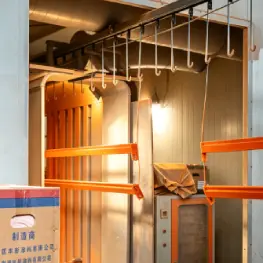
Advanced Pretreatment: Pickling & Phosphating Chemistry

Simple solvent wiping or single-stage wash pretreatments fail within 24 months in humid or coastal environments. Contemporary standard specifications mandate multi-stage automated immersion: alkaline degreasing, acid pickling to eradicate mill scale, hot zinc-iron phosphating, and deionized water rinsing before applying electrostatic thermosetting polyester powder cured at 200°C.

05

Smart Sensorized Racking & Structural Health Monitoring

High-bay installations (above 12 meters) are incorporating IoT-based triaxial tilt and impact sensors directly onto lower upright sections. Connected to warehouse management systems (WMS), these monitoring arrays issue immediate overload and forklift collision alerts, preventing progressive row failure and enabling data-driven preventative structural maintenance audits.

Enterprise Manufacturing Scale

Guangzhou Heda Shelves Co., Ltd.: Engineering Authority & Production Prowess

Established in 2001, Guangzhou Heda Shelves Co., Ltd. has grown from a regional manufacturer into an international benchmark for heavy-duty warehouse storage equipment. With end-to-end metallurgical control, CE certification, and automated multi-line fabrication, we engineer peace of mind for the world's most demanding logistics facilities.

Unmatched Production Scale with Total Quality Traceability

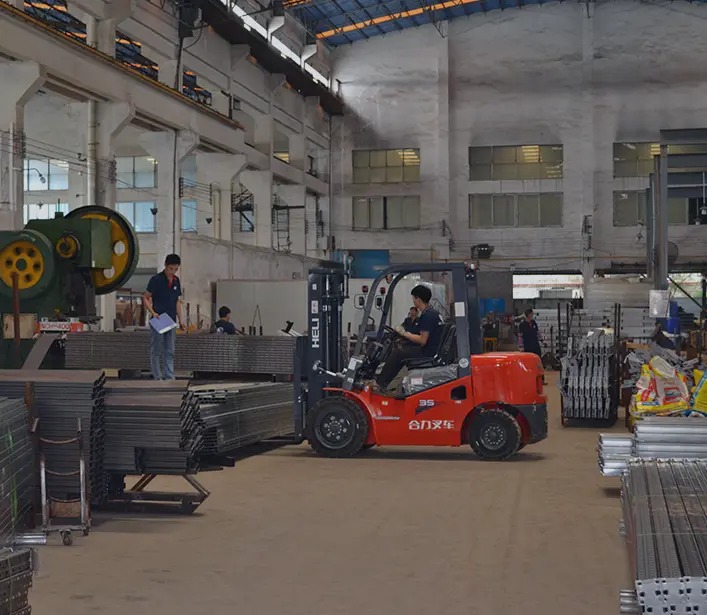
From raw steel coil verification to CNC continuous roll forming, automated high-precision column punching, and eco-friendly electrostatic curing lines, our 30,000 square meter factory operates under rigorous ISO 9001:2015 controls. Our engineers ensure every single beam and upright frame matches certified loading limits with traceable mill test reports.

2001yr
Established
30,000m²
Factory Area
30,000T
Monthly Output
300+
Engineers & Staff
CE Certified: 2435-CPR-8605159
ISO 9001:2015 (Valid through 2027)
RoHS Heavy-Metal Free Powders
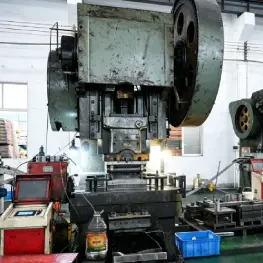
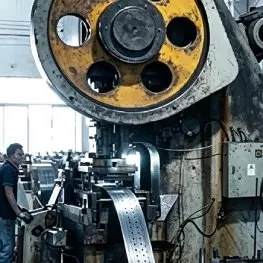
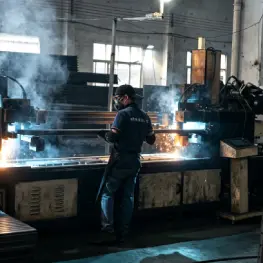
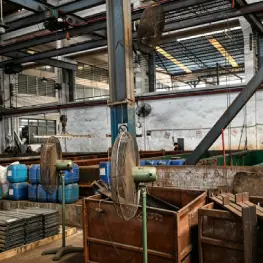
Guangzhou Heda Shelves factory production line

Audited 10-Stage Manufacturing Workflow

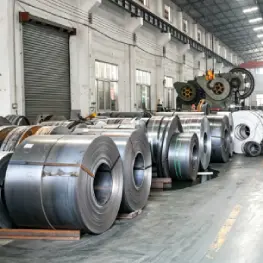
01 Raw steel coil inspection

Prime Raw Coil

Spectrometric & tensile verification of certified Q235B/Q355B coils.

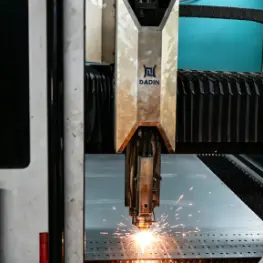
02 Precision steel slitting and cutting

Precision Slitting

High-speed CNC slitting maintaining ±0.2mm strip width tolerance.

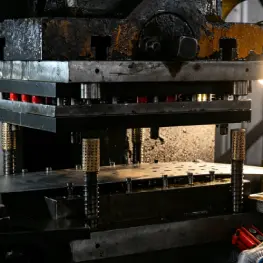
03 Automated column punching line

Automated Punching

Continuous servo punching ensures pitch accuracy along 16m profiles.

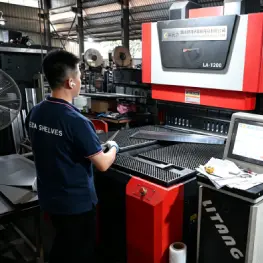
04 Cold bending and forming

Cold Bending

Progressive multi-pass forming prevents micro-cracking at structural radii.

05 Profile continuous roll forming

Roll Forming

18-stand roll forming units producing interlocking closed box beams.

06 Mechanical polishing and edge deburring

Deburring & Polish

Automated edge dressing eliminates burrs to protect workers and goods.

07 Robotic welding of beam connectors

Robotic Welding

Gas-shielded MIG robotic welding guarantees full throat weld penetration.

08 Pickling and phosphating surface treatment

Acid Pretreatment

Immersion pickling & phosphating for 500+ hour salt-spray durability.

09 Electrostatic powder coating application

Powder Coating

Gema automatic powder spray bells ensure 60–80μm uniform thickness.

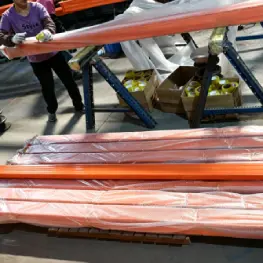
10 Quality control and export shipping bundling

QC & Bundling

Barcoded pallet strapping and nested bracing for ocean transit safety.

Expert Engineering Answers

Industrial Pallet Racking Procurement & Compliance FAQ

Written by HEDA’s senior structural design team to resolve the technical, regulatory, and logistical inquiries frequently raised by supply chain directors, safety consultants, and procurement managers.

What concrete legal and structural protection does the CE CPR 305/2011 mark provide?

Under European Construction Products Regulation CPR 305/2011 (harmonized standard EN 1090-1 and design code EN 15512), the CE mark certifies that the racking system has undergone factory production control (FPC) audits, verified mechanical testing, and accredited third-party surveillance. Unlike self-declared declarations of conformity, HEDA’s CE certification (Certificate No. 2435-CPR-8605159) is issued by an EU-notified body. This certification confirms that calculated yield strengths, weld throat dimensions, and safety load factors are legally defensible under corporate safety liability audits.

What is the maximum allowable beam deflection under full rated load according to EN 15512?

Per EN 15512:2020 clause 7.6.2, the vertical beam deflection under maximum uniformly distributed design load must not exceed δ ≤ L/200 for standard pallet configurations, where L represents the clear span of the beam between upright column faces. For automated crane systems or sensitive cold-storage gravity flow conveyors, HEDA engineers often apply a stricter design constraint of δ ≤ L/250 or L/300 to avoid pallet catch hazards and roller track binding.

How does acid pickling & phosphating differ from standard degreasing sprays?

Standard fabricators commonly clean steel with basic pressure-wash degreasers, which fail to strip away high-temperature mill scale and micro-oxidation produced during hot rolling. HEDA employs an industrial 9-stage chemical immersion process that incorporates hydrochloric acid pickling to fully dissolve oxides, followed by an immersion iron/zinc phosphating reaction. This molecular conversion creates a micro-crystalline layer that anchors the electrostatic powder coating, exceeding 500 hours of ASTM B117 salt spray testing and preventing corrosion creep from accidental forklift scratches.

What site data is required from an EPC contractor or warehouse owner to produce a CAD/FEM proposal?

To generate a complete structural design, FEA simulation, and accurate commercial proposal within 24 hours, our design office requires: (1) Warehouse architectural drawings showing column grid spacing, building clear eaves height, and overhead obstruction levels; (2) Concrete floor slab data including thickness, reinforcement grid, and compressive strength class (typically C20/25 to C30/37); (3) Unit load profiles (pallet footprint W × D × H, overhang, and maximum pallet gross mass); and (4) Forklift specifications, including mast lift height, collapsed mast height, and minimum aisle turning radius ($A_{st}$).

How are HEDA export shipments packaged to prevent transit corrosion and optimize container volume?

Export bundles are engineered to maximize ISO ocean container volume while protecting structural profiles against condensation and dynamic wave-slam forces. Uprights are nested on customized wood runners with protective corrugated edge angles and shrink-wrap bands. Beams are palletized in oriented layers separated by non-abrasive spacers to prevent powder-coat abrasion. Small hardware items (safety pins, expansion bolts, leveling shims, baseplates) are sealed in vapor-barrier poly bags within reinforced wooden crates, enabling contractors to unpack and stage components smoothly on site.

Can HEDA pallet racking systems integrate directly with seismic zones and floor expansion joints?

Yes. Our structural engineering department regularly models dynamic seismic actions under Eurocode 8 (EN 1998-1) and US ASCE 7 provisions. For facilities located across active seismic faults, we calculate frame ductility factors ($q$), enlarge baseplate footprint thicknesses to distribute peak dynamic shear stresses, and apply dual-anchor chemical capsule fasteners. When warehouse floors cross building expansion joints, our layout engineers configure separate back-to-back rack runs with sliding mechanical spacers to absorb building sway without transferring shear loads through the rack frame.

Accelerate Your Storage Project with Free CAD Layouts & Structural Calculations

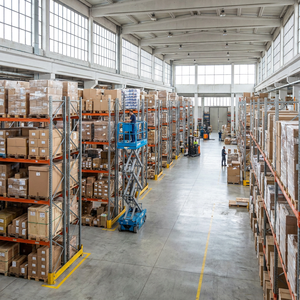
Whether you are expanding a 3PL logistics hub, commissioning an agricultural cold-storage facility, or building a high-bay automated warehouse, Guangzhou Heda Shelves Co., Ltd. delivers direct factory supply backed by verified CE credentials and global sea freight execution.

  • 24-Hour Free 3D & CAD Layout Designs
  • Full Container Packing Density Optimization
  • CE Certificate No. 2435-CPR-8605159
  • ISO 9001:2015 Audited Production Lines

Contact Our Engineering Team

Connect with a HEDA senior application engineer now to review your pallet sizes, bay loads, and warehouse layout drawings.

Get a Quote