High-Throughput Picking Racks & Industrial Storage Systems
Factory-direct configurations engineered for multi-SKU fulfillment centers, e-commerce sortation facilities, and high-density industrial warehouses worldwide.
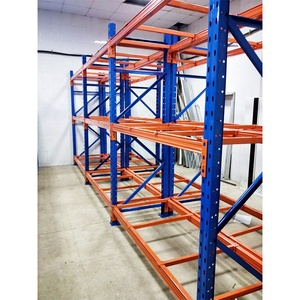
Steel Shelving Adjustable Metal Boltless Shelf Pallet Storage Use Metal Racking Stacking Racks & Shelves
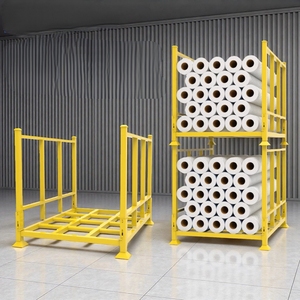
Removable Folding Stacking Rack Workshop Warehouse Cloth Rack Coiled Material Cloth Roll Stacking Rack Metal Folding Pallet
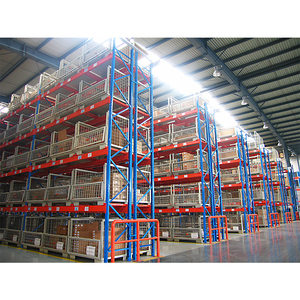
High Quality Selective Racking System Warehouse Storage Forklift Heavy Duty Rack Pallet Racking System Heavy Duty Racks
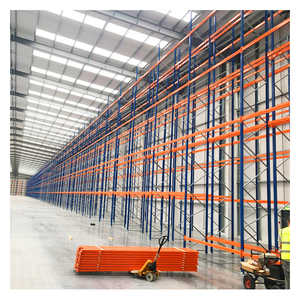
Industrial Storage Rack Pallet Shelving For Sale Heavy Duty Metal Shelf
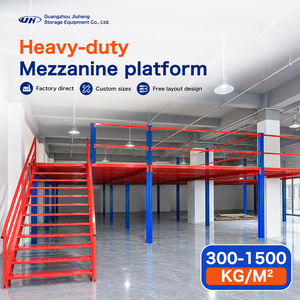
Multi Tier Warehouse Mezzanine Rack Heavy Duty Steel Storage Platform Industrial Shelving Space Saving Customized System
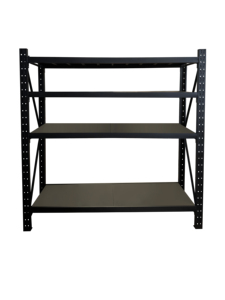
Commercial Warehouse Selective Heavy Pallet Racking System Manufacturer Industrial Storage Pallet Rack Shelves
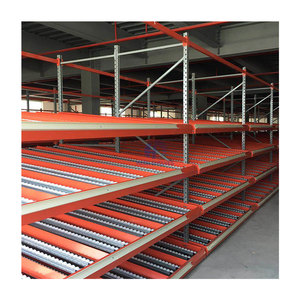
Ebb And Flow Vertical Rack Pallet Flow Racking Track Customized Gravity Carton Flow Racking System
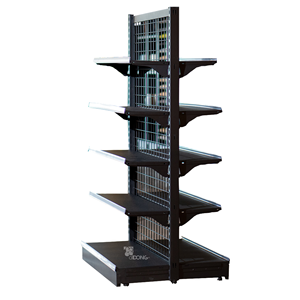
High Quality Custom Double-Sided Vertical Light Duty Metal Supermarket Shelf Gondola Shelving OEM Service Available Vietnam
The Evolution of Picking Racking Architecture in Global Order Fulfillment
Modern order fulfillment has shifted drastically from passive bulk storage to high-frequency, dynamic micro-picking operations. As retail channels merge into omnichannel logistics hubs and consumer expectations demand sub-24-hour dispatch, the racking structure is no longer just static steel—it is the operational backbone governing pick travel time, operator ergonomics, and cubic volumetric efficiency.
In typical e-commerce and fast-moving consumer goods (FMCG) distribution centers, order picking accounts for over 55% of total warehousing operational expenditure (OPEX). Traditional selective pallet racking, while flexible for single full-pallet movements, introduces debilitating friction when applied to piece-picking or split-case retrieval. Forklift-pedestrian aisle conflicts, excessive vertical transit times, and unoptimized retrieval trajectories quickly bottleneck facility throughput during demand spikes.
To bridge the chasm between pure automated storage and retrieval systems (ASRS) and cost-effective manual operations, leading global warehouse designers increasingly deploy hybrid architectures. These systems integrate heavy-duty pallet reserve buffers on upper tiers (fed by reach trucks or VNA cranes) directly above carton-flow gravity tracks or longspan boltless picking levels at ground floor. Furthermore, rack-supported multi-tier mezzanine picking structures utilize unused building vertical clearance up to 14 meters, effectively doubling or tripling picking footprint without incurring commercial real-estate expansion penalties.
Technical Development Trends: Metallurgy, Smart Interfaces & Robotics
The engineering design of picking racking is undergoing radical technological elevation. As warehouses integrate Autonomous Mobile Robots (AMRs), Pick-to-Light (PTL) optical guidance, and complex sensor arrays, structural steelwork must satisfy exacting deflection limits, dynamic load resistance, and dimensional micro-tolerances.
High-Yield Q355B Steel
Transition from standard carbon steel (Q235B) to micro-alloyed, cold-rolled high-yield Q355B steel. Delivers 25% higher tensile strength, thinner profiles with greater elasticity, and superior seismic resistance under cyclic loading.
AMR & Cobot Synergy
Precision-manufactured baseplates, recessed front columns, and laser-guided track tolerances engineered for seamless docking of autonomous mobile picking robots navigating dense picking tunnels.
IoT & Dynamic Tracking
Direct pre-drilled integration channels for digital display bars, weight-sensing load cells, RFID proximity transponders, and automated pick-to-light wiring harness routes built inside upright return flanges.
Crucially, surface treatment technology has transformed structural longevity. In maritime shipping hubs, coastal warehouse installations, and cold-storage environments with intense condensation cycles, traditional spray painting degrades rapidly, leading to sub-surface rust that compromises structural safety factors. Modern tier-1 manufacturers utilize continuous 10-stage automated pickling, phosphating, and electrostatic epoxy-polyester powder coating systems, achieving a salt spray resistance test rating exceeding 500 hours without coating delamination.
Future Procurement Trends (2025–2030): Total Cost of Ownership & Strategic Sourcing
Global supply chain leaders no longer evaluate picking racking solely on initial Ex-Works (EXW) quotation metrics. Procurement strategy has matured into a disciplined Total Cost of Ownership (TCO) calculation encompassing container freight cube utilization, structural life cycle, modular reconfigurability, and safety code compliance.
| Picking Racking Configuration | Throughput Capability (Picks/Hr) | Footprint Utilization (%) | Container Cube Packing Index | Standard Compliance | Optimal Procurement Application |
|---|---|---|---|---|---|
| Selective Pallet Racking with Low-Tier Picking | 120 - 200 UPH | 40% - 50% | High (98% 40HQ fill) | EN 15512 / RMI / ISO | Multi-SKU Wholesale & General Cargo |
| Gravity Carton Flow Picking Bed | 350 - 550 UPH | 65% - 75% | Medium (Requires sub-frame nests) | CE / FEM 10.2.02 | E-Commerce Split Case, Pharma Expiry Batch |
| Multi-Tier Rack-Supported Mezzanine | 400 - 800 UPH | 180% - 280% (Volumetric) | Optimized Flat-Pack Kits | IBC / EN 1090-2 / CE | High-Bay Distribution Centers, Apparel Sorting |
| Boltless Industrial Longspan Shelves | 150 - 280 UPH | 45% - 55% | Very High (Nested bundles) | ISO 9001:2015 | Automotive Spare Parts, Hardware Stores |
| Foldable Roll & Cloth Stacking Racks | Variable Bulk Movement | Dynamic Seasonal Flexible | Maximum (Collapsible ratio 4:1) | CE Certified Welding | Textiles, Industrial Fabric Rolls, Agricultural Hubs |
Key procurement shifts observed across North America, Europe, Australia, and South Asia include:
- Container Freight Density Maximization: Steel profile geometries are increasingly engineered with nested taper designs, allowing uprights and beams to interlock inside 40HQ containers, driving container volume efficiency up from 82% to 96% and shaving thousands of dollars off landed transport costs per facility.
- Pre-Drilled Modular Scalability: Facilities prioritize beam-to-frame locking connectors with 50mm or 75mm standardized pitch adjustments. This allows operations to transition from manual shelf picking to carton-flow tracks or automated belt conveyors without re-welding or structural scrapping.
- Independent Third-Party Verification: Stringent verification of mill test certificates (MTC), certified weld penetration to EN ISO 15614-1, and certified CE marks (Regulation (EU) No 305/2011) to eliminate catastrophic collapse risks and secure favorable commercial property insurance terms.
Enterprise Strengths & Factory Infrastructure: Guangzhou Heda Shelves Co., Ltd.
Established in 2001, Guangzhou Heda Shelves Co., Ltd. has grown into an international powerhouse in storage engineering, warehouse racking manufacturing, and worldwide turnkey project export. With over two decades of technical dedication, Heda Shelves commands a comprehensive 30,000 square meter modernized manufacturing base staffed by over 300 experienced engineers, CNC tooling specialists, and structural fabrication technicians.
Operating with monthly processing throughput reaching 30,000 tons of prime steel, Heda Shelves retains complete in-house control over every link of the manufacturing value chain. We eliminate outsourced subcontracting variability by maintaining dedicated roll-forming production lines, robotic multi-axis welding cells, automated continuous punching machines, and proprietary surface finishing lines.
The Heda Proprietary 10-Stage Precision Manufacturing Workflow
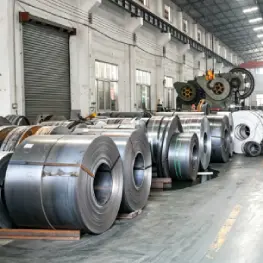 STAGE 01
Raw Steel Inbound
Strict spectral chemistry & mechanical tensile verification of steel coils.
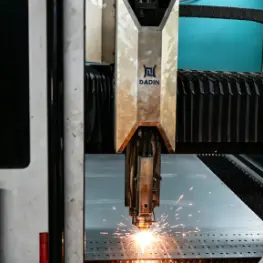 STAGE 02
CNC Steel Slitting
Ultra-accurate length and strip cutting within sub-millimeter tolerances.
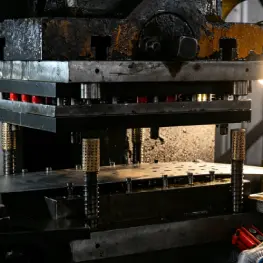 STAGE 03
Continuous Punching
Automated hole-punching for teardrop, diamond, or omega pitch accuracy.
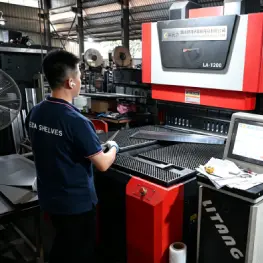 STAGE 04
Cold Roll Bending
Multi-roller progressive forming maximizing cross-sectional load inertia.
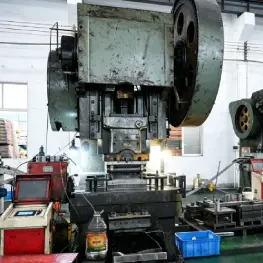 STAGE 05
Profile Roll Forming
Specialized heavy box-beams, step-beams, and closed-profile fabrication.
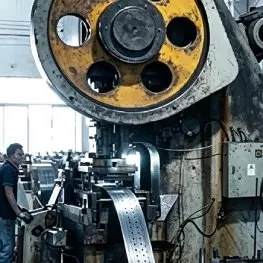 STAGE 06
Mechanical Deburring
Automated chamfering and weld preparation preventing handling hazards.
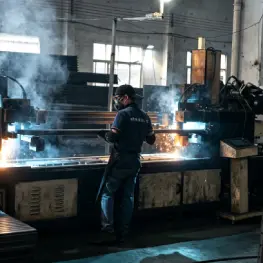 STAGE 07
Robotic Beam Welding
Shielded gas robotic welding ensuring deep structural joint penetration.
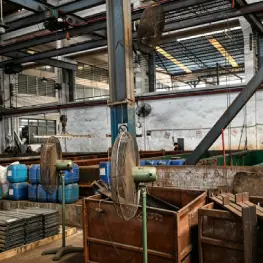 STAGE 08
Acid Pickling & Phosphate
Deep-dip chemical degreasing and phosphating for corrosion protection.
 STAGE 09
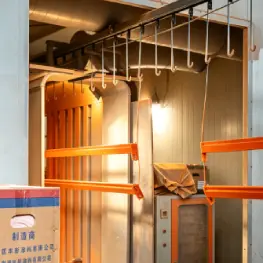
Electrostatic Powder Bake
200°C curing tunnel delivering an ultra-durable, scratch-proof thermoset shell.
 STAGE 10
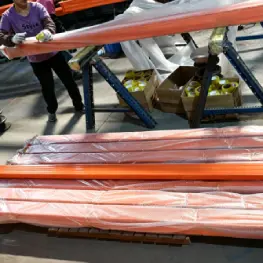
QC & Container Packing
Rigorous ultrasonic weld testing, dimension checks, and palletized bundling.
International project directors and structural consultants demand auditable compliance. Guangzhou Heda Shelves Co., Ltd. holds fully verifiable certifications including:
- CE Factory Production Control Certification: Certificate No. 2435-CPR-8605159, attesting full compliance with European Construction Products Regulations (CPR) and structural execution standards.
- ISO 9001:2015 Quality Management System: Certificate No. 18624Q00169R0M (valid through June 2027), auditing continuous quality improvement across engineering design, production, and after-sales support.
- RoHS Environmental Compliance: Ensuring all polymers, powder coatings, and galvanic additives are 100% free of hazardous toxic substances.
Additionally, every client project is supported by Heda’s structural design team, providing complimentary CAD floor layout optimization, 3D parametric visualizations, and finite element analysis (FEA) calculations to verify slab loading limits before project capital is committed.
Frequently Asked Questions (FAQ) for Enterprise Racking Procurement
Here are direct engineering answers to the most critical technical and logistics inquiries raised by procurement officers, project engineers, and supply chain directors.
Q What floor slab parameters are required to calculate baseplate sizing and seismic anchor embedment?
To calculate baseplate surface area, anchor bolt diameter, and anchor embedment depth, our structural engineering team requires: (1) Concrete slab compressive strength rating (e.g., C20/25, C25/30, or minimum 3,000 PSI / 20.7 MPa); (2) Slab thickness (typically 150mm to 250mm) and reinforcement mesh details; (3) Subgrade modulus (k-value); and (4) Site seismic zone rating according to local building codes (e.g., Eurocode 8, ASCE 7, or IS 1893). For light or unknown slab thicknesses, we engineer enlarged baseplates with dual or quad-anchor patterns to distribute concentrated point loads and prevent floor punch-through failure.
Q How does HEDA prevent rust and paint chipping on export shipments to tropical, coastal, or high-humidity regions?
All Heda structural steel profiles undergo a continuous chemical pre-treatment process comprising hot-alkaline degreasing, clean water rinse, sulfuric acid pickling (derusting), phosphate conversion coating, and passivation. This produces an inert iron-phosphate micro-crystalline barrier on the steel substrate. Subsequently, an automated electrostatic gun array applies high-adhesion polyester resin powder at an 80–120μm dry film thickness (DFT), baked at 200°C. For extreme open sheds, coastal marine salt spray, or low-temperature cold storage (-30°C), hot-dip galvanized (HDG) or pre-galvanized coils with zinc coating density up to Z275 (275 g/m²) can be engineered.
Q Can your picking racking systems integrate directly with automated conveyor belts, carton chutes, and AMRs?
Yes. HEDA picking systems—including heavy-duty industrial longspan racks, carton flow live beds, and multi-tier platforms—are engineered with standardized CNC punched hole matrices (50mm or 75mm pitch). This allows direct bolting of powered roller conveyor frames, zero-pressure accumulation (ZPA) line brackets, spiral carton chutes, and Pick-to-Light optical guidance busbars directly to upright columns. For Autonomous Mobile Robot (AMR) navigation, we incorporate floor guide-rail anchors, recessed baseplates, and high-clearance tunnel bays engineered specifically to accommodate robot turning radiuses and sensor clearance zones.
Q What are the sea freight packaging and container loading protocols for large-volume overseas projects?
To safeguard goods during ocean transit and eliminate inter-bundle friction abrasion, all upright frames and beams are nested with custom corrugated cushion separators and wrapped with high-tensile stretch film and composite PET strapping. Steel footplates, brackets, row spacers, and fasteners are crated in seaworthy, heat-treated wooden boxes or reinforced corrugated cartons on export pallets. Furthermore, Heda’s logistics team generates custom 3D container packing load plans (for 20GP, 40GP, 40HQ, and 45HQ containers) that balance container axle weights and achieve 95%+ volumetric cube utilization, dramatically lowering landed freight cost per pallet position.
Q How do you assist with on-site installation, component identification, and local contractor supervision?
Every dispatched export shipment is supplied with a comprehensive Project Assembly Manual containing 3D isometric exploded view drawings, structural component schedules, torque specification charts, and step-by-step video installation guides. Every component bundle carries a weatherproof QR code and alphanumeric label cross-referenced with your project architectural layout drawing. For large enterprise fulfillment centers, multi-tier mezzanines, or complex automated installations, HEDA can deploy certified senior bilingual installation project managers to provide on-site supervision, laser alignment auditing, and final commissioning sign-off.
Q What structural engineering information is required to receive a free custom CAD layout and pricing proposal?
To generate an engineered layout and commercial estimate within 24 hours, our engineering department requests: (1) Warehouse architectural drawings (AutoCAD DWG or dimensional PDF) indicating building clear height under truss, column grid spacing, dock door locations, and fire exit corridors; (2) Unit load specifications: pallet or carton dimensions (L x W x H), including cargo overhang, and maximum gross weight per unit; (3) Target storage capacity or inventory turnover rate; and (4) Materials handling equipment (MHE) profile, including forklift model, minimum turning aisle width (AST), and maximum mast lift reach.
Request Your Engineered Warehouse Racking Layout
Accelerate your facility’s pick throughput while maximizing vertical cubic capacity. Our senior intralogistics engineers provide free 2D CAD layouts, structural load calculations, and comprehensive commercial proposals within 24 hours.
- Free 2D CAD & 3D Modeling Layouts
- CE & ISO 9001:2015 Traceable Quality
- Global Export Container Loading Support
- 30,000 Tons Monthly Output Capacity
Connect with Storage Engineers
Get the full technical catalog, profile dimension sheets, and standard test load certifications.
Get Catalog