Dynamic Mobility
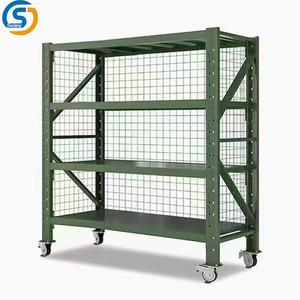
Heavy Duty Assemble Pallet Racking with Wheels
Mobile Castor Base
800-1500kg/Tier
Agile Reconfiguration
In urban logistics, micro-fulfillment centers, and satellite commercial distribution hubs, operating under 5,000 square meters presents structural constraints distinct from regional mega-distribution centers. Designing storage for compact industrial spaces is governed by rigid trade-offs between forklift turning radiuses, ceiling truss clearances, point load concrete slab capacities, and stock keeping unit (SKU) picking velocity.
Direct from our automated Guangzhou production lines, these eight standardized and custom-engineered racking platforms solve specific micro-space challenges—ranging from zero-aisle dynamic live storage to manual mezzanine pick modules and mobile pallet racks.
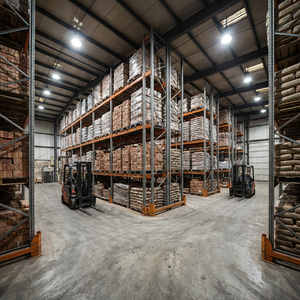
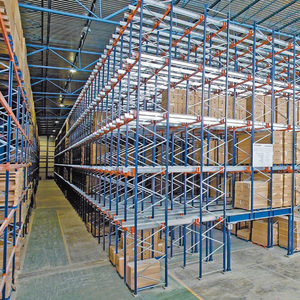
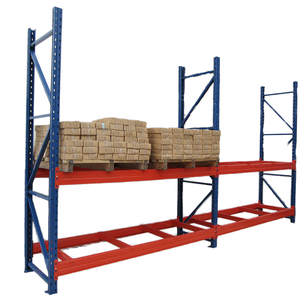
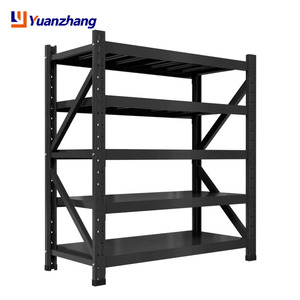
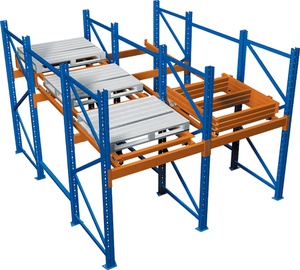
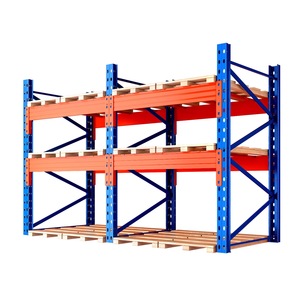
In large-scale 3PL distribution centers exceeding 30,000 square meters, racking layouts prioritize wide, linear aisle runs configured for high-reach wire-guided turret trucks or counterbalanced forklifts requiring 3.8 to 4.2-meter aisles. When operating in a small facility—often repurposed industrial units, city-fringe fulfillment centers, or factory annexes—clear floor space is scarce, ceiling height is commonly restricted between 4.5 and 7.5 meters, and structural columns interrupt layout grids.
Procuring off-the-shelf catalog racks without engineering analysis introduces profound operational bottlenecks:
Standard selective racking in small footprints allocates over 60% of floor space to forklift aisles. Utilizing push-back, drive-in, or multi-tier rack mezzanines converts dead vertical airspace into functional dynamic storage, lifting CVU utilization from 38% to over 74%.
Commercial leases often feature unreinforced 120-150mm floor slabs with conservative 20-30 kN/m² distributed load ratings. Customizing footplate spreaders, anchoring depths, and upright profiles avoids punching shear failure under concentrated upright loads.
In narrow aisles (1.8m to 2.6m), counterbalanced forklifts cannot operate. Racking must be customized to accommodate walkie reach stackers, articulated trucks, or integrated manual picking carton-flow bays with strict safety guide rails.
The Information Gain Reality for Importers: Trading companies selling racking systems online often re-sell standard profile uprights (80x60mm with 1.5mm wall thickness) that cannot legally support 2,000kg pallet positions when seismic and impact factors are applied under FEM 10.2.02 or ANSI MH16.1 codes. Direct tier-1 factories engineer cold-formed omega profiles (90x70mm to 120x95mm with 1.8mm–2.5mm certified Q235B steel) with engineered 4-claw safety locks to assure zero beam dislodgement under tight-aisle forklift operations.
Selecting the optimal steel storage topology requires mapping your facility's SKU velocity against unit storage handling costs. The matrix below benchmarks how the primary compact racking structures compare across critical mechanical and financial metrics.
| Racking Architecture | Space Utilization | Pallet Selectivity | Inventory Logic | Target Handling Equipment | Capex Index |
|---|---|---|---|---|---|
| Standard Selective Rack | 35% – 45% | 100% Immediate | FIFO / Random | Reach Truck / Counterbalance | Baseline ($) |
| Push-Back Cart Racking | 65% – 75% | 30% – 50% | LIFO | Standard Forklifts | Moderate ($$) |
| Drive-In / Drive-Through | 70% – 85% | 10% – 20% | LIFO (Drive-In) / FIFO | Reach Truck (Mast-in-lane) | Moderate ($$) |
| Radio Shuttle Automation | 80% – 90% | Selective by Lane | FIFO or LIFO | Forklift + Smart Shuttle | High ($$$$) |
| Rack-Supported Mezzanine | 100% Footprint Doubling | 100% Hand Pick | Carton / SKU Sorting | Manual / Pallet Jack / Conveyor | Medium-High ($$$) |
*Data based on empirical project averages calculated across 10,000+ completed HEDA engineering deployments in high-density facilities.
The global shift toward near-shoring, rapid-turnaround urban fulfillment, and sky-rocketing industrial land lease rates is fundamentally reshaping racking specifications. When auditing Chinese manufacturers for upcoming procurement cycles, forward-thinking operations managers focus on three disruptive trajectories:
Small warehouses can no longer afford single-purpose floor space. Modern procurement contracts prioritize hybrid systems: ground floors configured for bulk selective pallets supporting an overhead mezzanine floor engineered for high-density carton flow pick faces, dark store operations, or administrative operations.
Autonomous Mobile Robots (AMRs) are rapidly entering smaller facilities. Unlike manual operations where structural deflection variations of 10mm go unnoticed, robotic fleets demand precision roll-formed uprights and laser-cut beam slots with dimensional tolerances under ±0.5mm, alongside floor-level robotic docking integration.
Global ESG mandates require sustainable steel manufacturing. Leading Chinese suppliers are replacing hazardous hexavalent chromium surface washes with automatic closed-loop 9-stage pickling, silane-based phosphating, and thermoset lead-free epoxy-polyester electrostatic powder coatings resistant to 500+ hours salt-spray testing.
True manufacturing authority (E-E-A-T) is defined by shop-floor process control. At Guangzhou Heda Shelves Co., Ltd., raw coils undergo fully automated CNC-controlled transformation, guaranteeing every beam connector, welded footplate, and roll-formed omega profile meets rigorous structural safety standards.
Inspection of Baosteel/Shougang prime Q235B/Q355B coils with mill test certificates.
High-speed uncoiling and precision slitting to tight profile-width tolerances.
Continuous mechanical press punching with ±0.1mm pitch accuracy for beam adjustment.
Multi-station precision roller tooling creating cold-work hardened structural uprights.
Automated flying hydraulic shear cutting profiles with clean, burr-free edges.
MIG/CO2 robotic welding cells attaching beam end connectors and heavy baseplates.
Automated shot-blasting and mechanical descaling removing weld spatter and mill scale.
Chemical immersion degreasing, rust removal, and dense micro-crystalline zinc phosphating.
Electrostatic Gema powder spray lines with 180°C–200°C curing for scratch resistance.
Bundle wrapping with corrugated protection, timber chocks, and container loading checks.
Headquartered in Guangzhou, China, Guangzhou Heda Shelves Co., Ltd. has stood at the forefront of warehouse racking design, engineering, and export manufacturing since 2001. Operating a modern 30,000 square meter factory staffed by over 300 experienced structural engineers, certified welders, and export technicians, we manage your project from initial CAD spatial modeling through to customs-ready shipment.
Every small warehouse layout calculated by HEDA Shelves undergoes strict structural validation using finite element analysis (FEA). We calculate beam flexure deflection ratios (designed to remain strictly within L/200), upright column buckling thresholds under eccentric loads, and concrete anchor pull-out limits.
"Our engineering goal is simple: maximize your floor-to-ceiling storage ratio without ever exceeding safe slab or steel stress factors."
Global Shipping Experience: Serving major ports including Nhava Sheva, Mundra, Chennai, Kolkata, Chittagong, Karachi, Colombo, Singapore, Jebel Ali, Rotterdam, Los Angeles, and Santos.
Essential technical and commercial answers for operations managers, supply chain consultants, and warehouse equipment buyers.
Under European FEM 10.2.02 and US RMI MH16.1 design codes, the maximum allowable vertical deflection for pallet rack beams under full operational load is 1/200th of the clear beam span (L/200). For a standard 2,700mm beam carrying two 1,000kg pallets, deflection must not exceed 13.5mm. HEDA engineers test every beam profile to ensure zero permanent plastic deformation upon unloading.
Our layout team integrates facility CAD drawings to map exact column locations and obstruction envelopes (HVAC ducts, sprinklers, lighting). We place internal warehouse columns within the dead flue space between back-to-back rack runs or incorporate custom portal tie beams spanning column bays, ensuring zero loss of usable forklift aisle width.
Standard solvent coatings peel under thermal cycling and high humidity. HEDA utilizes automated pickling and phosphating acid baths that chemically passivate the raw cold-rolled steel, followed by an electrostatic thermoset epoxy powder bake at 190°C. For sub-zero walk-in freezers or coastal port facilities, we supply hot-dip galvanized components certified up to ASTM A123.
To produce an engineering-grade layout, please provide: (1) Facility dimensional drawing (PDF or DWG) with clear ceiling height; (2) Pallet dimensions (W x D x H) including overhanging load; (3) Gross weight per loaded pallet; (4) Forklift model, turning radius, and maximum lift height; and (5) Target SKU picking methodology (FIFO vs LIFO).
Upright frames and long beams represent high volume-to-weight freight. Our packaging engineers run nesting simulation software for every export order. Beams are bundle-banded with protective corner protectors, uprights are nested with wooden spacers, and hardware is boxed on pallets. A single 40HQ container typically achieves 95%+ volumetric stowage without in-transit surface friction damage.
Yes. As an authentic OEM/ODM factory, we support distributor partnerships and commercial warehouse branding. We provide custom electrostatic RAL powder color matching (e.g., corporate orange, blue, charcoal), custom hole punch spacing (50mm or 75mm pitch), laser-stamped beam load rating plates, and private-label packaging.
Send your warehouse dimensions or architectural blueprints today. Our technical design team will return a certified spatial plan, pallet capacity schedule, and direct factory pricing within 24 hours.