Technical Whitepaper & Architectural Insights
Engineering Paradigms in Modern Warehouse Picking Racks
In modern intra-logistics, selecting, custom-engineering, and deploying picking rack infrastructure is no longer merely an exercise in commodity fabrication. With the hyper-acceleration of omni-channel distribution networks, multi-echelon SKU distribution models, and tight order fulfillment windows, picking racks now serve as the structural nexus where human labor, robotics, and Warehouse Management Systems (WMS) converge. As a dedicated OEM/ODM manufacturer and international exporter, our manufacturing operation centers on precise metallurgy, static deflection limitation, and structural resilience under dynamic cycle fatigue.
The Information Gain Metric: Structural Deflection and Yield Limits
According to the FEM 10.2.02 (Federation Europeenne de la Manutention) and ANSI MH16.1 specifications, the structural limit for load-carrying pallet beams under static design loading must not exceed a maximum vertical deflection of L/200 (or L/300 where sensitive picking sensors or automated handling devices operate). Achieving this requires precision roll-forming tolerances where tensile stress distribution is uniformly dispersed across the cold-formed profile.
Metallurgical Metallurgy & Structural Forming Integrity
The foundation of all picking rack safety begins at the steel mill. Standard commercial mild steels often suffer from inhomogeneous ferrite-pearlite grain structures and inconsistent carbon equivalents, which can lead to unpredictable buckling failures under combined axial compression and bending stresses. At Guangzhou Heda Shelves Co., Ltd., we exclusively procure certified, coil-tested structural carbon steel in Q235B and Q355B chemistries (comparable to ASTM A36 and ASTM A572 Grade 50 respectively).
Cold-roll forming is executed across 18 to 24 continuous forming stations. Gradual progressive deformation prevents localized micro-fissures in cold-worked radii, preserving ductility along the outer flange boundaries. Upright omega profiles are engineered with ribbed return flanges, increasing the radius of gyration ($r_x, r_y$) and raising the critical elastic buckling load capacity ($P_{cr}$) without inflating structural deadweight. When exporting containerized loads across global shipping lanes, every metric ton saved through cold-formed section optimization translates directly to lower landed freight expenditure per pallet position.
25+
Years Engineering Lineage
30,000
Sq. Meter Automated Facility
30,000T
Monthly Cold Forming Capacity
120+
Global Export Destinations
Surface Protection Chemistry: Multi-Stage Pretreatment & Electrostatic Powder Curing
Mechanical strength becomes irrelevant if atmospheric oxidation undermines the integrity of steel profiles. In tropical, humid, or coastal distribution hubs (such as Chennai, Chattogram, Colombo, or coastal GCC regions), uncontrolled condensation creates galvanic corrosion cells along rack joints, floor anchor plates, and cold-stamped adjustment punch holes. We combat this environmental stress through an automated 10-stage immersion and spray pretreatment process:
- Hot Alkaline Degreasing: Eliminates residual stamping lubricants, rust-preventive rolling oils, and particulate soil.
- Dual-Stage Cascade Water Rinse: Eliminates drag-out chemical contamination across process wash tanks.
- Chemical Acid Pickling: Dissolves mill scale, surface oxidation, and inorganic thermal oxides.
- Micro-Crystalline Phosphating (or Nano-Ceramic Silane Conversion): Forms a dense, 1.5–2.5 g/m² insoluble zinc-iron phosphate conversion coating, anchoring the subsequent organic resin barrier and isolating steel from ambient electrolyte migration.
- Deionized Passivation & Dry-Off Oven: Thermal baking at 120°C ensures zero residual moisture before entering cleanroom powder coating booths.
- Automated Reciprocating Electrostatic Powder Application: Virgin TGIC-free polyester-epoxy powders are deposited with automated negative corona charging guns, achieving a consistent 60 to 90 micron cured thickness across deep recessed channel geometries.
- Thermal Polymerization Curing: Cured at 180°C to 200°C for 20 minutes, guaranteeing full cross-linking density, impact resistance exceeding 50 kg·cm (ASTM D2794), and cross-hatch adhesion reaching Grade 0 (ISO 2409).
High-Yield Steel Upgrades (Weight-to-Load Ratio)
Global procurement teams are replacing heavy, unalloyed mild steels with micro-alloyed, high-yield cold-rolled coils (Q355B and Q460). This transition decreases overall steel volume by up to 18% while sustaining identical or superior pallet working loads. The resulting weight reduction cuts ocean container deadweight penalties, minimizes structural foundation slab loadings, and decreases carbon-tariff liabilities under emerging cross-border carbon border adjustment mechanisms (CBAM).
Nearshoring and Micro-Hub Modularity
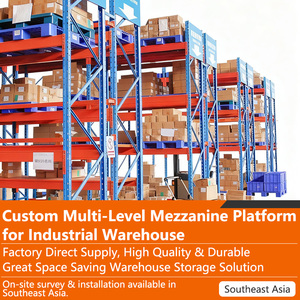
To reduce last-mile parcel shipping costs, global e-commerce supply chains are deploying decentralized Micro-Fulfillment Centers (MFCs) inside urban boundaries. These facilities require specialized, modular picking racks with multi-tier mezzanine capabilities, standardized water-drop or teardrop boltless connectors, and adjustable beam levels that can be reconfigured within hours without hot-work permits or welding operations.
Standardized Container-Max Packaging
Volatile ocean freight pricing has transformed rack packing from an afterthought into a primary procurement KPI. Sophisticated OEM buyers demand computerized nesting of upright frame assemblies, nested beam bundles, and precision-bracket knock-down packing. Our container loading algorithms routinely secure 95%+ cube utilization across standard 40-foot High Cube (40HQ) maritime containers, lowering the landed logistics cost per cubic meter.
AMR & Autonomous Picking Integration
Picking racks now feature standardized ground clearances, recessed bottom baseplates, and high-visibility positioning fiducials to accommodate Autonomous Mobile Robots (AMRs) and automated lift carts. Clear aisle tolerances are engineered to avoid mechanical collision, while front upright legs are reinforced with heavy-duty structural wrap-around deflector guards manufactured from 5mm structural steel.
Pick-to-Light & Sensor Wiring Trays
Modern carton flow and longspan picking shelving are fabricated with integrated routing pathways, pre-punched wiring apertures, and protective snap-on raceways. This enables seamless, tool-free mounting of electronic Pick-to-Light (PTL) LED modules, digital SKU displays, infrared tote occupancy sensors, and emergency line-stop controls without compromising the load-carrying capacity of the load beams.
Hybrid Dynamic FIFO Carton Gravity Flow
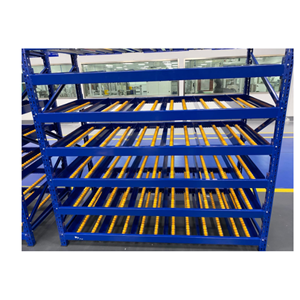
To eliminate wasted motion during batch picking, gravity flow racks incorporate precision roller tracks featuring high-density acetal/polyethylene resin wheels mounted on galvanized steel channels. Engineered on a calculated 2.5° to 4.5° incline with integrated speed controllers, high-velocity SKU cartons glide smoothly from the replenishment rear face to the picking front face, keeping the active pick boundary consistently supplied.
Fully Audited Compliance
Independently verified certifications including CE Factory Production Control (2435-CPR-8605159), ISO 9001:2015 Quality Management System (Certificate 18624Q00169R0M, valid through 2027), and full European RoHS compliance.
Free 24-Hour CAD & 3D Engineering
Our 30+ member structural design department develops complete warehouse layout drawings, 3D parametric visualizations, structural calculations, and accurate pallet-position counts within 24 to 48 hours of receiving your facility drawings.
Automated In-House Production
Operating a 30,000 square meter factory campus in Guangzhou with 300+ skilled personnel, our production runs continuously through automated CNC punching lines, robotic welding stations, and a modern continuous electrostatic powder coating plant.
Global Logistics & Port Access
Direct proximity to South China container terminals (Huangpu, Nansha, Yantian, Shekou) enables reliable maritime dispatch to major global destinations, with established shipping pipelines across Europe, the Middle East, Southeast Asia, and the Americas.
Requirement Intake & Data Audit
We analyze your architectural drawings, slab load-bearing ratings, SKU dimensions, operating temperature zones, forklift aisle requirements, and pick-frequency profiles.
CAD Engineering & Structural Sizing
Our structural team produces full AutoCAD drawings, 3D visual renderings, and structural calculations to verify beam profiles and baseplate anchor configurations.
Precision Fabrication & QC Gating
Steel coils undergo automated decoiling, roll forming, CNC punching, robotic welding, and automated powder coating, with dimensional and coating inspections at each milestone.
Export Packing & Site Support
Bundled components are packed for maximum container-cube utilization. We provide numbered part schematics, 3D assembly guides, and remote or on-site engineering supervision.
?
What steel grade should be specified for industrial warehouse picking racks?
For structural integrity and predictable deflection, certified Q235B and Q355B (equivalent to ASTM A36 and ASTM A572 Grade 50) are the industry benchmarks. Q235B offers a minimum yield strength of 235 MPa, making it ideal for standard pallet beams, horizontal bracing, and light-to-medium longspan shelf panels. For high-bay upright columns, heavy-duty mezzanine support posts, or applications in seismic-active zones, Q355B (with a minimum yield strength of 355 MPa) is recommended to prevent column buckling under axial compression while reducing structural deadweight.
?
How does carton flow racking improve picking productivity over static shelving?
Carton flow racking uses inclined roller tracks (typically set at a 2.5° to 4.5° slope) that employ gravity to feed cartons from the replenishment side to the picking face automatically. This physically separates picker traffic from restocking forklifts, eliminating replenishment bottlenecks. Picking productivity typically increases by 30% to 50% because travel paths are condensed, SKU picking faces are kept compact, and inventory naturally rotates on a strict First-In, First-Out (FIFO) basis, preventing stale or expired stock.
?
What calculations determine allowable beam deflection under full working load?
Under European standard FEM 10.2.02 and US standard ANSI MH16.1, allowable vertical deflection ($δ$) of a horizontal pallet load beam must not exceed $L/200$, where $L$ is the clear span distance between upright columns (for instance, a 2,700 mm beam has a maximum permissible deflection of 13.5 mm under full rated load). For high-precision automated systems, AGV loading corridors, or fragile picking stock, designers typically enforce a more rigorous deflection tolerance of $L/300$ or $L/350$ to avoid sensor misalignment or product displacement.
?
Can Guangzhou Heda Shelves manufacture OEM custom hole patterns and branding?
Yes. As a direct OEM/ODM manufacturer, we operate high-tonnage automated CNC punch presses that can produce custom upright punch geometries, including 50mm metric European pitch, 75mm standard pitch, 76.2mm (3-inch) teardrop punches, and custom slotted profiles. We also provide full private-label services, including custom corporate RAL powder coating colors, stamped logo plates, serialized barcoding tags, and specialized export packaging designed for brand distributors.
?
What environmental protections are used for cold storage or coastal distribution centers?
For cold-chain facilities operating down to -30°C, structural steel is selected to prevent low-temperature ductile-to-brittle transitions, and pure polyester TGIC-free powder finishes are applied to withstand freeze-thaw condensation cycles. In high-salinity coastal areas, high-humidity port warehouses, or outdoor pick sheds, we provide a multi-stage zinc-phosphate or silane chemical conversion pre-treatment, enhanced powder coating thickness (up to 100+ microns), or full continuous Hot-Dip Galvanizing (HDG) compliant with ISO 1461, delivering over 20 years of active corrosion protection.
?
What data is needed for your engineering team to generate a free CAD layout?
To receive a free CAD layout, 3D rendering, and structural quotation within 24 to 48 hours, share: (1) Warehouse architectural drawings or dimensions indicating clear building heights, interior column centers, and service door locations; (2) Concrete slab thickness and compressive strength rating; (3) Pallet or carton dimensions (Length x Width x Height) along with maximum gross weight; (4) Total active SKU count and picking velocity; (5) Forklift or picking equipment model, mast collapsed height, and turning radius; and (6) Project location for local seismic/wind load calculations.
?
How are picking racks packaged to prevent transit damage in overseas containers?
We use customized export packing methods engineered for maritime shipping. Upright frames and long structural beams are bound in dense, steel-strapped bundles with heavy protective cardboard corner guards and water-resistant polyethylene stretch wrap. Small components such as beam locking pins, footplates, row spacers, and anchor bolts are crated in corrugated export cartons secured to fumigated wooden or steel pallets. Bundle dimensions are optimized to allow smooth forklift offloading at destination ports while maximizing container fill rates.
?
What international quality credentials and mill test certifications accompany shipments?
Every export shipment from Guangzhou Heda Shelves is traceable to its original raw material production lot. We provide EN 10204 Type 3.1 Mill Test Certificates detailing carbon content, chemical composition, and physical tensile/yield test results. Our manufacturing operations maintain third-party audited CE Certification (No. 2435-CPR-8605159), ISO 9001:2015 Quality Management Accreditation (No. 18624Q00169R0M), and full RoHS compliance documentation, fulfilling international regulatory and insurance auditing requirements.