High-Density Radio Shuttle & Heavy-Duty Pallet Systems
Manufactured using premium Q235B/Q355B cold-rolled structural steel with high-durability electrostatic powder coating and sub-zero cold room galvanic corrosion protection.
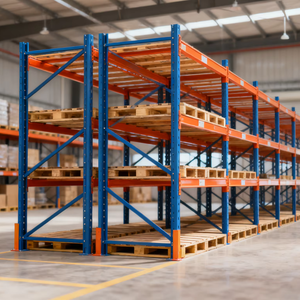
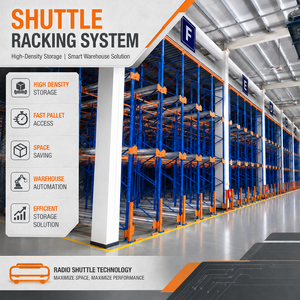
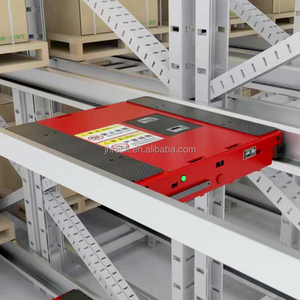
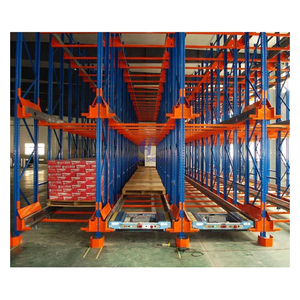
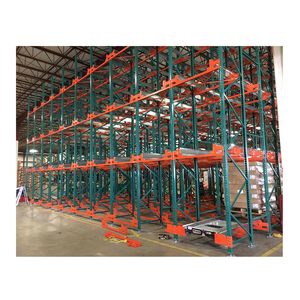
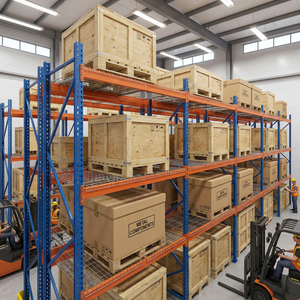
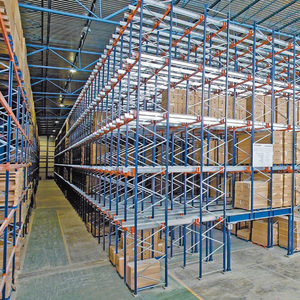
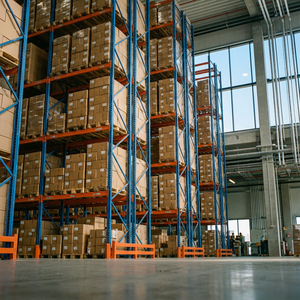
Architectural Anatomy of Industrial Pallet Shuttle Racking
A comprehensive examination of how heavy-duty steel profiles, galvanised dual-rail geometries, and autonomous shuttle cart mechanics converge to eliminate forklift collision risks and maximize volumetric utilization.
Heavy Cold-Formed Steel Rails
Formed from continuous coil steel with high yield strength (Q355B / S355JR), our proprietary guide rails feature integrated anti-tilt flanges and mechanical wheel interlocks. This eliminates shuttle cart derailment during high-speed acceleration runs under 1,500kg payloads.
- Galvanised steel finish (min 275g/m²)
- Rail deflection under 1/400 span limit
- Integrated entry guide chamfers
Autonomous Carrier Navigation
Equipped with dual optical positioning encoders, laser obstacle telemetry, and ultrasonic payload boundary detectors, the radio shuttle coordinates seamless LIFO (Last-In-First-Out) and FIFO (First-In-First-Out) cycles via 433MHz / 2.4GHz Wi-Fi industrial protocols.
- Travel speed: 0.8 m/s loaded, 1.1 m/s empty
- Positioning accuracy within ±2.0mm
- Automatic recovery and battery alerts
Upright Frame Load Dynamics
Our heavy-duty uprights are roll-formed through 24-pass precision rollers, creating closed-section stiffening ribs. Certified to European FEM 10.2.02 and Australian AS4084 structural criteria, each frame absorbs dynamic loading, seismic shear, and forklift dock vibration.
- Upright profile depth: 80mm to 140mm
- Bolted horizontal and diagonal bracing
- Heavy seismic anchor footplates
Pallet Shuttle vs. Conventional High-Density Racking
Evaluating warehouse cubic space utilization, operating speed, equipment wear, and long-term operating costs across mainstream storage topologies.
| Storage Topology | Space Utilization | Throughput Efficiency | Forklift Damage Risk | Cold Room Suitability | SKU Flexibility |
|---|---|---|---|---|---|
| Pallet Shuttle Racking | Up to 85% - 90% | High (Auto Lane Run) | Near Zero (External MHE) | Optimal (-30°C Capable) | High (FIFO & LIFO Supported) |
| Drive-In Racking | Up to 70% - 75% | Low (Slow Lane Access) | Critical High (Mast Impact) | Moderate (High Labor Cost) | Low (LIFO Only) |
| Push-Back Rack | Up to 65% - 70% | Moderate (Gravity Push) | Moderate | Good (Mechanical Only) | Moderate (2-5 Pallets/Lane) |
| Standard Selective Rack | 40% - 45% (Aisle Heavy) | 100% Direct Access | Low to Moderate | Poor (High Volume Chilling Cost) | Maximum (1 Pallet/Location) |
| ASRS Stacker Crane | Up to 92% | Ultra High (Fully Auto) | Zero (No Forklifts) | High (High Initial Capex) | Maximum (Software Routed) |
Future Procurement Trends in Pallet Shuttle Automation (2026-2030)
Global logistics heads and cold-chain infrastructure planners are moving beyond simple manual storage toward autonomous, connected, and power-efficient material handling ecosystems.
Evolution toward 4D Multi-Way Shuttles
While traditional 2D radio shuttles operate along a single straight lane, modern procurement programs are prioritizing 4D shuttle architectures. These units transition across longitudinal lanes and transverse cross-aisles without requiring forklift relocation, transforming dense racks into decentralized mini-ASRS systems.
Cold-Resistant LiFePO4 Battery Integration
Procurement specifications for sub-zero food and vaccine cold chains (-25°C to -30°C) now ban lead-acid batteries in favor of integrated Lithium Iron Phosphate cells equipped with built-in thermal resistance mats, micro-inverters, and continuous BMS telemetry.
Open API & WCS Edge Computing
Modern pallet shuttle systems are no longer isolated hardware. Buyers demand native WCS (Warehouse Control System) APIs that link directly with SAP, Manhattan, Oracle, or proprietary cloud WMS platforms, unlocking dynamic slotting, wave picking, and automated inventory heat-mapping.
High-Tensile Thin-Walled Roll Forming
Driven by corporate carbon targets and rising ocean container freight costs, manufacturers are shifting to ultra-high-strength micro-alloy steels (e.g., Q355B/S420MC). This reduces total rack steel weight by 12-15% while improving torsional rigidity and impact resistance.
Technological Frontiers in Shuttle Racking Manufacturing
Direct from our engineering laboratory: How digital twin simulations, automated roll forming tolerances, and condition-based IoT maintenance are elevating storage longevity.
Digital Twin & Finite Element Analysis
Every shuttle racking project undergoes comprehensive structural FEA modeling prior to metal cutting. We simulate maximum dynamic pallet braking loads, mast oscillation, differential foundation settlement, and local seismic acceleration spectrums (IBC / Eurocode 8 / GB50011).
This predictive simulation ensures that upright buckling safety factors remain comfortably above 1.95, even under non-uniform lane distribution.
Automated Continuous Laser Piercing
Beam connectors and upright pitch holes require tight tolerances for shuttle rails to stay parallel. We deploy 60-meter continuous roll forming lines with in-line CNC servo-punching. Hole spacing tolerance is held within ±0.15mm over a 12-meter continuous column, ensuring frictionless cart operation.
This avoids rail binding, excessive polyurethane wheel wear, and drive motor amp spikes.
IoT Sensor Telemetry & Fleet Diagnostics
Next-generation radio shuttle carriers are equipped with tri-axial vibration sensors, thermal infrared monitoring for drive gears, and onboard cycle counters. Data is beamed in real time to maintenance tablets, warning operators of bearing degradation or rail misalignment before an in-lane stoppage occurs.
This enables predictive maintenance and cuts unplanned warehouse downtime to near zero.
Guangzhou Heda Shelves Co., Ltd. Manufacturing Authority
Delivering turn-key warehouse storage engineering since 2001. We combine extensive steel fabrication capacity with rigorous international certifications to serve clients across 120+ countries.
End-to-End In-House Manufacturing Control
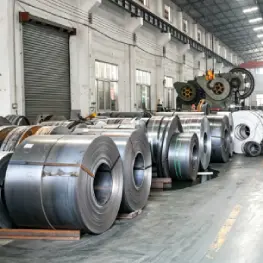
Prime Raw Materials
Mill-certified Q235B/Q355B coils tested for yield, elongation, and chemistry.
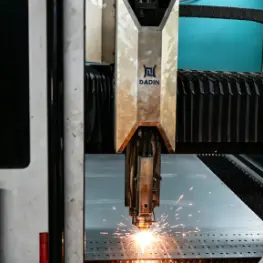
Precision Slitting
High-speed CNC slitting lines ensure clean edges and tight width tolerances.
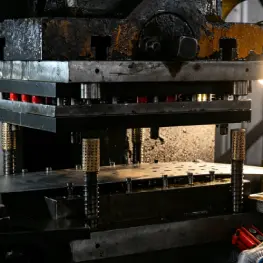
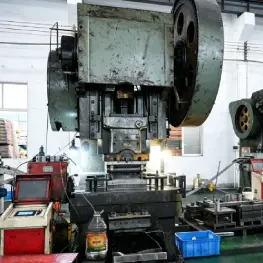
Automated Punching
Servo-driven multi-station punches punch teardrop and diamond pitches with ±0.1mm accuracy.
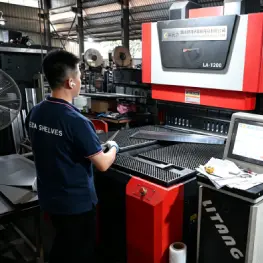
Cold Bending
Multi-angle progressive cold bending for load beams and structural bracketry.
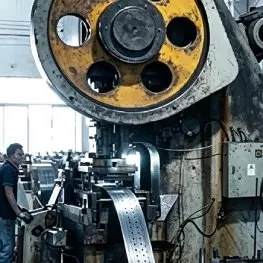
Profile Roll Forming
24-stage progressive rolling forming heavy box beams and shuttle guide rails.
Mechanical Polishing
Automatic deburring, slag grinding, and seam smoothing for safe operation.
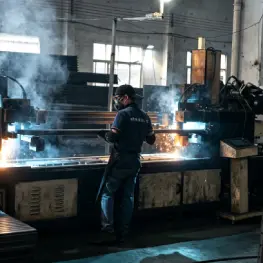
Robotic Shielded Welding
CO2 gas-shielded robotic arm welding guarantees uniform weld penetration on connectors.
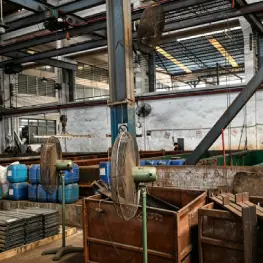
Chemical Pretreatment
Acid pickling, degreasing, and silane/phosphate immersion to prevent rust creep under paint.
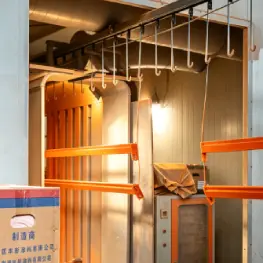
Electrostatic Coating
Automatic Swiss Gema spray guns apply 70-90μm epoxy powder cured at 200°C.
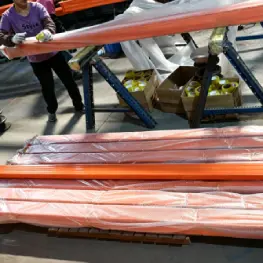
QC Inspection & Packing
Cross-hatch adhesion tests, dimensional audits, and container bundling for export transit.
Fully Certified for Municipal Audits and Structural Code Compliance
Our production facilities and structural calculations are certified under strict international testing bodies. We supply stamped structural packages, certified raw material test certificates (MTRs), and formal load declarations with every export consignment.
Frequently Asked Questions on Pallet Shuttle Racking
Technical, financial, and logistical insights for EPC contractors, warehouse logistics directors, and international procurement teams.
While drive-in racking provides high storage density, it requires forklift trucks to enter the storage lanes. This leads to slow loading cycles (3-5 minutes per pallet), mast height limits, and chronic structural damage from vehicle collisions with uprights. In contrast, a radio pallet shuttle racking system keeps forklifts outside the racking block; the autonomous cart travels inside the lane to store and retrieve loads. This cuts pallet handling times by 40-60%, eliminates in-rack structural collisions, increases vertical building space utilization up to 85-90%, and supports both FIFO and LIFO rotation schemes.
Our cold-chain shuttle units are purpose-built for low-temperature environments. We incorporate: (1) cold-resilient Lithium Iron Phosphate (LiFePO4) battery packs with internal silicone heating pads that maintain optimal electrochemical operating temperatures; (2) IP65-sealed optical sensors and internal heating elements to prevent lens condensation during rapid thermal shifts; (3) low-temperature food-grade synthetic lubricants that resist thickening down to -35°C; and (4) hot-dip galvanised or cold-galvanised steel guide rails that eliminate paint flaking and corrosion in high-humidity thaw cycles.
To produce an engineered CAD layout and calculate footplate anchor stresses, our design office requires: (1) warehouse architectural drawings in DWG/PDF showing column grids, clear height under trusses, expansion joints, overhead utilities, and fire sprinkler clearance; (2) concrete slab specifications including thickness, rebar mesh layout, concrete compressive strength (typically ≥C25 or C30 / 3000-4000 PSI), and floor flatness ratings (e.g., DIN 18202 Table 3 or ASTM E1155 F-min ratings); (3) pallet details: dimensions (W x D x H), bottom runner orientation (2-way, 4-way, perimeter base), pallet deflection limits, and gross weight ranges (e.g., 500kg - 1,500kg); and (4) forklift lift height, turning radius, and aisle mast clearance.
Our heavy-duty shuttles use commercial 24V/48V LiFePO4 cells offering >3,000 full charging cycles before capacity degrades to 80% (equating to 7-10 years of typical two-shift operations). A fully charged battery pack delivers 8 to 10 hours of continuous transit under maximum load. Fast-charging stations recharge the pack in 2.5 to 3.5 hours. Routine preventive maintenance is scheduled every 6 months and involves inspecting polyurethane wheel wear, blowing dust from laser sensors, checking chain or belt tension, and inspecting rail entry chamfer bolts.
Uprights are nested and steel-banded with plastic edge protectors into modular packs designed to fit 40' High Cube (40HQ) containers, maximizing weight capacity up to 26-28 metric tons per container. Load beams are bundled on dunnage with protective wrap between powder-coated faces to prevent transit abrasion. Radio shuttle units and electrical charging cabinets are vacuum-sealed in anti-moisture foil and packed into certified export wooden crates (ISPM-15 compliant). We ship regularly via Guangzhou, Shenzhen, Ningbo, and Shanghai ports with comprehensive ocean logistics management.
Yes. We offer tiered control architectures. Tier 1 provides handheld industrial RF remote controllers for direct forklift driver dispatch. Tier 2 provides our integrated standalone Warehouse Control System (WCS) via an in-warehouse tablet, managing lane-by-lane batch orders, automatic empty-lane compacting, and battery statuses. Tier 3 includes open RESTful APIs and OPC-UA / Modbus TCP industrial protocols for two-way data handshakes with high-level WMS/ERP platforms (SAP, Manhattan, Infor) as well as front-end AGVs, AMR lifters, or pallet roller conveyors.
Request an Engineered Layout & Wholesale Factory Proposal
Partner directly with Guangzhou Heda Shelves Co., Ltd. for factory-direct wholesale pricing, custom cold-rolled tooling, and complimentary structural CAD/3D modeling within 24 hours.