High-Density Warehouse Optimization: The Engineering Case for Drive-Through Racking Systems
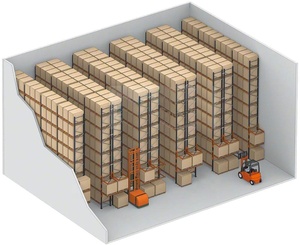
In modern industrial logistics, storage density and volumetric operational efficiency have become the primary benchmarks for warehouse profitability. As industrial real estate pricing and cold-chain energy costs escalate worldwide, conventional selective pallet configurations—requiring up to 60% of floor space exclusively for forklift access aisles—prove economically unviable for high-volume, low-SKU inventory profiles. Drive-Through Racking Systems (alongside Drive-In equivalents) provide an optimal volumetric footprint by consolidating storage blocks and establishing high-density, multi-lane pallet accumulation lanes.
Unlike standard Drive-In racking—which utilizes a single access aisle based on a Last-In, First-Out (LIFO) inventory cycle—Drive-Through Racking Systems are engineered with independent loading and retrieval faces. This configuration establishes a strict First-In, First-Out (FIFO) material handling logic. Pallets are systematically loaded from one end and retrieved from the opposite end, creating a non-congested, high-throughput passage suited for temperature-controlled storage, food and beverage processing, fast-moving consumer goods (FMCG), and agricultural commodity buffers.
Featured Heavy-Duty Warehouse Storage & Pallet Racking Systems
Direct factory engineering from Guangzhou Heda Shelves Co., Ltd., certified to CE (2435-CPR-8605159) and ISO 9001:2015 quality standards.
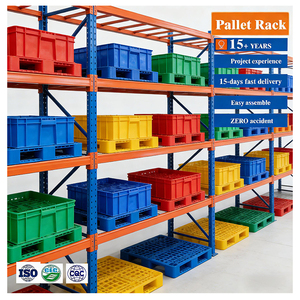
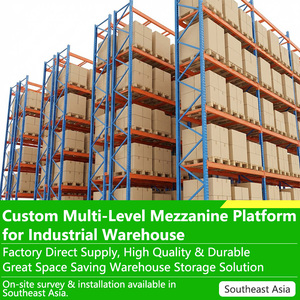
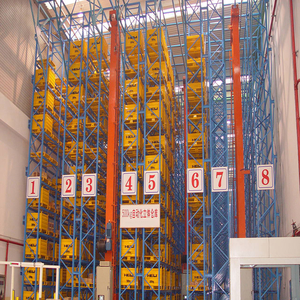
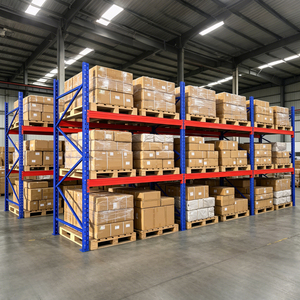
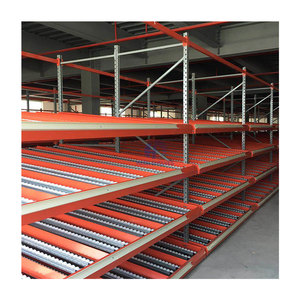
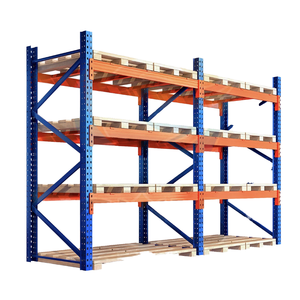
Engineered Quality from China's Leading Racking Manufacturer
Direct manufacturing control from certified steel coil selection to continuous roll-forming and robotic welding lines.
Structural Engineering & Seismic Integrity
Drive-Through racks eliminate intermediate cross-aisle tying beams. HEDA Shelves addresses lateral rigidity by using continuous heavy-gauge top-tie portal frames, rear cross-bracing towers, and anchor plates sized for seismic zones across Asia, the Americas, and Europe.
Q235B / Q355B Certified Cold-Rolled Steel
All load-bearing members—including Omega upright columns (80/90/100/120mm profiles) and pallet support rails—are roll-formed from certified high-tensile steel coils with mill test certificates (MTC) verifying consistent yield and tensile strength.
Pickling, Phosphating & Powder Pretreatment
To resist tropical humidity and the sub-zero condensation typical of cold storage facilities, all structural components undergo a 10-stage automated surface cleaning process prior to electrostatic polyester powder coating, preventing micro-corrosion.
Drive-Through Racking System Technical Specifications Matrix
Use this technical guideline to specify column depths, cantilever bracket loads, and forklift rail clearances.
| Structural Component | Standard Production Specification | Heavy-Duty / Cold-Store Configuration | Quality Standard Reference |
|---|---|---|---|
| Upright Columns | 80×60, 90×70, 100×70 mm (Thickness: 1.8–2.0 mm) | 120×95, 140×95 mm (Thickness: 2.3–3.0 mm) | EN 15512 / FEM 10.2.02 / RMI |
| Pallet Support Rails | Formed Galvanized / Painted Steel (2.0–2.5 mm) | Single/Double Flange C-Profile (2.5–3.2 mm) | ISO 9001 / Hot-Dip Galvanized Options |
| Pallet Capacity Range | 500 kg – 1,200 kg per pallet position | 1,200 kg – 2,000 kg per pallet position | Calculated Safety Factor ≥ 1.65 |
| Top Tie & Portal Bracing | Rigid Box Section Beam (80×50 to 120×50 mm) | Double Box Trussing with Heavy Gusset Plates | Seismic Analysis to GB50011 / UBC |
| Floor Guide Rails | Cold-Formed Angle Steel (L75×50×5 mm) | Cast-in Structural Channel or Heavy Box Guard | Forklift Mast Protection Profile |
| Standard Heights & Depths | Up to 8,000 mm height; 2 to 6 pallets deep | Up to 14,000 mm height; 7 to 12 pallets deep | Custom CAD Structural Engineering |
Future Sourcing & Procurement Trends for Industrial Racking Systems
Global logistics, automation, and supply-chain risk mitigation are altering how procurement managers, 3PL directors, and distribution engineers specify high-density racking. Over the coming years, four technical procurement trends will influence project approvals:
1. The Transition to Hybrid Pallet Shuttle Interoperability
While mechanical drive-through racks rely on forklift operators driving directly into structural bays, operational footprints are increasingly transitioning toward hybrid configurations. Modern drive-through racking rails are now engineered to allow retrofitting with semi-automated radio shuttle carts. This upgrade allows warehouses to transition from operator-driven cycles to high-speed semi-automation without replacing structural uprights or re-pouring floor anchors.
2. Stringent Sustainability Audits and Whole-Life Carbon Tracking
International procurement frameworks—particularly across Europe, North America, and Australasia—require verifiable Environmental Product Declarations (EPDs) for structural steel. Specifiers look for manufacturers who use energy-efficient electric-arc furnace (EAF) steel coils, reduce volatile organic compounds (VOCs) through advanced powder coatings, and optimize shipping volume per 40HQ container to lower sea-freight carbon intensity per stored pallet position.
3. Integration with Structural Health Monitoring (SHM)
Given the continuous risks associated with forklift masts colliding with lower upright frames inside drive-through channels, procurement directors are specifying intelligent impact-monitoring sensors. These IoT-enabled vibration-analysis nodes detect deflections that exceed allowable structural tolerances, immediately logging an alert within the warehouse management software (WMS) before catastrophic rail failures occur.
4. Demand for Comprehensive Turnkey EPC Sourcing
International importers are shifting away from fragmented multi-vendor procurement models. Instead, enterprise procurement teams partner with single-source manufacturers capable of delivering structural design calculations, custom CAD layouts, seismic verification, automated roll-forming, containerized export bundling, and local installation guidance under unified ISO-certified accountability.
Frequently Asked Questions on Drive Through Racking Procurement
Direct answers from our structural engineering and export compliance team to assist your project planning.
Request an Engineered Warehouse CAD Layout & Factory Quote
Connect directly with the HEDA Shelves engineering team in Guangzhou to receive custom structural calculations, 3D project renderings, and container-optimized pricing within 24 hours.