[email protected] Serving India · Bangladesh · Pakistan · Sri Lanka · Nepal
English (South Asia)
Direct Factory Source • CE & ISO 9001:2015 Certified

China Top Industrial Rack Shelving Supplier & Exporters

Engineered heavy-duty steel pallet racking, radio shuttle automation, and multi-tier structural mezzanine solutions delivered with turnkey CAD design, verified seismic compliance, and export-grade factory direct value.

Precision Engineering Portfolio

Flagship Industrial Racking & High-Density Storage Systems

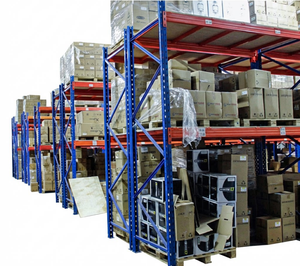
Manufactured in Guangzhou, China from certified Q235B/Q355B cold-rolled structural steel. Fully configurable for cold chain warehouses, intensive 3PL fulfillment hubs, cross-dock distribution facilities, and high-throughput industrial plants.

Direct Factory Pedigree

Why Global Supply Chains Partner with Guangzhou Heda Shelves Co., Ltd.

Since 2001, Guangzhou Heda Shelves Co., Ltd. has operated at the nexus of structural civil engineering and automated warehousing. Unlike trading intermediaries, we command a vertically integrated 30,000 m² production base in South China, guaranteeing batch-to-batch metallurgical consistency and stringent dimensional tolerances.

2001EST.
Established Pedigree
Over two decades of structural racking engineering and export logistics.
30,000m²
Modern Manufacturing Plant
Vertically integrated cold-roll forming, robotic welding, and automated powder lines.
30,000TONS
Monthly Structural Output
Scalable raw coil allocation with direct Chinese primary steel mill procurement.
120+
Global Export Destinations
CE (2435-CPR-8605159), ISO 9001:2015, and RoHS third-party certified.

Ten-Stage Production Quality Control for Heavy Industrial Demands

Structural integrity in seismic and high-load warehousing begins with prime steel quality. HEDA utilizes exclusively inspected hot-rolled and cold-rolled steel coils conforming to Q235B and Q355B (equivalent to ASTM A36 and S355JR). Our production process is entirely internalized: precision coil slitting, multi-pass continuous cold roll forming, high-speed automated column punch stamping, robotic double-pass CO2 shielded welding, and specialized end-plate joining.

Prior to coating, every component passes through a rigorous continuous 10-stage immersion or spray pretreatment process—including hot water washing, chemical degreasing, industrial acid pickling to strip mill scale, surface neutralization, and dense zinc phosphating. This chemically bonds our thermosetting epoxy-polyester powder finish (60–80μm thickness), passing 500-hour ASTM B117 salt spray tests to withstand coastal maritime salt air and harsh tropical monsoon humidity without delamination or under-film corrosion.

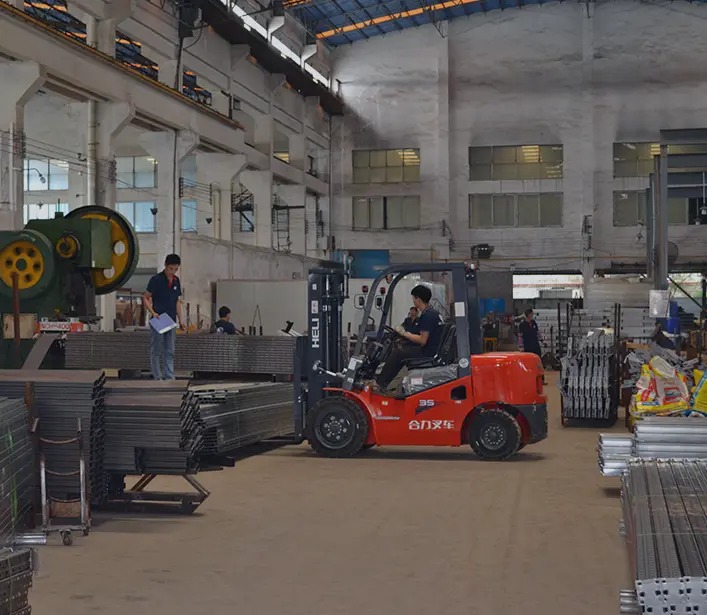
HEDA Shelves automated racking production line in Guangzhou

Turnkey CAD & 3D Modeling

Complimentary warehouse spatial layouts, forklift aisle radius validation, and 3D structural visual simulations delivered within 24 hours to streamline capital allocation.

Includes finite element load verification & dynamic seismic zoning calculation.

International Certifications

Verified European CE Mark (Notified Body CPR-2435-CPR-8605159), ISO 9001:2015 Quality Management, and hazardous substance RoHS regulatory compliance.

Strictly designed per FEM 10.2.02, EN 15512, and RMI MH16.1 specifications.

Container Cube Optimization

Engineering nesting packaging profiles tailored to 40ft High Cube containers. Minimizes dead freight, protects upright flanges during sea transit, and reduces landed costs.

Achieving 96%+ volumetric container utilization for heavy structural bundles.

End-to-End Export Support

Color-coded component tagging, comprehensive mechanical installation blueprints, HD installation video tutorials, and optional remote or on-site field engineering supervision.

Complete export dossier including Mill Test Reports (MTR) & Certificates of Origin.
Strategic Procurement Intelligence

Emerging Trends Transforming Global Racking Sourcing (2025–2030)

Industrial supply chain directors and warehousing investors are transitioning away from localized spot-buying toward strategic, long-cycle manufacturing partnerships. The modernization of third-party logistics (3PL) and automated distribution requires deeper engineering scrutiny during early procurement phases.

1. Total Cost of Ownership (TCO) vs. Initial Steel Tonnage

Historically, procurement tenders prioritized minimal cost per kilogram of steel. However, forward-thinking enterprise buyers calculate Lifecycle ROI based on usable cubic storage yield, structural beam deflection limits (L/200 standard vs. lower unverified thresholds), and resistance to continuous material handling vehicle impacts. Purchasing higher-yield steel (such as Q355B with yield strength ≥ 355 MPa) permits thinner, structurally stiffer column walls that expand vertical clear heights while reducing dead load stress on warehouse slabs.

Key Metric: Cost-per-pallet-stored per annum yields superior financial performance over raw unit steel pricing.

2. Geotechnical Slab Integration & Seismic Anchoring

Modern industrial real estate frequently contends with varied geotechnical conditions across emerging distribution hubs. Procuring racking without structural seismic analysis creates catastrophic collapse liabilities. Advanced procurement directives now require vendor structural calculations covering seismic spectral acceleration coefficients (Ss, S1), base-plate load dispersion, chemical anchor shear depth, and second-order P-Delta structural modeling under dynamic seismic loading, certified to RMI MH16.1 or EN 15512 specifications.

Engineering Mandate: Full dynamic slab reaction data must be shared prior to factory roll-forming.

3. Nearshore Decoupling & Consolidated Direct Sourcing

Global enterprise logistics directors are progressively consolidating supply chains by sourcing complete modular packages directly from Tier-1 Chinese manufacturers rather than fragmenting purchases across regional distributors. Bypassing tier-2 markups enables operators to incorporate heavy-duty accessories—such as wire mesh decking, column bullnose protectors, backstop safety netting, and pallet drop stops—without breaching capital expenditure constraints.

Procurement Advantage: Direct mill sourcing provides fixed pricing stability against steel commodity volatility.
Technological Frontiers

Architectural Evolution: The Shift from Static Racks to Intelligent Storage

The industrial warehousing sector is experiencing a massive paradigm shift. High urban land acquisition costs, coupled with labor shortages, are driving facilities from purely manual forklift environments toward semi-automated and lights-out automated intralogistics ecosystems.

Radio Shuttle & Autonomous Pallet Runners

Deep-lane radio shuttle racking is displacing traditional drive-in configurations. Rather than requiring forklifts to navigate inside narrow rack channels—a frequent cause of structural impact damage—automated radio shuttles traverse internal high-precision galvanized guide rails at speeds up to 1.2 m/s. This methodology reduces operating cycle times by 40%, eliminates rack collision hazards, and allows storage depths exceeding 30 to 40 pallets per lane in both First-In-First-Out (FIFO) and First-In-Last-Out (FILO) workflows.

Sub-Zero Cold Chain Density Optimization

As global cold-chain pharmaceutical and frozen perishable volumes surge, refrigerated warehouse energy costs have reached historic peaks. Cooling empty overhead space is thermodynamically inefficient. High-density shuttle systems and mobile powered racking compress refrigerated footprints by up to 55%. Racks engineered for -25°C to -30°C environments require specialized cold-drawn micro-alloyed steel formulations with enhanced Charpy V-notch impact toughness to prevent low-temperature structural embrittlement.

Vertical Mezzanines for E-Commerce Fulfillment

Omnichannel distribution centers are rapidly adopting multi-tier rack-supported mezzanine platforms. By utilizing unobstructed vertical clear heights of modern 12m to 16m facilities, operators establish 2 to 4 levels of walkable carton picking space directly above ground-floor pallet storage. Coupled with vertical spiral gravity chutes, carton flow tracks, and autonomous mobile robot (AMR) sortation zones, space productivity is multiplied by 300% without ground-level footprint expansion.

Engineering Evaluation

Industrial Racking System Comparison Matrix

Selecting an optimal structural system requires balancing selectivity against volumetric storage density, SKU complexity, material handling equipment (MHE) constraints, and budgetary parameters.

Racking Architecture Pallet Selectivity Storage Density Inventory Rotation Recommended Pallet Load Primary Industrial Use Case
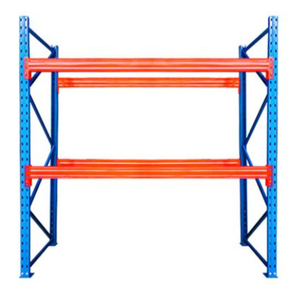
Selective Pallet Racking 100% Direct Standard (40-45%) FIFO or LIFO 500 – 4,000 kg / level General 3PL, FMCG, retail hubs with diverse SKUs
Double Deep Pallet Racking 50% Direct Access High (55-60%) LIFO 1,000 – 3,000 kg / level Medium SKU volumes, reach trucks with pantograph
Drive-In / Drive-Through Lane Dependent Very High (70-75%) LIFO (FIFO with Drive-Thru) 1,000 – 2,000 kg / pallet Cold storage, raw ingredient staging, beverage bottling
Radio Shuttle System Lane Dependent Maximum (80-85%) FIFO or LIFO Dual 500 – 1,500 kg / pallet Automated cold rooms, meat/dairy processing, large-batch SKUs
Gravity Pallet Flow Lane First Pallet Very High (75-80%) Strict FIFO 500 – 1,500 kg / pallet Perishable foods, pharmaceutical manufacturing buffers
Push Back Racking 1 per Lane (2-6 Deep) High (65-70%) LIFO 800 – 1,500 kg / cart Overstock buffer, seasonal products, dry food storage
Multi-Tier Mezzanine Floor 100% Manual Hand-Pick Vertical Multiplication Direct Manual Pick 300 – 1,000 kg / m² Apparel e-commerce, automotive spare parts, picking galleries
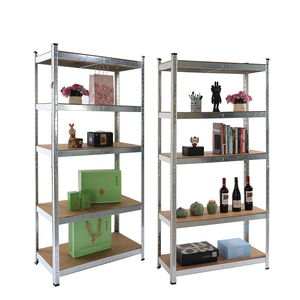
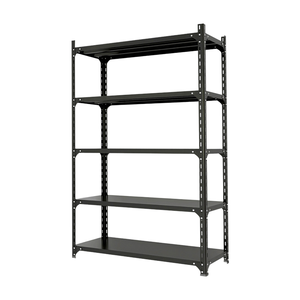
Slotted Angle / Longspan 100% Direct Hand-Pick Modular / Flexible Direct Access 100 – 800 kg / tier Small part workshops, tool cribs, office archiving
Procurement Knowledge Base

Frequently Asked Questions: Global Industrial Racking Procurement

Authoritative answers on material specifications, international engineering standards, corrosion resilience, shipping logistics, and structural safety to assist engineering and commercial procurement teams.

1. What primary steel grades are utilized in HEDA racking systems, and how is structural capacity certified?

We manufacture industrial racking systems primarily utilizing certified high-tensile hot-rolled and cold-rolled steel coils in Q235B (yield strength ≥ 235 MPa) and Q355B (yield strength ≥ 355 MPa), functionally equivalent to European standards S235JR and S355JR, as well as American ASTM A36 and ASTM A572 Grade 50. Every production heat lot is accompanied by Mill Test Certificates (MTC) validating mechanical tensile properties, yield limits, and chemical composition.

Structural capacities are verified in accordance with EN 15512:2020 (European standard for adjustable pallet racking systems), FEM 10.2.02, and American ANSI/RMI MH16.1. Deflection limits under maximum working load are strictly bounded to L/200 for horizontal load beams and H/350 for vertical upright column frames.

2. How does HEDA treat components to resist rust in coastal, tropical, and high-humidity logistics environments?

Atmospheric corrosion resistance is achieved through an automated 10-stage chemical surface conversion line prior to coating. The process sequence comprises: (1) High-temperature hot alkaline spray degreasing, (2) Immersion rinse, (3) Industrial hydrochloric acid pickling to eliminate mill scale and oxidation, (4) Dual cold water cascades, (5) Surface neutralization, (6) Dense zinc-phosphate conversion micro-coating, (7) Deionized water rinse, and (8) Thermal moisture-stripping oven drying.

Immediately following, components enter an automated electrostatic booth where an environmentally safe, heavy-metal-free epoxy-polyester hybrid powder is applied to a dry film thickness of 60 to 80 microns (μm), followed by thermal polymerization at 180°C–200°C. This industrial finish exceeds 500-hour continuous salt spray exposure under ASTM B117 testing without blistering or rust migration. For continuous sub-zero cold stores or open-sided maritime dock facilities, hot-dip galvanizing (HDG) per ISO 1461 (≥ 65μm zinc layer) is available.

3. What structural and operational data must a buyer supply to receive an engineering layout and formal quotation?

To produce an optimized CAD proposal and static structural calculation, our engineering department requires:

  • Warehouse Architectural Blueprint (CAD or PDF): Overall building length, width, clear height below the lowest obstruction (joists, lighting, sprinkler mains), and column grid locations.
  • Floor Slab Engineering: Concrete slab thickness (mm), compressive strength rating (e.g., C25/30), reinforcement mesh details, and allowable point/uniform load capacities.
  • Unit Load Dimensions: Pallet depth, width, total load height including the pallet base, and gross maximum weight per pallet.
  • Forklift / MHE Parameters: Truck brand, model, mast collapsed height, maximum lift height, and minimum right-angle stacking aisle width (Ast).
  • Environmental / Geographic Location: Project site location to account for local seismic zone spectral acceleration and wind/cyclone criteria (for external rack structures).
4. What is the typical production lead time and international ocean freight shipping procedure?

Standard manufacturing cycle time for typical project volumes (1 to 5 forty-foot containers / 40HQ) ranges between 15 to 25 business days following signed approval of engineering layout drawings and down-payment receipt. For large-scale automated installations exceeding 20 containers, rolling container batch shipments are coordinated to align with field erection milestones.

Ocean freight is dispatched from South China ports (primarily Guangzhou Huangpu or Nansha, and Shenzhen Yantian or Shekou). We export across major global shipping lanes on CIF, CFR, FOB, or DDU/DDP terms, servicing gateway container hubs including Nhava Sheva (JNPT), Mundra, Chennai, Chattogram, Colombo, Karachi, Jebel Ali, Rotterdam, Los Angeles, and Santos.
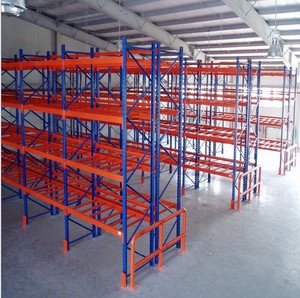
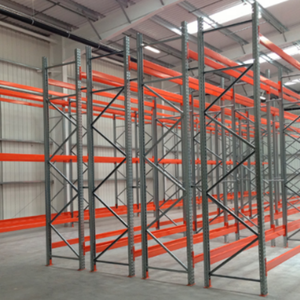
5. How does HEDA pack heavy structural steel to avoid transit damage and optimize shipping container space?

Improperly packed racking leads to scratched coatings, distorted beam connectors, and underutilized container space. HEDA employs dedicated bundling protocols: upright frames are nested with industrial wooden dunnage spacers and strapped with heavy-gauge polyester composite strapping. Load beams are sorted by length, interlocked flange-to-flange with protective foam separators, and skid-mounted on custom steel dunnage feet to allow direct unloading via standard counterbalanced forklifts.

All loose hardware—including M8/M10/M12 high-strength Grade 8.8 galvanized bolts, safety locking drop pins, base leveling shims, and wedge anchors—are sealed in heavy-duty polybags, packed into double-wall export corrugated master cartons, and palletized on heat-treated ISPM-15 compliant pallets. Our loading schematics consistently achieve over 96% volumetric stuffing efficiency in 40HQ shipping containers.

6. What installation support is provided for international projects?

Every international export package includes a dedicated documentation dossier: detailed 2D anchor-bolt setting plans, 3D isometric frame assembly diagrams, color-coded component part manifests matching container bundle numbers, and high-definition video walkthroughs demonstrating upright bracing and beam connector locking. Local millwright and mechanical contractors can assemble the systems rapidly using these instructions.

For complex installations—such as automated radio shuttle lanes, high-density drive-in systems, or multi-story mezzanine floors exceeding 2,000 square meters—HEDA can deploy experienced field installation supervisors to manage laser leveling, torque auditing, and test loading on-site.

7. Can HEDA supply customized OEM/ODM profiles, specialized paint schemes, and private label branding?

Yes. As a direct equipment manufacturer, we support original equipment manufacturing (OEM) and original design manufacturing (ODM) for racking distributors, integrators, and multinational logistics operators. We manufacture custom teardrop (American standard), hex-hole, keyhole, and 50mm/75mm European pitch upright profiles. Custom RAL color matching (e.g., RAL 5015 Sky Blue, RAL 2004 Pure Orange, RAL 7035 Light Grey) is completed on automated powder booths at no added tooling premium. Private label screen printing, embossed branding on upright caps, and custom drop-ship carton packaging are standard OEM capabilities.

8. What warranty coverage and life-cycle structural durability do HEDA systems carry?

HEDA structural racking systems carry a 5-year comprehensive manufacturer’s warranty covering raw material metallurgical defects, weldment separations, and manufacturing anomalies under rated design working loads. The structural design life cycle of our indoor warehouse systems exceeds 15 to 20 years when operated within designated load classifications and maintained through scheduled safety audits conforming to EN 15635 or SEMA Codes of Practice.

9. What safety accessories are recommended to prevent rack collapse from forklift impact?

Material handling equipment (MHE) collisions account for over 85% of severe racking structural failures. To safeguard upright columns, we recommend and manufacture three lines of defense: (1) Heavy-Gauge Column Protectors: Floor-anchored 5mm structural steel guards wrapped around lower column sections; (2) End-of-Aisle Barrier Railings: Heavy circular or C-channel double-rail steel crash barriers that shield aisle intersections; and (3) Pallet Backstop Beams & Wire Mesh Decking: Retaining bars and heavy-duty galvanized wire mesh that distribute non-standard pallet loads across beams and prevent carton drops into internal picking aisles.

10. What are the Harmonized System (HS) codes and documentation provided for customs clearance?

Industrial steel racking and shelving are universally classified under Harmonized System (HS) Code 7308.90.00 (Structures and parts of structures of iron or steel). For customs import clearance, we provide complete, certified documentation sets including: Commercial Invoice, Packing List, Clean On-Board Ocean Bill of Lading, Certificate of Origin (Form E for ASEAN nations, Form A, or RCEP where applicable), and Mill Test Certificates (MTC). This comprehensive paperwork ensures swift clearance through destination customs authorities without demurrage delays.

Transform Your Warehouse Floor into a High-Performance Profit Center

Whether you require a scalable selective pallet rack system for a new 3PL facility, a cold-storage radio shuttle integration, or a multi-tier structural mezzanine, our structural engineering team will deliver a comprehensive 2D CAD layout, 3D visualization, and detailed cost proposal within 24 hours.