High-Density Warehouse Racking & Material Handling Systems
Engineered for maximum volumetric efficiency, structural stability, and rigorous throughput velocity. Inspect our core export configurations supplied worldwide.
Engineering Whitepaper: Structural Mechanics & Kinematics of Drive-Through Pallet Racking
Drive-through pallet racking represents an elite evolution in high-density warehouse storage engineering, designed specifically to address the dual constraints of floor footprint optimization and inventory throughput speed. Unlike standard selective racking systems—which demand dedicated operating aisles between every rack row—or conventional drive-in systems that rely on Last-In, First-Out (LIFO) single-entry access, a true Drive-Through Pallet Racking System utilizes a dual-sided structural corridor framework. Forklifts enter from one access face to deposit unit loads onto continuous structural cantilever load rails and retrieve them from the opposite loading aisle. This mechanical arrangement delivers uncompromised First-In, First-Out (FIFO) stock rotation within a volumetric footprint that achieves up to 75% to 85% cubic space utilization.
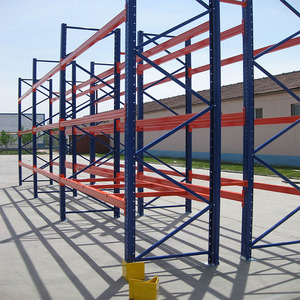
The structural integrity of drive-through systems differs substantially from conventional beam racking. In traditional beam configurations, crossbeams tie the front and rear upright columns together, providing inherent lateral resistance and stabilizing frame trusses. In drive-through configurations, intermediate horizontal pallet beams cannot cross the internal drive-in bays; forklift trucks must freely travel inside the racking lanes beneath the stored pallets. As a result, the engineering burden of lateral and longitudinal stability transfers entirely to heavy-duty top tie beams, overhead portal horizontal and diagonal cross-bracing, rear-to-front top structural truss ties, and continuous cold-rolled cantilever support arms bolted to specialized multi-bend upright columns.
At Guangzhou Heda Shelves Co., Ltd., our engineering department designs every drive-through installation utilizing premium cold-rolled structural steel grades (predominantly high-tensile Q235B and Q355B with verified mill test certificates). Upright profiles are roll-formed through a 24-station automated cold-rolling line into complex, multi-flanged omega cross-sections. This multi-bend geometry dramatically increases the radius of gyration, providing exceptionally high torsional rigidity and load-bearing resistance against torsional buckling under extreme axial compressive stress.
Comparative Technical Analysis of High-Density Storage Paradigms
Selecting the appropriate intralogistics system requires balancing capital expenditure, operational access velocity, and floor slab mechanical dynamics.
| Racking Configuration | Stock Rotation | Floor Space Utilization | Direct Accessibility | Forklift Impact Vulnerability | Ideal SKU Profile |
|---|---|---|---|---|---|
| Drive-Through Pallet Racking | Strict FIFO | 75% - 85% | Lane-Indexed Batches | Moderate (Mitigated by Guide Rails) | High-volume perishable goods, FMCG, cold storage |
| Drive-In Racking System | Strict LIFO | 75% - 85% | Single Entry Point | Moderate to High | Non-perishable homogenous goods, seasonal crops |
| Selective Pallet Racking | Flexible FIFO/LIFO | 35% - 45% | 100% Instant Direct | Low | Broad SKU variety, low-volume picking logistics |
| Radio Shuttle Cart Racking | Hybrid FIFO/LIFO | 80% - 90% | Semi-Automated Lane | Very Low (Trucks outside lanes) | Cold chain distribution hubs, automated buffering |
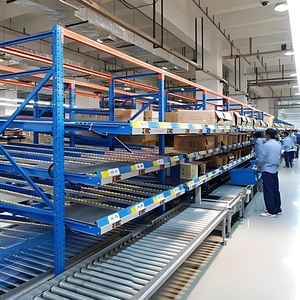
| Pallet Flow (Gravity Roller) | Dynamic FIFO | 70% - 80% | Continuous Flow Face | Low | Pharmaceutical fulfillment, date-critical consumables |
Future Procurement & Technological Trends in Industrial Racking
Logistics engineering is experiencing a structural transition toward automation compatibility, advanced anti-corrosion metallurgy, and rigorous seismic compliance.
AGV & Autonomous Forklift Interfacing
Modern drive-through facilities increasingly interface automated guided vehicles (AGVs) and vision-guided counterbalanced trucks. This trend mandates sub-millimeter manufacturing tolerances in rail alignment, floor guide track leveling, and laser-aligned pallet entry funnels to eliminate optical interference during automated lane ingress.
Multi-Stage Anti-Corrosion Metallurgy
With accelerated growth across tropical logistics hubs, maritime port bonded zones, and -30°C frozen food supply chains, procurement specifications have shifted from standard decorative coating to industrial multi-stage pickling, zinc-phosphating pretreatment, and electrostatic thermoset epoxy powders achieving salt spray ratings over 500 hours.
Non-Linear FEA & Seismic Design
Global procurement standards now enforce finite element analysis (FEA) testing under European standard EN 15512:2020 and US RMI MH16.1 codes. Modern installations incorporate enlarged, high-ductility base plates with dual chemical expansion anchors capable of dissipating dynamic seismic shearing forces without upright fracture.
Direct Factory Engineering: Guangzhou Heda Shelves Co., Ltd.
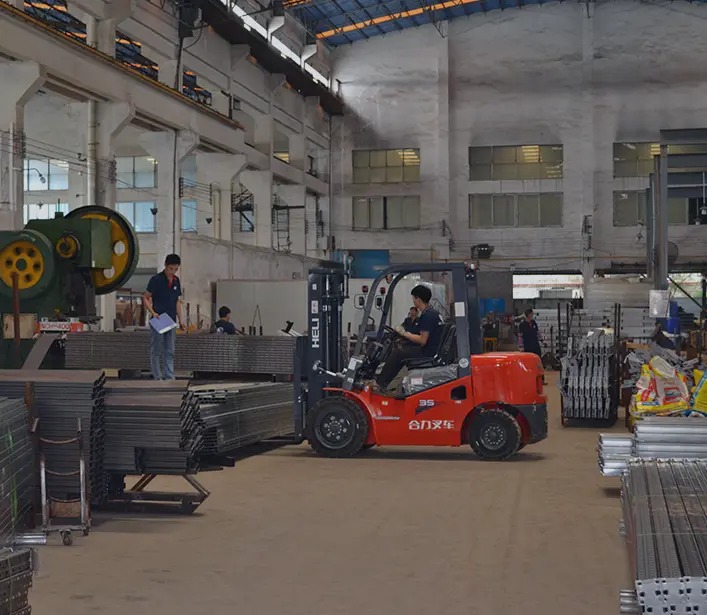
Established in 2001, Guangzhou Heda Shelves Co., Ltd. has developed into one of China's preeminent heavy-duty pallet racking exporters and turnkey storage system manufacturers. Headquartered in Guangzhou, our production infrastructure spans over 30,000 square meters, delivering a robust output exceeding 30,000 tons of structural steel storage equipment per month.
Our export operations encompass more than 120 countries, delivering engineered solutions across Southeast Asia, South Asia, the Middle East, Europe, and the Americas. By managing the complete manufacturing value chain in-house—from cold-coil slitting, automatic punch pressing, and CNC roll-forming to automated welding robots, phosphating pre-treatment, and electrostatic powder coating—we provide full material traceability and documented quality control for every project.
Frequently Asked Questions on Drive-Through Racking Procurement
In-depth engineering, logistical, and structural answers to critical questions raised by procurement directors, EPC contractors, and warehouse design consultants.
While both systems utilize continuous cantilever arms and support rails instead of traditional pallet beams across aisles, the structural variance lies in corridor access. Drive-In racking features a single entry/exit point per bay; forklifts deposit and retrieve pallets from the exact same side, enforcing a Last-In, First-Out (LIFO) inventory sequence. The rear of the bay is stabilized using heavy X-bracing. Drive-Through racking eliminates rear cross-bracing to enable dual-face access: forklifts load on one side and pick from the opposite side, enforcing true First-In, First-Out (FIFO) stock rotation. To compensate for the absent back bracing, Drive-Through systems require enhanced overhead top portal bracing, reinforced floor anchoring, and thicker upright steel sections to withstand dynamic lateral shearing.
Because drive-through racking concentrates significant point loads through a small contact area without cross-beam load dispersion, slab structural verification is essential. For racking heights ranging between 6m and 10m, we typically recommend a minimum reinforced concrete slab thickness of 180mm to 250mm, with a compressive strength grade of C25/30 or C30/37 (25 to 30 N/mm²). Floor flatness should conform strictly to DIN 18202 Table 3 Line 3 or FM2 (Concrete Society TR34) classification to prevent mast sway and forklift chassis vibration when trucks travel deep inside the narrow rack lanes.
Forklift impact represents the primary operational hazard in narrow-lane systems. HEDA Shelves addresses this through a multi-tier physical safety barrier package. First, continuous hot-rolled channel steel (C-channel) or heavy angle-iron floor guide rails are anchored along the entire lane length, mechanically restricting forklift wheel drift. Second, all entry uprights are fitted with high-impact, wrap-around column guards fabricated from 6mm to 8mm thick reinforced steel. Third, continuous flared entry lead-in shoes guide the forklift chassis safely into the aisle center, while bright, electrostatic signal yellow (RAL 1023) or high-visibility orange powder coatings optimize operator visual awareness.
For standard climate-controlled dry distribution centers, we apply a multi-step acid wash, pickling, phosphating, and automated electrostatic powder coating with an average cured thickness of 60 to 90 microns. For harsh environments—such as marine port terminals subjected to salt air or low-temperature cold rooms operating at -25°C to -30°C—we provide hot-dip galvanized (HDG) components conforming to ISO 1461, achieving a zinc coating thickness exceeding 65 to 80 microns. This metallurgical barrier eliminates rust bleed, flaking, and zinc embrittlement over decades of sub-zero condensation cycles.
To generate an accurate engineering drawing and structural bill of quantities, our design team requires: (1) Architectural warehouse CAD drawings showing column grid locations, clear ceiling heights, and door clearances; (2) Pallet specifications including overall dimensions (Width x Depth x Height, inclusive of overhang) and gross weight per pallet; (3) Forklift model details, specifically overall chassis width, mast collapsed height, and maximum fork lift height; (4) Target operating temperature (ambient or cold storage); and (5) Local seismic zone acceleration values. With this data, our engineers issue a 2D CAD layout, 3D visualization, and structural load analysis within 24 hours.
Long-span structural racking parts present distinct ocean shipping challenges. HEDA Shelves utilizes customized export bundling procedures. Upright frames are either flat-packed knocked-down (KD) to optimize container cube fill, or shipped pre-bolted based on client site labor preferences. Heavy components are strapped with high-tensile steel banding, wrapped in protective bubble membranes and corrugated cardboard cushioning, and placed on custom wood Dunnage runners to facilitate forklift unloading from open-top or 40ft High Cube containers. Loading manifests include container distribution plans that balance gross tonnage and cubic capacity, reducing ocean freight costs per pallet location.