High-Performance Storage Racking Systems & Modular Shelving
Explore our factory-engineered configurations built from certified Q235B and Q355B structural steel, finished with anti-corrosive electrostatic powder coatings, and certified for global project safety compliance.
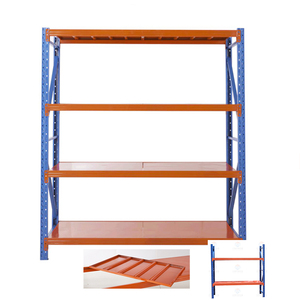
New Warehouse Longspan Racking Customized Color Supermarket Rack Manufacturers 200Kg Steel Wide Span Shelving Racks
Engineered for manual picking environments, micro-fulfillment centers, and retail staging. Features 50mm pitch beam adjustability and heavy-gauge steel deck panels.
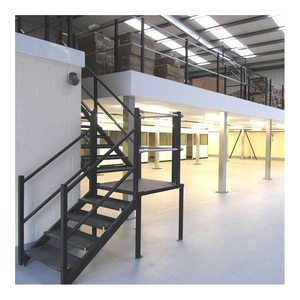
Mracking Industrial Storage Mezzanine Platform China Wholesale Multi-Tier Warehouse Rack Design Steel Material Easy Installation
Rack-supported multi-tier structural platform multiplying footprint height efficiency. Integrates heavy upright columns, interlocking galvanized steel floors, and stair assemblies.
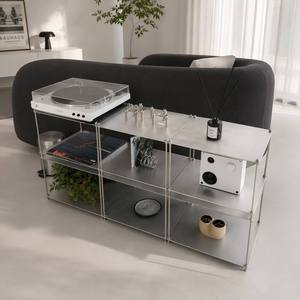
Modern Stainless Steel CD Rack Vinyl Record Storage Shelf Modular Media Player Stand Hifi Equipment Display Rack Wholesale
Precision-fabricated architectural stainless steel modular racking. Designed for specialized media archive facilities, exhibition rooms, and high-end retail merchandising.
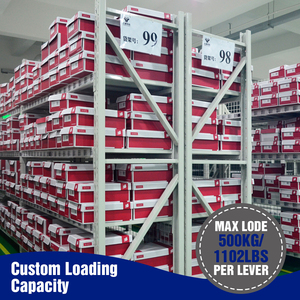
Steel Shelving Factory Boltless Light Duty Adjustable Storage Rack Warehouse Industrial OEM
Rapid snap-in rivet/boltless assembly system engineered for commercial fulfillment, maintenance tool cribs, and light-industrial parts storage without fastening hardware.
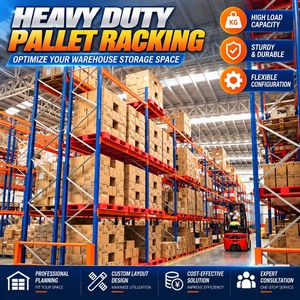
Heavy Duty Selective Steel Pallet Racks with Powder-Coated Finish for Industrial Warehouse
Heavy structural upright frames combined with box-step beams and safety locking pins. Delivers 100% direct pallet selectivity for high-throughput logistics hubs.
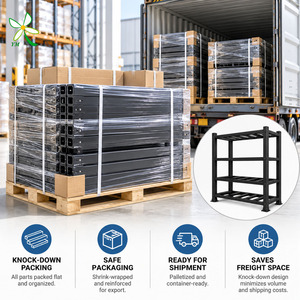
Fast Ship Washdown Food Processing Wet Area Easy Clean Sanitary Composite Storage Shelving FRP Storage Rack Warehouse Rack
Engineered for cold storage, food preparation facilities, and corrosive washdown environments. Fully impervious to brine, moisture, chemical disinfectants, and mold.
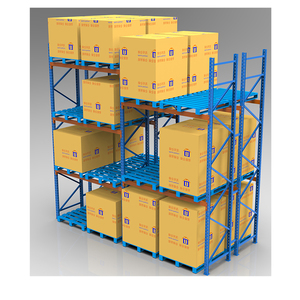
Single Deep Selective Rack Factory Metal Heavy Duty Industrial Racking Systems Pallet Racking
Standard single-deep selective racking layout supporting Euro, ISO, and GMA pallet profiles. Accommodates counterbalance forklifts, reach trucks, and narrow aisle equipment.
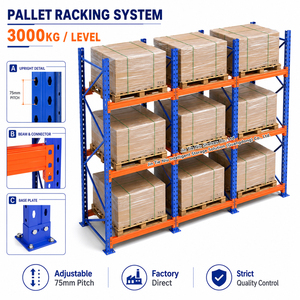
3 Pallet Levels Heavy Duty Steel Warehouse Rack Selective Pallet Racking System 3000KG
Heavy structural beam sections engineered for 3,000kg bay loads across 3 tiered levels. Reinforced with welded column footplates, seismic anchor bolts, and column safety guards.
Engineering Architecture of CE-Certified Selective Racking
A rigorous examination of metallurgy, beam deflection tolerances, moment-resisting connections, and structural compliance under European Standard EN 15512:2020.
1. Structural Steel Metallurgy & Profile Geometry
The bedrock of warehouse racking structural reliability is cold-formed steel metallurgy. While commodity suppliers frequently utilize unverified re-rolled commercial steel with broad yield deviations, CE Certified Selective Racking requires premium prime-grade Q235B or Q355B (equivalent to European S235JR and S355JR according to EN 10025-2). The minimum yield point for Q235B is strictly monitored at ≥235 MPa, while high-bay and heavy seismic installations deploy Q355B with yield strengths ≥355 MPa, delivering superior tensile energy absorption during seismic shear loading.
Upright columns undergo computerized 18-stage roll-forming lines to achieve an engineered multi-bend Omega profile (Ω-section). Each additional longitudinal cold bend increases the polar moment of inertia ($I_x$ and $I_y$), dramatically suppressing column torsional buckling and local web crippling under combined axial and eccentric bending moments. Precision CNC punch presses perforate the uprights at exact 50mm or 75mm increments, keeping punching center tolerances within ±0.1mm along the entire 12-meter continuous vertical profile.
Key Mechanical Properties of Structural Steel Components
| Component | Standard Steel Grade | Yield Strength ($R_e$) | Tensile Strength ($R_m$) | Elongation ($A_5$) | Safety Factor |
|---|---|---|---|---|---|
| Upright Frames | Q235B / Q355B Cold-Formed | 235 - 355 MPa | 375 - 510 MPa | ≥ 21% | 1.65 (EN 15512) |
| Box / Step Beams | Q235B High-Ductility | ≥ 235 MPa | 370 - 500 MPa | ≥ 26% | 1.50 (Static Limit) |
| Beam End Connectors | High-Manganese Steel | ≥ 310 MPa | 450 - 560 MPa | ≥ 22% | 2.00 (Connection) |
| Base Anchor Bolts | Grade 8.8 Structural Alloy | ≥ 640 MPa | ≥ 800 MPa | ≥ 12% | 2.50 (Shear/Pullout) |
2. Beam-End Connector Dynamics & Deflection Calculations
The beam-to-column node in selective pallet racking behaves as a semi-rigid connection. Under structural standard EN 15512, rack stability calculations must incorporate connector rotational stiffness ($C_{bi}$) derived from physical laboratory bending moment testing rather than assuming idealized pin or rigid joint models. Our factory designs heavy-gauge 4-hook and 5-hook cold-stamped connector claws that create a form-fitting wedge action around the column perforation.
Maximum serviceability deflection for pallet load beams is strictly limited to $\delta \le L / 200$ under maximum uniformly distributed load (UDL), where $L$ is the clear span distance between columns (e.g., for a 2,700mm beam bay holding three 1,000kg pallets, allowable vertical sag is constrained to under 13.5mm). Every beam connector includes high-visibility safety locking pins with spring detents that resist inadvertent vertical dislodgement from upward forklift impact forces exceeding 5.0 kN.
3. Automated 10-Stage Surface Pretreatment & Finishing
Long-term structural reliability requires an uncompromising anti-corrosion barrier, especially in coastal maritime hubs or cold chain staging facilities prone to condensation. Every component processed through our manufacturing plant follows an automated 10-step immersion and spray pretreatment cycle:
Step 1: Hot Alkaline Heavy Degreasing → Step 2: High-Pressure Water Rinse → Step 3: Sulfuric Acid Scale Pickling → Step 4: Neutralizing Rinse → Step 5: Surface Conditioning → Step 6: Micro-Crystalline Zinc Phosphating → Step 7: Deionized Water Final Rinse → Step 8: Moisture Drying Oven (140°C) → Step 9: Electrostatic Epoxy-Polyester Powder Cloud Deposition (70-90μm) → Step 10: Thermal Polymerization Curing Oven (190°C - 210°C for 25 minutes).
The resulting polymer cross-linking layer satisfies ASTM B117 salt spray exposure tests beyond 500 hours without edge blistering or surface flaking, providing decades of maintenance-free service.
Selective Racking vs. High-Density Alternatives
Evaluating warehouse layout geometry, inventory SKU velocity, equipment capital costs, and aisle clearance specifications.
| Storage Architecture | Pallet Selectivity | Floor Space Utilization | Required Forklift Aisle | SKU Profiling Suitability | Capex Index |
|---|---|---|---|---|---|
| Standard Selective Rack | 100% Direct Immediate Access | 35% - 45% Net Floor Area | 3,000 - 3,500 mm (Counterbalance) | High SKU variety / High velocity | Baseline ($) |
| Narrow Aisle (VNA) Selective | 100% Direct Immediate Access | 55% - 65% Net Floor Area | 1,650 - 1,900 mm (VNA Turret Truck) | High SKU variety / Costly Real Estate | Moderate ($$) |
| Double-Deep Selective | 50% Direct (LIFO per 2-slot) | 50% - 60% Net Floor Area | 2,800 - 3,200 mm (Pantograph Reach) | Medium SKU variety (2-4 pallets/SKU) | Low-Moderate ($$) |
| Drive-In / Drive-Through | Last-In, First-Out (LIFO) | 70% - 80% Net Floor Area | Aisles Eliminated (Inside Lanes) | Low SKU count / Bulk seasonal | Moderate ($$) |
| Radio Shuttle Automation | Semi-Automated FIFO / LIFO | 75% - 85% Net Floor Area | External Transfer Aisles Only | High-volume cold storage & FMCG | Advanced ($$$$) |
Why Selective Pallet Racking Remains the Undisputed Supply Chain Standard
Despite the rise of robotic automated storage and retrieval systems (ASRS), over 70% of global warehouse floor positions still rely on single-deep selective racking. The reasons are economic and operational:
1. Unconstrained 100% SKU Accessibility: Every single pallet is immediately accessible without relocating adjacent inventory. In third-party logistics (3PL), e-commerce fulfillment, and FMCG operations with fluctuating SKUs, zero-latency access prevents bottlenecking at loading docks.
2. Capital Equipment Neutrality: Selective systems do not require proprietary robotic maintenance teams. They interface seamlessly with any standard material handling equipment—including walkie stackers, counterbalance trucks, reach trucks, and articulated forklifts.
3. Reconfigurability: As supply chains change, beam levels can be disengaged and repositioned at 50mm or 75mm increments in minutes without structural welding or facility downtime.
Future Procurement & Technology Trends in Warehouse Racking
Key technological, regulatory, and engineering shifts transforming industrial racking procurement across the next 10 years.
1. Hybrid AMR/AGV Forklift Co-Navigation
Modern racking procurements increasingly mandate compatibility with autonomous reach trucks and autonomous mobile robots (AMRs). Beams now incorporate high-contrast photoluminescent barcode strips, optical reflector holes, and LiDAR targets. Bottom upright sections integrate flared heavy-wall ground deflectors to prevent autonomous vehicular wheel-chassis contact.
2. Decarbonized Steel & Eco-Responsible Coatings
Global ESG reporting requires verifiable Scope 3 embodied carbon data for structural capital assets. Tier-1 buyers favor racking fabricators leveraging electric arc furnace (EAF) low-emission scrap steel, low-VOC thermoset hybrid powders, and closed-loop wastewater recovery lines. Our manufacturing facility minimizes zinc sludge discharge to near-zero levels.
3. Dynamic IoT Structural Health Monitoring
Racking operations are transitioning from annual visual inspections to continuous telemetry. Smart acoustic emission and triaxial strain-gauge sensors embedded at critical lower upright joints detect minor structural impacts, cumulative fatigue stress, and ground slab settlement in real time, alerting safety directors before progressive collapse can occur.
4. Extreme Seismic Micro-Zoning Engineering
With the global consolidation of logistics mega-parks, racking engineers must design for precise geographic seismic micro-zones under ASCE 7-22, Eurocode 8, and NZS 1170.5. Heavy selective racking systems now regularly incorporate oversized base plates ($200 \times 200 \times 12$mm) and internal structural cross-bracing diagonals to manage ground acceleration without plastic hinge failure.
5. Micro-Fulfillment & Multi-Tier Urban Integration
Urban land costs are driving the expansion of rack-supported multi-tier platforms and modular mezzanine installations. Facilities integrate pallet selective storage on ground levels with multi-level catwalks and automated parcel conveyor spirals overhead, combining heavy pallet reserves with fast item-level picking in a single cubic footprint.
Guangzhou Heda Shelves Co., Ltd.
Founded in 2001, Guangzhou Heda Shelves Co., Ltd. has established itself as an engineering benchmark in warehouse storage systems. Operating a 30,000 square meter modernized manufacturing complex staffed by over 300 experienced engineers and technicians, we maintain a monthly output exceeding 30,000 tons of precision-formed steel racking components.
Our core manufacturing philosophy integrates end-to-end quality control—from computerized raw coil slit inspection and automated roll-forming to robotic welding, pickling phosphating, and powder polymer coating. We provide free engineering consultation, CAD 2D layouts, and full 3D rendering designs within 24 hours to project planners globally.
Engineering Quality Assurance Protocol
Every project batch produced undergoes strict mechanical testing before container pack-out:
- Spectrometric Chemical Analysis: C, Si, Mn, P, S verification.
- Tensile & Yield Testing: Universal testing machine pull tests.
- Weld Seam Ultrasonic Inspection: Zero void / porosity tolerance.
- Cross-Hatch Adhesion Test: ISO 2409 Class 0 coating adhesion.
Frequently Asked Questions by Industrial Racking Buyers
In-depth answers to technical questions concerning European standards, floor slab tolerances, seismic compliance, and export logistics.