[email protected] Serving India · Bangladesh · Pakistan · Sri Lanka · Nepal
English (South Asia)
ISO 9001:2015 & CE Certified Heavy-Duty Engineering

Top Trusted Drive In Racking System Manufacturers & Exporters

High-density cubic optimization, certified Q235B/Q355B structural cold-formed profiles, cryogenic cold-storage execution, and turnkey factory-direct export solutions across 120+ nations.

Enterprise Product Portfolio

Featured Industrial Pallet Racking & High-Density Storage Solutions

Engineered to maximize volumetric warehouse density by up to 85%, reducing aisle footprints and ensuring certified structural safety for high-bay logistics, commercial facilities, and cold storage chains.

Structural Engineering Whitepaper

Engineering Principles: Space Utilization Index (SUI) & Drive-In Mechanics

A comprehensive engineering evaluation of high-density continuous-lane racking architectures for senior logistics directors, warehouse planners, and supply chain project managers.

In modern industrial logistics, floor area acquisition and high-bay building construction represent massive capital expenditure. Conventional single-selective racking networks commit approximately 55% to 65% of overall warehouse square footage purely to forklift operating corridors. For enterprises managing substantial volumes of homogeneous stock—such as cold chain perishables, beverage distribution hubs, bulk agricultural commodities, and chemical raw materials—such low volumetric efficiency incurs recurring operational losses.

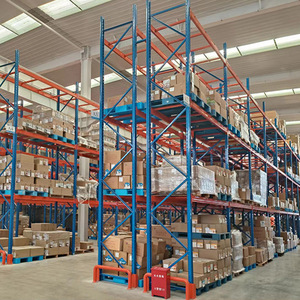
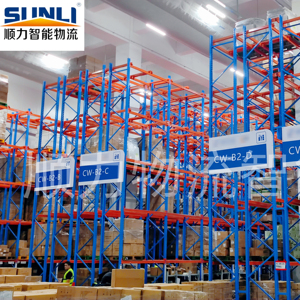
Drive-In Racking Systems resolve this structural bottleneck by consolidating storage lanes into continuous uninterrupted blocks. By eliminating intermediary forklift aisles, pallets are supported along side-mounted cantilevered load rails (continuous bracket tracks) extending across lane depths of up to 10 to 15 pallets deep and 4 to 8 tiers high. Forklifts physically navigate inside the storage columns to stage or retrieve pallet loads, shifting the facility's Space Utilization Index (SUI) from 35% to upwards of 75%–85%.

Technical Topology: Drive-In vs. Alternative High-Density Systems

Racking Topology Volumetric Storage Density Pallet Retrieval Logic Forklift Travel Profile Capital Investment / Pallet Best Operating Scenario
Drive-In Racking Very High (75–85%) LIFO (Last-In, First-Out) Enters Internal Bay Lanes Low to Moderate (1.0x Base) Bulk homogeneous SKUs, Cold Stores, Raw Materials
Drive-Through Racking High (70–80%) FIFO (First-In, First-Out) Passes through dual entry faces Moderate (1.15x Base) Perishable foods, strict expiry inventory buffers
Push-Back Racking Medium-High (60–70%) LIFO (Gravity Cart Driven) Remains in Central Aisle Medium-High (1.6x Base) 2–6 Pallets per SKU, quick turnover staging
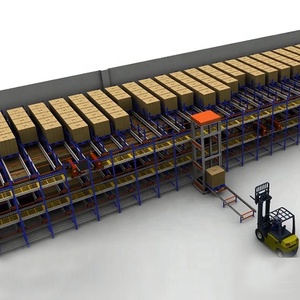
Radio Shuttle System Extreme (80–90%) Programmable FIFO / LIFO Aisle-bound, shuttle enters lane High Capital (2.4x Base) Automated deep-lane freeze storage, high throughput
Selective Pallet Racking Low (35–45%) 100% Direct Selective Access Standard Corridor Traversal Standard (0.8x Base) High-variety retail logistics, e-commerce SKUs
Enterprise Reliability & Manufacturing Credibility

Why Tier-1 Importers Partner with Guangzhou Heda Shelves Co., Ltd.

Founded in 2001, HEDA Shelves integrates precision structural engineering, fully automated manufacturing lines, and international export expertise to ensure maximum safety, zero defective parts, and seamless sea freight logistics.

30,000 m² Mega Factory Base

Equipped with 10 heavy-gauge automated continuous roll-forming lines, computerized multi-station CNC punching presses, and high-frequency robotic welding cells producing up to 30,000 tons annually.

Certified Compliance (CE & ISO)

Audited strictly under CE Certification No. 2435-CPR-8605159, ISO 9001:2015 Quality Management System No. 18624Q00169R0M, and RoHS standards. Designed under European FEM 10.2.02 and EN 15512 codes.

Free 3D Layout & CAD Design

Our in-house structural engineering department drafts complimentary CAD warehouse layouts, seismic load calculations, Finite Element Analysis (FEA) simulations, and 3D renderings within 24 business hours.

Global Export in 120+ Countries

Over two decades of export experience delivering containerized pallet racking shipments through major worldwide sea ports, including complete installation drawings, video walkthroughs, and local engineer dispatching.

2001 Established Since
30,000 m² Factory Floor Space
10,000+ Global Projects Completed
30,000 T Monthly Manufacturing Cap
Strategic Sourcing Intelligence

Future Procurement Trends & Racking Industry Advancements

How material science innovations, cryogenic cold chain demands, seismic codes, and hybrid automation pathways are reshaping the global racking procurement market.

Trend 01: Cold Chain & Cryogenics

Subzero Metallurgy & Anti-Embrittlement

With global cold chain logistics expanding by over 14% annually, Drive-In systems face harsh low-temperature operating environments (-25°C to -35°C). Standard commercial carbon steel risks ductile-to-brittle transition fractures under high point loads.

Procurement Shift: Buyers specify Q355D micro-alloyed structural steels, increased zinc-phosphate wash stages, and 80–120μm electrostatic epoxy powder coatings to prevent cryogenic embrittlement and condensation rust.
Trend 02: Automation Pathway

Modular Hybridization: Drive-In to Shuttle Migration

To reduce long-term capital risk, engineering procurement directors are demanding "Automation-Ready" Drive-In structures. Forward-thinking companies install heavy upright structures that can accept radio shuttle runner tracks in later project phases.

Operational Gain: Allows companies to begin with cost-effective manual forklift drive-in lanes today, and easily upgrade to high-speed semi-automated radio shuttles without dismantling upright columns.
Trend 03: Structural Resilience

Seismic Non-Linear Modeling & Finite Element Analysis

Global standards (including US RMI ANSI MH16.1, Australian AS4084, and European EN 15512) enforce tighter dynamic load criteria. Because Drive-In racks lack interior vertical cross-bracing in forklift access bays, top horizontal portal ties and back bracing must bear high torsional loads.

Engineering Standard: Advanced manufacturers run 3D ANSYS non-linear simulations, verifying column base-plate anchorage, concrete slab shear capacity, and floor deflections under full load.

TCO (Total Cost of Ownership) Insight for Warehouse Procurement Teams

When budgeting high-density warehouse racking, look beyond the raw metric ton price of fabricated steel. Evaluate container cubic packing efficiency (our precision bundle-nesting achieves up to 26 tons per 40ft HQ container), life-cycle floor anchor wear, forklift driver visibility geometry, and integrated upright column protector shoes. Heavy-duty wrap-around floor column guards and heavy ground guide rails routinely prevent expensive forklift impact damage, reducing maintenance costs by up to 60% over a 10-year facility lifecycle.

Technical Sourcing Clarity

Frequently Asked Questions by Industrial Racking Buyers

Direct engineering insights addressing floor slab capacities, forklift mast clearance, seismic certifications, and worldwide containerized freight logistics.

What warehouse floor slab specifications are required for high-bay Drive-In racking?

Because Drive-In systems channel intense point loads through continuous upright column clusters without wide intermediary distribution beams, concrete floor slab integrity is paramount. Typically, industrial warehouses require a reinforced concrete slab with a minimum thickness of 180mm to 250mm and a concrete compressive strength rating of at least C25/C30 (3,000 to 4,000 PSI).

For installations exceeding 8 meters in height or bay loads exceeding 10,000 kg per upright frame, HEDA engineers compute column baseplate footprints (e.g., enlarged 200×200×10mm plates) and specify dual M12/M16 chemical anchor studs to distribute punch loads within safe structural soil limits.

How does the forklift mast and overall vehicle width dictate the internal bay clear width?

Internal clear lane dimensions depend on two factors: the widest dimension of the forklift (chassis or overhead guard) and the pallet overhang profile. The nominal clear span between load support rails is sized to support standard pallet skids (e.g., 1,000mm width across 1,200mm depth pallets), typically leaving 75mm of landing surface per rail edge.

Forklift total exterior width must maintain a clearance buffer of at least 75mm to 100mm on each side relative to the pallet support rail brackets. HEDA Shelves integrates ground-anchored structural angle guide rails (either 100×75×8mm steel angles or heavy-duty tubular steel) to physically guide forklift tires through deep bays, virtually eliminating structural mast collisions.

What anti-corrosion treatments are applied for sub-zero cold stores and tropical coastal ports?

All HEDA manufactured profiles pass through an automated 9-stage surface treatment line: initial degreasing, twin acid pickling washes (to eliminate all steel scale), surface conditioning, phosphate conversion coating, and high-purity water rinses before entering the powder application booth.

Components receive an electrostatic thermosetting epoxy-polyester powder coat cured at 200°C, producing an impermeable dry film thickness (DFT) of 70μm to 100μm that resists mechanical abrasion and chemical cleaners. For coastal ports with high saline mist or cryogenic freezing rooms experiencing constant humidity cycling, components can be specified with hot-dip galvanization (HDG according to ISO 1461, yielding 60–85μm zinc thickness) to ensure multi-decade rust immunity.

Can standard wooden pallets be utilized in Drive-In racks, or are custom pallets needed?

Standard industrial pallets (including Euro pallets 800×1200mm, GMA standard 40×48 inch pallets, and Australian 1165×1165mm pallets) operate reliably within properly engineered drive-in bays. The crucial factor is pallet structural bottom geometry and bottom board continuity.

Because the pallet is supported along its outer underside edges rather than by two continuous horizontal beams, broken bottom deck boards, two-way notched stringers of poor grade, or cracked skids can sag or split under heavy loads. HEDA offers custom rail flange safety stops, entry guide horns, and optional center safety bars to support varying pallet designs safely.

What information must a buyer prepare to receive an optimized engineering layout and quotation?

To produce an authoritative structural CAD layout, our engineering group requires:

  • Architectural building blueprint (CAD/PDF): Indicating building boundaries, building column grids, clear ceiling height under trusses, fire sprinklers, and overhead door locations.
  • Pallet metrics: Pallet dimension (W × D × H overall including cargo overhang) and maximum gross pallet weight.
  • Forklift operational data: Forklift model, maximum collapsed mast height, maximum reach height, turning radius, and outer chassis width.
  • Operational environment: Ambient room temperature, cold store requirements (-25°C), or local seismic classification zone.
How does HEDA handle export packaging to prevent maritime shipping damage and minimize freight costs?

International ocean logistics demand robust cargo protection and optimal volumetric density. Uprights and beams are bundled using heavy steel strapping, non-scratch corrugated paper protectors, and plastic moisture wraps. Brackets, footplates, safety pins, and anchor hardware are shipped in heavy wooden crates with individual serial tags.

Our loading engineers design dedicated 3D container packing layouts for 20GP, 40GP, and 40HQ containers, achieving up to 98% spatial container efficiency and keeping ocean freight cost per pallet position to an absolute minimum.

Request an Engineered Layout & Factory-Direct Quote

Connect directly with the structural engineering department at Guangzhou Heda Shelves Co., Ltd. Share your warehouse floor dimensions, SKU parameters, and ceiling heights to receive a custom CAD layout, FEA stress validation, and complete container freight estimates within 24 hours.