Engineered Storage Equipment & Warehouse Solutions
Explore our heavy-duty industrial shelving, dynamic roller gravity racks, modular cantilever systems, and automated storage solutions. Each system is structurally verified to meet international standards including ISO 9001:2015, CE, AS4084-2023, and FEM 10.2.02 regulations.
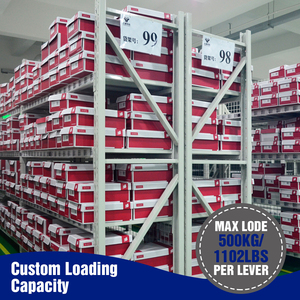
Steel Shelving Factory Boltless Light Duty Adjustable Storage Rack Warehouse Industrial OEM
- Payload Rating: 150 - 300 kg/tier
- Assembly Method: Boltless Rivet Lock
- Steel Specification: SPCC Cold Rolled
- Adjustable Pitch: 38mm Increments
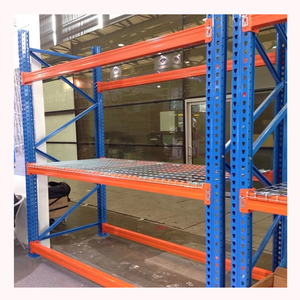
Heavy Duty Warehouse Storage Industrial Shelf Rack Metal Shelving with Steel Deck to Storage
- Payload Rating: 500 - 1,500 kg/level
- Deck Type: Reinforced Steel Panels
- Steel Specification: Q235B High Tensile
- Upright Pitch: 50mm / 75mm
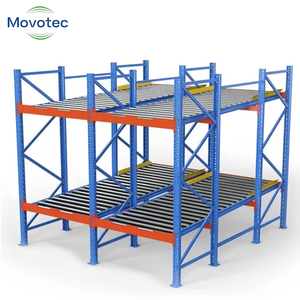
Warehouse Storage Racks Shelving Systems Pallet Rack Gravity Roller Flow Racking Movotec MTG100 1 Year Warranty
- Inventory Rule: FIFO Strict Rotation
- Roller System: Brake Rollers Included
- Incline Gradient: 3% - 4% Self-Driven
- Capacity / Lane: Up to 15 Pallets Deep
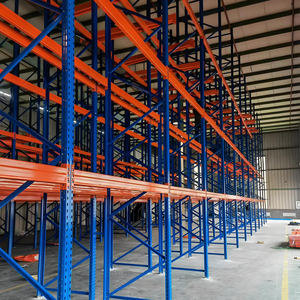
Heavy Duty Adjustable Cold Rolled Steel Warehouse Shelving Turnkey Storage Solution with 4000kg Capacity Easy Installation
- Tier Capacity: 4,000 kg Beam Level
- Structural Profile: Box Beam with 4 Claws
- Finish: Epoxy Polyester Powder
- Deflection Ratio: ≤ 1/200 Span Limit
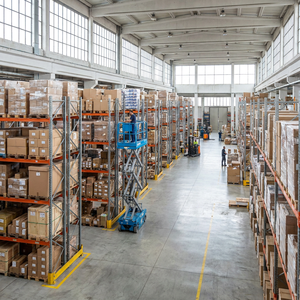
Professional Industrial Racking System Steel Warehouse Storage Equipment Supplier
- Engineering: Turnkey Layout & CAD
- Safety Standard: AS4084 / EN 15512
- Upright Section: 90mm / 100mm / 120mm
- Custom Finish: RAL Powder Coatings
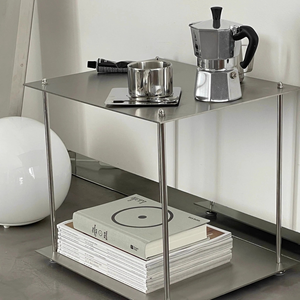
Stainless Steel Floor-Standing Multi-Tier Storage Rack Modular Bookshelf And Display Rack For Living Room Bedroom Study Room
- Material Type: SS304 / SS201 Alloy
- Corrosion Rating: Marine / High Humidity
- Shelf Options: Perforated / Solid Flat
- Modular Unit: Expandable bays
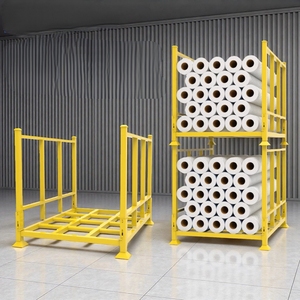
Removable Folding Stacking Rack Workshop Warehouse Cloth Rack Coiled Material Cloth Roll Stacking Rack Metal Folding Pallet
- Stackability: 4 - 5 Tiers Static Load
- Design Feature: Collapsible / Removable
- Handling: 4-Way Forklift Entry
- Storage Usage: Textile / Tires / Coils
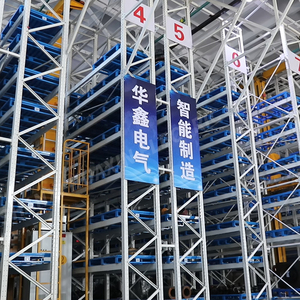
Smart Warehouse Robot Picking Systems Automated Storage Retrieval System Tool Storage System Asrs Shelving Rack
- Automation: ASRS Crane & AMR Picking
- Height Capacity: Up to 30 Meters High
- Control Logic: WMS / WCS Real-Time API
- Tolerance Class: EN 15620 Millimeter Class
Enterprise Strengths of China's Premier Racking Manufacturer
Operating from Guangzhou, South China, Guangzhou Heda Shelves Co., Ltd. has spent over two decades engineering advanced storage solutions for 3PL logistics, FMCG conglomerates, pharmaceuticals, chemical processors, and cold-chain facilities worldwide.
Industrial racking is the structural backbone of physical commerce. An engineered pallet rack does not merely hold goods; it mitigates seismic accelerations, survives aggressive daily forklift impacts, withstands corrosive warehouse atmospheres, and maximizes spatial volumetric density without compromising personnel safety. As a top China manufacturer and premier global exporter, HEDA Shelves maintains vertical integration across every stage of fabrication: from metallurgical coil verification and CNC punch profiling to multi-step chemical surface passivation and high-efficiency robotic welding.
Verifiable Engineering Certifications
Every structural profile is validated against stringent global load-bearing criteria. We hold CE Certificate No. 2435-CPR-8605159, ISO 9001:2015 Quality Management No. 18624Q00169R0M, and comprehensive RoHS chemical compliance documentation.
Full Structural CAD/3D Layouts Free
Our senior structural engineering division generates complete AutoCAD layout schematics, pallet beam calculations, bay deflection modeling, and dynamic 3D warehouse renderings at zero preliminary cost prior to contract commitment.
Export Logistics & Container Optimization
We leverage automated nest-loading algorithms to maximize 40ft High Cube (HQ) container cubing, reducing ocean freight costs per pallet position. Specialized protective steel crating protects powder-coated edges from maritime salt corrosion.
10-Stage Production Workflow: The Anatomy of High-Integrity Steel Racks
HEDA Shelves eliminates structural failure risks through strict in-house control. From mill-certified raw coils to final container packing, our 10-stage fabrication protocol enforces microscopic tolerances across every batch.
Coil Ingestion & QC
High-tensile Q235B and Q355B coils tested for yield strength and chemical composition.
Precision Slitting
Automated shearing lines cut coils to millimeter-exact widths for uprights and box beams.
CNC Column Punching
High-speed mechanical presses punch 50mm / 75mm tear-drop or butterfly pitch patterns.
Cold Roll-Forming
Up to 24 progressive continuous roller stations eliminate internal metal residual stresses.
Interlock Box Seaming
Twin-C profiles roll-interlocked and resistance seam-welded to create heavy-duty box beams.
Robotic Claw Welding
Multi-axis robotic arms weld structural 3-claw or 4-claw connectors to beam extremities.
Shot Blasting & Cleaning
Automated surface descaling to Sa 2.5 removes all mill scale, oxidation, and oil residues.
9-Stage Phosphatization
Pickling and silane-zirconium chemical conversion bath builds impenetrable anti-corrosion barrier.
Electrostatic Powder Cure
German Wagner automatic spray guns deposit 60-80µm epoxy powder, baked at 200°C.
Laser Deflection & Pack
Final CMM laser inspection, bundled in heavy-duty poly-wrap with protective timber cradles.
Future Sourcing & Procurement Trends in Industrial Storage (2025–2030)
An analytical overview for supply chain directors, industrial real estate developers, and operations executives navigating the evolving warehouse automation landscape.
1. The Transition from Static Storage to Autonomous Kinetic Ecosystems
The global warehousing landscape is witnessing an aggressive transformation driven by land scarcity, soaring metropolitan square-foot leases, and labor volatility. Traditional selective racking is increasingly being retrofitted or replaced with automated dynamic storage solutions. Sourcing strategies are moving toward hybrid architectures where conventional heavy-duty pallet racks serve as structural anchor bays for Autonomous Mobile Robots (AMRs), Automated Guided Vehicles (AGVs), and 4-way Radio Shuttles.
Procurement teams must specify racking systems with significantly tighter structural tolerance classes. While standard manual forklift racking allows operational tolerances within Class 400 (EN 15620), automation-ready racking demands Class 100 or Class 200 precision. This requires upright deflection limitations under full dynamic load to remain strictly under 1/350 of span width, compared to the conventional manual threshold of 1/200. Chinese manufacturers equipped with CNC automated roll-forming equipment, such as HEDA Shelves, provide this exact tolerance discipline without the prohibitive Capex overhead of European OEMs.
2. Total Cost of Ownership (TCO) vs. Initial Capital Outlay
Forward-thinking supply chain directors evaluate racking procurement not on ex-works steel tonnage prices, but through a rigorous 15-year Total Cost of Ownership (TCO) lens. The three main determinants of long-term racking durability are:
- Steel Grade & Elastic Limit: Utilizing Q355B (yield point ≥ 355 MPa) over generic mild steel allows down-gauging profile thickness while yielding superior impact absorption, cutting tare weight, shipping tariffs, and foundation slab stress.
- Surface Chemistry Longevity: Sub-standard dry powder coating on un-pickled steel leads to micro-cracking, under-film corrosion, and structural peeling within 36 months, especially in humid or cold-storage environments. Nine-stage pre-treatment ensures salt spray resistance exceeding 500 hours (ASTM B117).
- Modular Upgradability: Standardizing bay configurations with interchangeable beam connectors and standardized teardrop/wedge punch patterns allows warehouses to seamlessly add picking tiers, wire decking, pallet backstops, or structural mezzanine mezzanines without scrapping primary uprights.
3. Structural Resilience, Seismic Performance & Clad-Rack Systems
In earthquake-vulnerable zones across the Pacific Rim, South Asia, and the Americas, warehouse building permits demand rigorous non-linear dynamic seismic calculations. Modern procurement guidelines enforce strict verification of rack baseplate anchoring, ductile beam-end connector moment-rotation curves, and vertical cross-bracing. Furthermore, the market is adopting "Rack-Supported Buildings" (Clad-Rack Warehouses), wherein the pallet racking itself serves as the structural frame carrying the roof trusses and exterior wall cladding, cutting construction timelines by up to 40% and eliminating independent civil column grids.
| Storage System Type | Pallet Selectivity | Volumetric Density | Floor Utilization | Standard Forklift Access | Target Sector Application |
|---|---|---|---|---|---|
| Selective Pallet Racking | 100% Immediate | Moderate (40%) | Baseline (1.0x) | Standard Counterbalance, Reach | High-SKU 3PL, FMCG, E-Commerce Hubs |
| Double Deep Racking | 50% Semi-Direct | High (60%) | +30% vs. Selective | Deep-Reach Pantograph Forklift | Manufacturing Buffers, Raw Materials |
| Drive-In / Drive-Through | Low (LIFO / FIFO) | Maximum (75%) | +60% vs. Selective | Counterbalance Driving Inside Bays | Cold Storage, Beverage, Seasonal Batches |
| Radio Shuttle Automation | High Speed Batch | Extreme (85%) | +80% vs. Selective | Standard Forklift at Aisle Face + Shuttle | Deep Freezers, Dairy, Pharma Warehouses |
| Gravity Flow Pallet Rack | 100% Strict FIFO | Maximum (80%) | +70% vs. Selective | Loading Rear / Picking Front | Perishables, Fast-Moving Food, Pharma |
| ASRS High-Bay Racking | 100% Computerized | Extreme (90%+) | Vertical Space up to 40 Meters | Automated Stacker Cranes & AMRs | Gigafactories, High-Value Precision Hubs |
Engineering FAQ: Heavy-Duty Pallet Racking Procurement
Direct, highly granular answers to technical and commercial questions routinely raised by procurement directors, civil structural engineers, and facility planners.
What is the structural difference between steel grades Q235B and Q355B in racking design?
Q235B is an industry-standard carbon structural steel offering a minimum yield strength of 235 MPa and ultimate tensile strength of 370–500 MPa. It is optimal for standard pallet racking and light-to-medium industrial shelving. Q355B (equivalent to European S355 and ASTM A572 Grade 50) delivers a significantly higher yield strength of 355 MPa. In heavy-duty high-bay applications (uprights exceeding 10 meters, load capacities exceeding 4,000 kg per beam level, or seismic zones), specifying Q355B reduces overall steel profile thickness while providing higher structural ductility and impact resistance.
How are beam deflection limits calculated under European and Australian codes?
Under both EN 15512 and AS4084-2023, beam deflection under maximum design working load (safe working load + dead weight) must not exceed L/200 for standard pallet storage, where L represents the clear span of the horizontal beam. For automated systems, high-reach narrow aisle (VNA) trucks, or sensitive robotic interfaces, our structural engineers design to tighter limits of L/250 or L/300 to prevent dynamic sway, mast jamming, and sensor false-trips during high-speed pallet retrieval.
What warehouse floor slab criteria are necessary before upright anchor installation?
Warehouse concrete slabs should meet minimum compressive strength of C20/25 (25 N/mm²), with heavy-duty and high-bay installations requiring C28/35 or higher. Slab thickness must typically measure at least 150mm to 200mm to accommodate M10–M16 mechanical expansion wedge anchors or chemical anchor bolts. Slabs must also meet surface flatness standards such as DIN 18202 Table 3 Group 4 or TR34 FM2 for VNA turret truck navigation.
How does HEDA Shelves protect racks against high humidity, coastal air, and cold storage?
Prior to electrostatic coating, all steel components undergo a computerized 9-stage surface treatment including hot alkaline degreasing, acid pickling, silane-zirconium conversion coating, and high-purity water rinses. This maximizes powder adhesion. We utilize weatherable polyester and epoxy thermosetting powders cured at 200°C, producing a non-porous 60–80µm barrier. For cryogenic cold rooms (-30°C) or outdoor exposure, we provide continuous hot-dip galvanizing (HDG) per ISO 1461, yielding zinc coating thicknesses of 65–85µm.
What is the standard manufacturing lead time and container loading protocol?
Standard project production lead times range between 15 to 25 working days from engineering CAD sign-off, depending on total tonnage (e.g., 2–10 containers). Container packing is modeled via 3D loading software: upright frames are interleaved with corrugated card cushioning, beams are bundled in custom timber saddles, and fragile connectors are crated. This approach achieves 98%+ volumetric container utilization while facilitating rapid, damage-free offloading via forklift at destination ports.
Can HEDA Shelves provide on-site installation supervision and international certification dossiers?
Yes. Every export shipment includes full 2D assembly drawings, piece-marked structural component manifests, torque specifications, and step-by-step video installation guides. For multi-thousand-pallet distribution hubs, we deploy senior bilingual site installation supervisors to manage local rigging crews. Each completed project is provided with mill test certificates (MTCs), raw steel traceability logs, and formal CE compliance declarations.