Featured Industrial Pallet Racking & High-Load Frame Systems
Explore our precision roll-formed cold-rolled steel storage systems engineered for standard, narrow aisle (VNA), drive-in, dynamic push-back, and automated logistics warehouses globally.
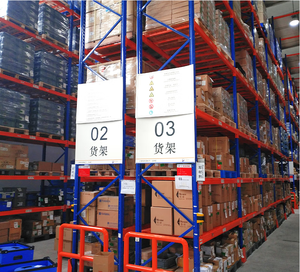
Yueyang Adjustable Heavy Duty Pallet Racking Cold Rolled Storage
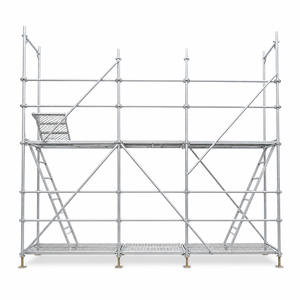
European Modern Style 500kg Load Multidirectional Warehouse Rack
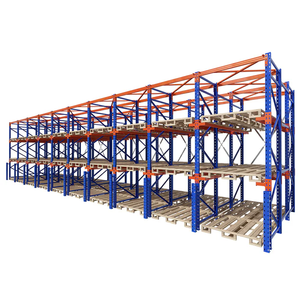
Cost-Effective Drive-In & Drive-Thru High-Density Storage Rack
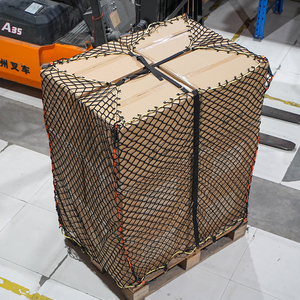
High-Strength Reusable Pallet Cargo Safety Containment Nets
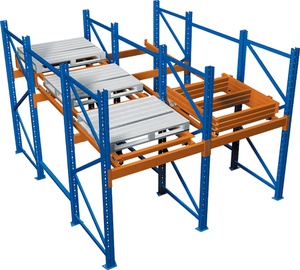
URGO Engineered Heavy Duty Push-Back Intensive Pallet System
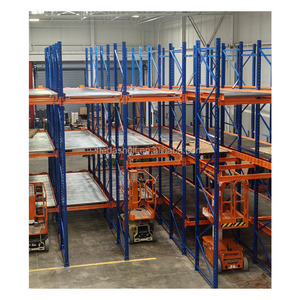
Heavy Duty Steel Gravity Flow Pallet Racking System FIFO
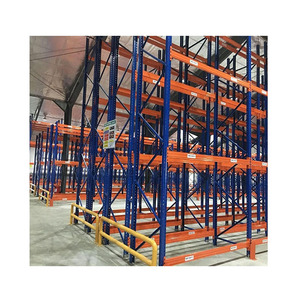
Industrial Galvanized Heavy Duty VNA / Double Deep Racks
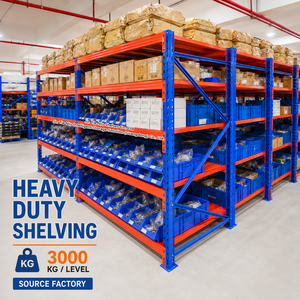
3000KG Custom Solid Steel Deck Storage Rack for Heavy Parts
Upright Frame Anatomy: Structural Mechanics, Steel Grades & Roll-Forming Physics
An authoritative engineering breakdown of pallet rack upright columns, diagonal bracing triangulation, Euler buckling constraints, and seismic load mitigation standards.
Omega (Ω) 13-Fold Profile Dynamics
The structural upright post is the critical vertical load-bearing member of any racking installation. Modern Chinese manufacturing utilizes advanced cold roll-forming with up to 13 to 18 rolling stages to create an Omega (Ω) continuous multi-flange section. This intricate geometry significantly elevates the post's moment of inertia ($I_x$, $I_y$) and torsional rigidity ($J$), effectively delaying the onset of torsional-flexural buckling under extreme axial compressive loads.
- High section modulus per kilogram of steel
- Mitigates local buckling around punch holes
- Dual-side return lips for high-stiffness beam lock
Metallurgical Selection: Q235B vs. Q355B
Choosing between structural steel grades dictates load capacity, material thickness, and ultimate project economics. Chinese top-tier mills (Baosteel, Shougang) provide prime hot-rolled coils slit to tight width tolerances. Standard applications deploy Q235B (Yield strength $f_y \ge 235 \text{ MPa}$, Tensile strength $370\text{--}500 \text{ MPa}$), whereas high-bay AS/RS systems and dense seismic installations demand Q355B (equivalent to ASTM A572 Gr 50 / S355JR with $f_y \ge 355 \text{ MPa}$), delivering a 51% yield improvement.
- Controlled elongation (>22%) prevents brittle fracture
- Strict chemical control of carbon, sulfur, phosphorus
- Certified Mill Test Certificates (EN 10204 3.1) standard
Triangulated Bracing & Baseplate Anchoring
An upright frame functions as a vertical truss. It consists of two cold-formed upright posts braced together via C-shaped horizontal and diagonal structural tubes fastened with high-tensile grade 8.8 zinc-plated hardware. The angle of inclination for diagonal bracings is mathematically optimized between $35^\circ$ and $45^\circ$ to minimize unbraced column length ($L_{cr}$), while heavy-gauge baseplates (4.0mm to 10.0mm) transfer concentrated point loads safely into the warehouse floor slab.
- M12 / M16 high-grade mechanical expansion or chemical anchors
- Seismic oversized baseplates with dual anchor slotting
- Precision CNC punching guarantees zero misaligned bolt holes
| Profile Model | Section Width × Depth | Material Thickness | Steel Grade | Max Load per Frame (1.5m Beam Pitch) | Standard Pitch Options | Target Compliance |
|---|---|---|---|---|---|---|
| HEDA 80M | 80mm × 60mm | 1.8mm – 2.0mm | Q235B | 8,000 – 11,500 kg | 50mm / 75mm | EN 15512 / ISO 9001 |
| HEDA 90M | 90mm × 70mm | 2.0mm – 2.3mm | Q235B / Q355B | 12,000 – 16,500 kg | 50mm / 75mm / 76.2mm | EN 15512 / ANSI MH16.1 |
| HEDA 100H | 100mm × 70mm | 2.0mm – 2.5mm | Q355B | 16,000 – 21,000 kg | 50mm / 75mm | AS 4084 / CE Marked |
| HEDA 120H | 120mm × 95mm | 2.5mm – 3.0mm | Q355B | 22,000 – 28,500 kg | 75mm / 76.2mm | Seismic Zone 4 / AS/RS |
| HEDA 140XH | 140mm × 120mm | 3.0mm – 3.5mm | Q355B | 30,000 – 40,000 kg | 75mm | Clad-Rack High-Bay |
Future Procurement & Technological Trends in Pallet Racking (2025–2030)
How automation integration, decarbonized steel supply chains, modular knocked-down logistics, and stringent structural safety codes are reshaping international warehouse procurement from China.
1. Automated AS/RS & High-Tolerance Specs
The global surge in automated storage and retrieval systems (AS/RS) and autonomous mobile robot (AMR) fleets demands millimetric upright frame tolerances. Deflection tolerances are tightening from $L/200$ to $L/500$ under full live payload. Chinese suppliers are investing heavily in automated continuous optical laser measurement on roll-forming lines to eliminate twist, camber, and bow across upright frame lengths reaching 24 to 30 meters.
2. Knocked-Down (KD) Freight Optimization
Ocean freight volatility has fundamentally transitioned upright frame procurement from pre-welded frames to bolted knocked-down (KD) configurations. A standard 40HQ container can accommodate only 80–110 assembled upright frames due to volumetric deadweight. Conversely, nesting unbolted Omega posts and bundled bracings achieves 25–27 metric tons container weight limit, packing up to 350–450 frame equivalents and slashing per-pallet landed logistics costs by up to 60%.
3. Rigorous Seismic & Dynamic Testing
Procurement directors increasingly reject static structural tables in favor of dynamic finite element modeling (FEM) validated by physical shake-table tests. Compliance with European EN 15512:2020 (which mandates partial factor safety design and stub-column testing) and US RMI MH16.1-2012 has become table stakes for Chinese exporters bidding on Tier-1 logistics hubs across seismic zones in North America, Japan, New Zealand, and Southern Europe.
4. Low-VOC & Pre-Galvanized Sustainability
Global ESG mandates require full disclosure of embodied carbon in warehouse structural steel. Top Chinese manufacturers are pioneering zero-heavy-metal chemical pre-treatment and low-temperature thermosetting epoxy-polyester powder coats emitting zero volatile organic compounds (VOCs). Additionally, pre-galvanized continuous slit strip coil is replacing traditional post-weld dipping for cold storage environments, providing 20+ years of rust protection without zinc dripping flaking.
Why Tier-1 Global Procurement Directs to Guangzhou Heda Shelves Co., Ltd.
Operating since 2001, Guangzhou Heda Shelves Co., Ltd. combines deep structural engineering acumen with full vertically integrated manufacturing across 30,000 square meters in South China.
25+ Years of Engineering Mastery
Founded in 2001, HEDA Shelves possesses over two decades of technical evolution in industrial storage systems, solving heavy-duty warehousing challenges across 120+ destination countries.
Free 3D & CAD Engineering Layout
Our dedicated team of 30+ licensed structural engineers provides comprehensive AutoCAD warehouse layouts, 3D renderings, and finite element frame capacity calculations within 24 hours.
Verifiable Global Certifications
Independently audited and certified by international bodies: CE Certification No. 2435-CPR-8605159, ISO 9001:2015 Quality Management No. 18624Q00169R0M, and comprehensive RoHS compliance.
OEM / ODM Profile Customization
Complete custom tooling capability. Whether matching legacy 76.2mm European teardrop patterns, specialized hook-in box beam brackets, or RAL project branding colors, we build to exact client specs.
The 10-Stage Controlled Production Process
Inside HEDA’s 30,000 m² Guangzhou production facility: rigorous mechanical and chemical QC checkpoints governing every upright frame and beam assembly.
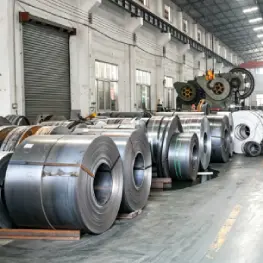
Raw Material Verification
Spectrometer chemical testing and tensile yield checks on every incoming steel batch.
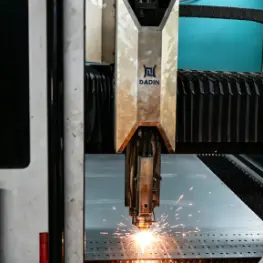
High-Precision Slitting
Automated uncoiling and precision slitting with width tolerances held to ±0.1mm.
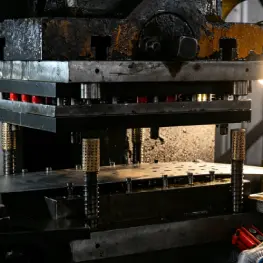
Automated CNC Punching
High-speed continuous mechanical press punching 50mm, 75mm, or teardrop pitches without burrs.
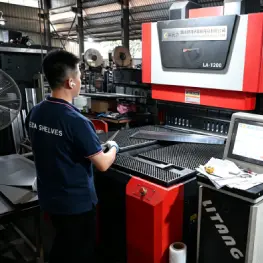
Progressive Cold Forming
16-roller continuous rolling forming lines eliminating internal residual strain.
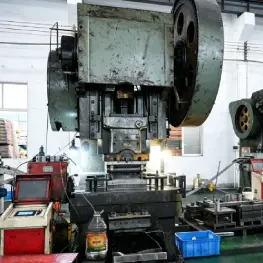
Omega Profile Calibration
Laser optical calibration verifies dimensional cross-sections and squareness.
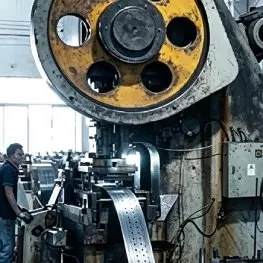
Automated Deburring
High-speed mechanical brushing strips sharp edges for worker safety during installation.
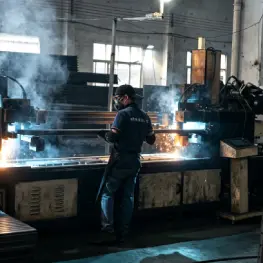
Robotic MIG/CO2 Welding
Robot-controlled multi-axis welding of beam end connectors and heavy baseplates.
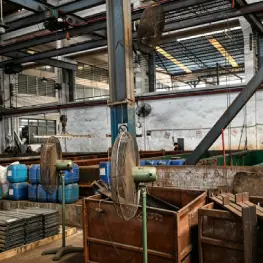
Pickling & Phosphating
Multi-stage immersion cleaning, degreasing, and zinc-phosphating creating superior adhesion.
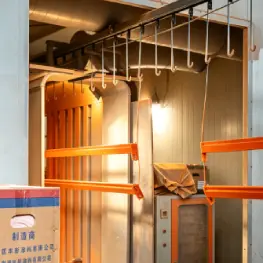
Electrostatic Coating
GEMA automatic powder spray guns delivering 60–90µm cured coating thickness at 200°C.
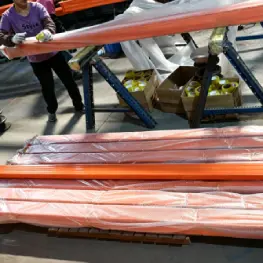
Final QC & Bundling
Cross-hatch adhesion checks, dry film thickness (DFT) logs, and container nesting strapping.
Auditable Global Testing Certifications
International tender documentation requires verifiable compliance. Our factory quality systems are maintained under continuous notified body oversight.
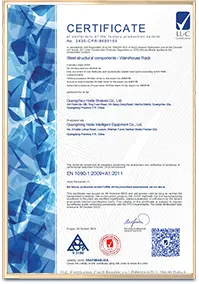
CE Structural Certificate
Registration No. 2435-CPR-8605159
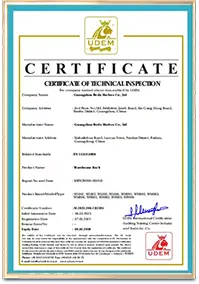
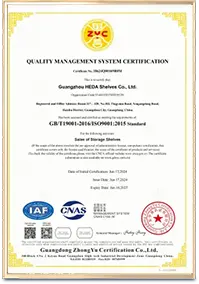
ISO 9001:2015 Management
Certificate No. 18624Q00169R0M
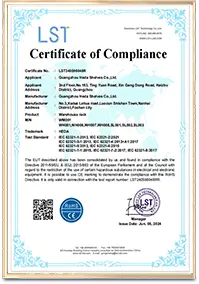
RoHS Chemical Safety
Eco-Friendly Powder & Pretreatment
Structural Load Verification
Stub-Column & Shear Testing Compliant
How Engineering Directors Audit Chinese Upright Frame Suppliers
Avoid catastrophic rack collapses and landed cost surprises by adopting this standardized four-phase quality verification protocol before signing purchase orders.
Phase 1: Mill Certificate Integrity
Never rely on generic spec sheets. Require original 3.1 Mill Test Certificates directly from the primary steel mill corresponding to the coil heat numbers used in your production run. Verify that carbon content is held below 0.20% and sulfur/phosphorus below 0.045% to guarantee clean cold bending without micro-fissures along the profile corners.
Phase 2: Tooling & Punch Pitch Accuracy
Punch pitch pitch accumulation errors can cause catastrophic misalignments over 10-meter frames. Demand optical measurement verification showing pitch variance does not exceed $\pm 0.5\text{mm}$ across a 1,000mm length. Inspect punched holes for uniform clearance, clean edges, and zero oil residue that could compromise powder coating adhesion.
Phase 3: Pre-Treatment & Salt Spray
Powder coating over raw or poorly cleaned steel leads to under-film corrosion within 24 months, particularly in coastal or unconditioned logistics facilities. Confirm that the supplier utilizes an 8+ stage chemical immersion (or spray) cycle including acid pickling and zinc phosphating. Require certified ASTM B117 salt spray test logs exceeding 500 hours without red rust.
Phase 4: Dunnage & Container Nesting
Upright posts that shift during transoceanic shipping suffer flange denting and paint abrasion. Audit the factory's export packing protocol: ensure heavy steel strapping with protective plastic corner guards, timber dunnage skids spaced every 1.5 meters, desiccants in maritime containers, and dedicated lifting slings for damage-free forklift unloading at port.
Frequently Asked Questions on Pallet Rack Upright Frames
Direct answers to the most frequent technical, structural, and contractual questions asked by commercial buyers, logistics consultants, and procurement managers.
How is the maximum permissible load of an upright frame determined?
The load capacity of an upright frame is not a static constant—it depends primarily on the first beam level height (unbraced length) and vertical tier spacing. According to EN 15512 and ANSI/RMI MH16.1 standards, as the distance from the floor slab to the first beam level increases, the effective column slenderness ratio increases, reducing the critical Euler buckling limit. For instance, a HEDA 90M upright post rated for 15,000 kg at a 1,500mm first-beam height may see its permissible load decrease to 11,800 kg if the first beam is elevated to 2,200mm to accommodate ground-level reach-truck picking. Capacity must always be calculated using finite element structural engineering based on your exact warehouse beam elevation drawings.
What is the standard hole pitch for upright frames, and can HEDA match existing racks?
Globally, three predominant punch hole pitches exist: 50mm (the European metric standard popularized by Dexion and FEM manufacturers), 75mm (common across Australia and South-East Asia under AS 4084), and 76.2mm / 3-inch (the North American standard used for Teardrop and Speedrack systems). Guangzhou Heda Shelves Co., Ltd. operates programmable CNC continuous punching dies capable of manufacturing exact 50mm, 75mm, and 76.2mm hole centers. If you are extending an existing warehouse installation, our engineering department can duplicate your legacy profile geometry, connector hooks, and safety pin positions from a physical sample or technical drawings.
Should we procure Knocked-Down (KD) bolted upright frames or fully welded frames?
For international sea freight shipments, Knocked-Down (KD) bolted frames are strongly recommended. A welded frame takes up excessive volume in an ocean container, causing you to pay heavy freight rates on mostly empty air (container cubing out at only 10–12 tons). Bolted frames pack completely flat: upright posts are nested in dense steel-strapped bundles, and bracing tubes are palleted compactly, allowing buyers to hit the full 26-ton container payload. Structurally, modern bolted frames using Grade 8.8 flange locking bolts meet or exceed welded frame capacity under EN 15512 because the bolted joints accommodate minor cyclic flexing without weld heat-affected zone (HAZ) fatigue.
How do you guarantee corrosion protection for coastal or cold storage applications?
Standard indoor warehousing utilizes an 8-stage chemical acid pickling and zinc-phosphating conversion pre-treatment followed by thermosetting electrostatic epoxy-polyester powder coating (thickness 60–90 microns). For high-humidity coastal zones (e.g., Chennai, Chattogram, Colombo, Manila) or low-temperature food cold storage facilities (-25°C to -30°C), thermal condensation will cause powder-coated steel to rust if chipped. In these scenarios, HEDA Shelves provides continuous pre-galvanized coil uprights (Z275 coating) or complete hot-dip galvanized (HDG) post-weld components compliant with ISO 1461, delivering over 65–85 microns of sacrificial zinc protection for decades of rust-free operation.
What engineering information is required to receive a formal CAD layout and quotation?
To prepare an accurate structural design and commercial proposal, our engineering team requires:
1. Architectural warehouse drawing (CAD or dimensioned PDF) indicating column grids, clear height under roof joists, and emergency egress doors.
2. Pallet specifications: width, depth, overall height including cargo overhang, and maximum gross weight per pallet.
3. Material handling equipment (MHE) data: forklift model, mast collapsed height, maximum fork elevation, and manufacturer-specified minimum aisle turning radius (AST).
4. Environmental factors: site geographic location for seismic ground acceleration coefficients ($S_s, S_1$) and concrete slab thickness/reinforcement rating.
How does HEDA handle international shipping, customs documentation, and assembly?
HEDA exports containerized racking systems on FOB, CIF, or DDP Incoterms to over 120 countries. All components are clearly tagged with waterproof part number labels matching the enclosed installation blueprint. Shipments are accompanied by certified commercial invoices, packing lists, Mill Test Certificates (EN 10204 3.1), Certificates of Origin (CO, Form E, or RCEP for duty concessions), and full structural installation 3D manuals and video guides. For high-bay or large-scale projects, we can deploy HEDA supervising engineers on-site to oversee local assembly contractors and conduct final load plaque sign-off.