[email protected] Serving India · Bangladesh · Pakistan · Sri Lanka · Nepal
English (South Asia)
Industrial Storage Engineering White Paper

Top 10 Shelving For Warehouse Racking Supplier & Suppliers

An authoritative engineering assessment of structural capacities, Q235B cold-rolled steel integrity, automated intralogistics compatibility, and global vendor procurement frameworks.

Precision Engineered Systems

Factory-Engineered Warehouse Shelving & Industrial Racks

High-density pallet racking, boltless industrial shelving, and heavy-duty structural decks certified to CE, ISO 9001:2015, and FEM specifications for harsh logistics environments.

25+
Years In-House Manufacturing
30,000 T
Monthly Cold-Forming Capacity
120+
Global Export Destinations
100%
CE & ISO 9001 Certified Traceability
Procurement Governance

Engineering Evaluation: How to Benchmark Top 10 Shelving & Racking Suppliers

Industrial buyers frequently encounter disastrous deflection rates, bolt slippage, and premature paint peeling caused by low-grade re-rolled scrap steel and absent pretreatments. Evaluating high-tier suppliers requires an objective structural audit.

1. Steel Quality & Certified Yield Strength

Top-tier racking suppliers construct uprights and load-bearing beams exclusively from certified Q235B or Q355B cold-rolled carbon steel. Mill test certificates (MTC) must document uniform tensile strength, carbon equivalence beneath 0.22% for secure crack-free welding, and yield points exceeding 235–355 MPa without micro-voids.

2. Roll-Forming Precision & Upright Section Geometry

The structural capacity of high-bay uprights relies on the number of roll-forming passes. Leading suppliers use 18 to 24 continuous forming stations to yield multi-ribbed Omega (Ω) profiles that prevent local torsional buckling under concentrated load conditions.

3. Pretreatment Chemistry & Powder Deposition

Uncompromising suppliers run automated multi-stage immersion: ultrasonic alkaline degreasing, clean-water rinses, zinc phosphating, and deionized passivating. Electrostatic deposition creates an 80–120μm cured epoxy-polyester shell that survives 500+ hours of continuous ASTM B117 salt spray exposure.

Engineering Matrix: Industrial Shelving vs. Heavy Pallet Racking

Storage Architecture Typical Beam / Shelf Capacity Standard Steel Grade Handling Interface Target SKU Velocity Structural Compliance
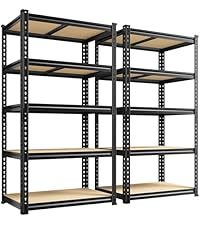
Light Boltless Rivet Shelving 150 – 300 kg / level Q195 – Q235 Cold Rolled Manual Cartons / Bins High Picking Density ANSI MH28.1
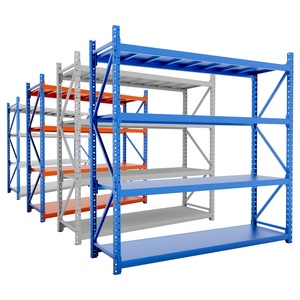
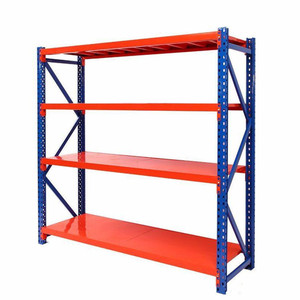
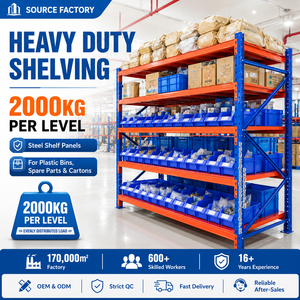
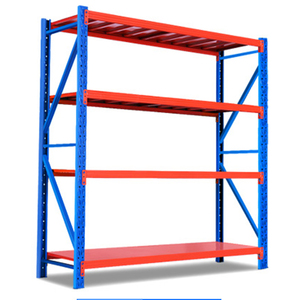
Heavy-Duty Longspan Shelving 500 – 1,200 kg / level Q235B Solid Structural Manual / Order Picker Medium / High FEM 10.2.06
Selective Pallet Racking 1,000 – 4,500 kg / pair Q235B / Q355B Formed Counterbalance / Reach Truck 100% Direct Selectivity RMI / EN 15512
Radio Shuttle High-Density 1,500 kg / pallet slot Q355B Heavy Gauge Rail Automated Robot Shuttle Deep Lane FIFO / LIFO FEM 10.2.02 Automated
Multi-Tier Mezzanine Platform 300 – 1,000 kg / m² Q235B Beam & I-Section Pedestrian, Forklift, AGV Multi-Level Processing EN 1090-2 / CE Class 2
Forward-Looking Intelligence

Future Procurement Trends in Warehouse Racking & Industrial Shelving

Logistics supply chains are undergoing permanent realignments influenced by omnichannel compression, urban fulfillment land scarcity, autonomous robotics, and ESG governance.

Automation-Ready Hybrid Topologies

Global procurement teams are shifting away from standalone static racking. Modern requests for proposals (RFPs) mandate that traditional selective racks incorporate modular running tracks for Autonomous Mobile Robots (AMRs), guide rails for Very Narrow Aisle (VNA) robotic turrets, and mounting nodes for automated conveyor pick modules.

Seismic Performance & Dynamic Fatigue Design

With warehouse footprints expanding into seismically sensitive subduction zones across South Asia, the Middle East, and the Pacific Rim, rack specifications now demand finite element analysis (FEA) testing under cyclic seismic acceleration. Dynamic simulations evaluate post-elastic frame behavior and floor baseplate shear capacity.

Low-VOC Formulations & Recycled Green Steel

Carbon footprint transparency is rapidly becoming a gating criterion for Fortune 500 supply chain bids. Enterprise procurement mandates supplier verification of EPD (Environmental Product Declarations), electric arc furnace (EAF) steel sourcing, and heavy-metal-free, zero-VOC thermoplastic powder formulations.

Engineering Evolution

The Structural Evolution of Shelving & Racking Systems

From rudimentary slotted angle bars to multi-tier smart vertical distribution platforms, engineering advancements continue to maximize cubic utilization while reducing structural steel tonnage.

High-Yield Cold Roll Forming vs. Heavy Hot-Rolled Sections

In early industrial warehouse design, heavy structural hot-rolled channels were standard. While rigid, their high self-weight placed immense point loads on unreinforced floor slabs and inflated ocean freight costs. Modern computer-controlled roll-forming lines bend high-strength steel sheets (Q235B/Q355B) through consecutive forming passes, introducing strengthening cold work into the corner radii.

The resulting Omega sections provide higher second moments of area (Ix and Iy) at a 30% to 45% reduction in dead weight. This maximizes live storage capacity without overloading standard 150mm to 200mm industrial concrete slabs.

Critical Evolutionary Milestones

  • Phase 1: Slotted Angle Iron (1960s-1980s): Bolted configurations, low load limits (<100kg), extensive assembly labor.
  • Phase 2: Welded Structural Racks (1980s-2000s): Fixed bay dimensions, high shipping costs, zero reconfiguration flexibility.
  • Phase 3: Hook-in Teardrop & Diamond Connectors (2000s-2015): Rapid tool-free beam adjustment with safety locking pins.
  • Phase 4: Sensor-Embedded High-Density Dynamic Racking (Present): Radio shuttle integration, automated pallet flow speed governors, optical deflection sensors.
Manufacturing Rigor

Factory Direct Advantages: Guangzhou Heda Shelves Co., Ltd.

With over two decades of technical mastery, Heda Shelves operates as an integrated Tier-1 manufacturing partner, executing layout planning, structural engineering, and automated fabrication under unified quality controls.

Verifiable International Accreditations

We operate in strict conformity with CE Certificate No. 2435-CPR-8605159 and ISO 9001:2015 Quality Management Registration No. 18624Q00169R0M (valid through June 2027), ensuring auditable quality compliance.

30,000 m² Scale & 30,000 Ton Monthly Volume

Our expansive South China manufacturing center runs automated multi-spindle punching machines, robotic continuous welders, and automated powder lines to guarantee on-time container despatches for large-scale logistics developments.

Complimentary 3D CAD & Structural Calculations

Our 300+ engineering and technical staff deliver bespoke CAD architectural layouts, load capacity tables, and 3D warehouse renderings within 24 hours of receiving site dimensions, column offsets, and pallet specs.

Proprietary 10-Stage Precision Production Workflow

Every beam, upright column, and wire deck is tracked through a 10-phase quality management protocol:

01

Raw Materials

Spectrometer analysis of certified prime steel coils upon arrival.

02

Steel Slitting

High-tolerance longitudinal shearing to precise strip dimensions.

03

CNC Punching

High-speed continuous perforation for consistent connector pitches.

04

Roll Forming

Multi-stage cold bending with up to 24 progressive passes.

05

Precision Cut

Hydraulic flying shear cutting to exact project architectural heights.

06

Surface Deburring

Automated edge grinding and weld preparation on all corners.

07

Robotic Welding

Gas-shielded CO₂ welding of connector claws to box beams.

08

Pretreatment

Alkaline degreasing, clean rinse, acid pickling, and zinc phosphating.

09

Powder Coating

Automated electrostatic spray with 200°C curing for 80-120μm finish.

10

QC & Bundling

Destructive load batch testing, moisture wrap, and sea bundling.

Procurement Risk Mitigation

Frequently Asked Questions (FAQ) on Warehouse Shelving & Racks

Essential technical, logistics, and commercial answers for project managers, 3PL directors, and engineering procurement teams.

How do we calculate required load capacity per pair of racking beams?

The beam capacity must support the maximum gross weight of all pallet loads positioned on that level, plus a statutory safety margin of 1.5 (per FEM / RMI standards). For example, a 2-pallet beam holding two 1,200 kg pallets requires a certified uniform distributed load (UDL) of at least 2,400 kg with maximum vertical deflection under load limited to L/200.

What is the structural difference between Q235B and Q355B steel in racking?

Q235B provides a minimum yield strength of 235 MPa, serving as the international benchmark for medium-duty shelves and standard selective racking up to 8 meters high. Q355B features an elevated yield point of 355 MPa, specified for high-bay racks (>10 meters), automated clad-rack warehouses, and cold storage environments where high stress loads require reduced profile thickness without sacrificing ductility.

How are upright frames protected against forklift impact damage?

Impact mitigation involves three layers: corner column guards manufactured from 5mm structural steel anchored directly to the slab, heavy-duty tubular aisle-end barriers that shield the entire frame depth, and internal post stiffeners welded inside the bottom 1,000mm of the Omega upright channel where collision risks are highest.

What container packaging methods protect racking components during ocean transit?

To prevent in-transit rubbing and moisture-induced coating damage, components are segregated with non-marking corrugated cardboard, banded with high-tension steel straps, and wrapped in heavy-duty polyethylene stretch film. Structural uprights and long beams are fitted with timber dunnage skids to allow direct forklift offloading from 40-foot high-cube shipping containers.

Can wire mesh decking replace solid steel shelf panels for fire code approval?

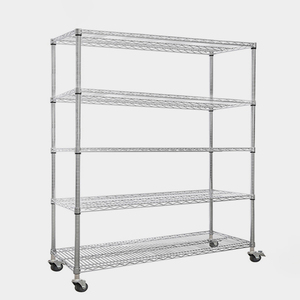
Yes. In most jurisdictions governed by NFPA 13 sprinkler regulations, solid steel or plywood shelving creates dry shadows beneath lower tiers during a fire. Open wire mesh decking (typically 50x100mm grid) provides a 70%+ open area, allowing overhead fire suppression water to penetrate lower storage levels, while preventing dust buildup.

What site information is required to receive a free engineered CAD layout?

To deliver an accurate 24-hour CAD layout and structural quotation, our engineering team requires: (1) warehouse architectural drawing with building columns and door locations, (2) clear ceiling height beneath sprinklers, (3) pallet dimensions (width, depth, overall height with load) and weight, (4) forklift turning radius and maximum mast lift height, and (5) project location for regional seismic codes.

Direct Engineering Assistance

Consult Our Factory Racking Engineers for Your Next Facility

Whether you require 100 bays of heavy longspan shelving, a multi-tier structural mezzanine platform, or high-density radio shuttle racking, our senior design team delivers custom CAD drawings and structural capacity evaluations within 24 hours.

Request Technical Evaluation

Connect with a storage structural specialist for complimentary layout optimizations and factory-direct container quotations.

Contact Us