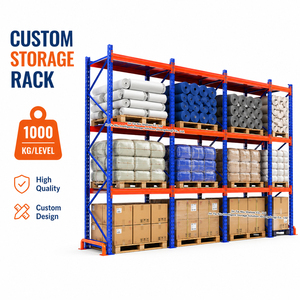
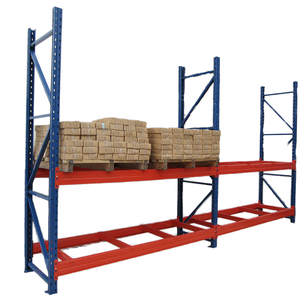
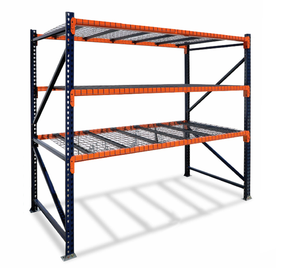
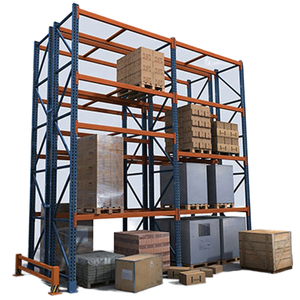
Precision-engineered using high-yield structural steel profiles (Q235B / Q355B). Designed for maximum spatial efficiency, seismic resistance, and heavy unit loads ranging from 1,000 kg to 4,000 kg per level.
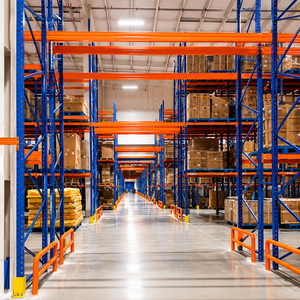
In modern industrial logistics, the structural integrity of heavy-duty pallet racks is the cornerstone of warehouse safety, asset preservation, and high-velocity order fulfillment. As global real estate costs escalate, supply chain executives, warehouse directors, and intralogistics engineers are forced to utilize every millimeter of vertical cube space. Modern high-bay warehouses routinely stack pallet loads weighing up to 2,000 kg each to elevations exceeding 12 to 16 meters. This level of physical stress creates massive static and dynamic structural forces that demand rigorous structural calculation.
A heavy-duty industrial pallet rack is not merely an assembly of steel channels; it is an engineered space-frame structure subject to compression buckling, frame sway, shear deformation, seismic excitation, and forklift collision dynamics. The engineering criteria governing modern racks are strictly regulated worldwide by specifications such as EN 15512:2020 (European standard for cold-formed steel racking systems), RMI MH16.1 (Specification for the Design, Testing, and Utilization of Industrial Steel Storage Racks in North America), and AS 4084:2023 (Australian Steel Storage Racking code).
Industrial procurement teams frequently encounter vast price disparities when evaluating proposals from European brand integrators versus direct-manufacturing steel mills. Navigating this marketplace requires clear insight into the world's leading racking manufacturers, their proprietary roll-forming profiles, testing regimes, and factory automation pipelines.
An independent engineering evaluation of the global leaders in industrial steel storage manufacturing, comparing factory automation, standard compliances, custom capabilities, and cost efficiency.
Founded in 2001, Guangzhou Heda Shelves has evolved into an engineering powerhouse in heavy-duty industrial pallet racking and mezzanine platforms. Operating a state-of-the-art 30,000 m² automated production facility with a 30,000 metric ton monthly steel transformation capacity, HEDA controls the complete value chain in-house. From uncoiling certified structural hot/cold rolled steel coils (Q235B / Q355B), CNC multi-stage punching, precision roll-forming of omega uprights and box beams, to automated robotic welding, 8-stage pickling and phosphating, and electrostatic powder coating. By eliminating EPC intermediaries and distributor markups, HEDA delivers international-standard compliant systems (CE 2435-CPR-8605159, ISO 9001:2015) with optimized container nesting directly to global ports.
SSI Schaefer is a global benchmark in automated intralogistics and heavy-duty static racking systems. Renowned for massive automated high-bay warehouses (rack-clad buildings) where the racking framework serves as the structural support for the building envelope. Schaefer provides exceptional metallurgical consistency, tight profile tolerances, and seamless compatibility with Automated Storage and Retrieval Systems (ASRS). Ideal for massive multi-million dollar automated logistics centers with long design cycles.
Operating across Europe and the Americas, Mecalux is a recognized authority in selective pallet racking, mobile base racks (Movirack), and automated pallet shuttle systems. Their proprietary calculation algorithms rigorously balance beam deflections (L/200) against seismic and live wind loadings. Mecalux combines physical cold-formed steel manufacturing with its in-house Easy WMS software package, catering to FMCG and industrial distribution complexes.
Inventors of the slotted angle concept that evolved into modern industrial shelving and racking, Dexion is an integral brand within Gonvarri Material Handling. Their flagship Speedlock pallet racking series offers standardized engineering profiles, exceptional beam-to-column locking strength, and high modularity. Dexion solutions are engineered to withstand strict European seismic zones, prioritizing long-term modular reconfigurability.
Daifuku is the undisputed global revenue leader in total material handling automation. In heavy-duty racking, Daifuku specializes in ultra-precise structural frameworks designed for high-speed automated stacker cranes and earthquake-resistant high-density warehouses. Japanese engineering ensures tight structural tolerances (sub-millimeter vertical plumbness), critical for semiconductor cleanrooms and advanced automotive assembly plants.
Unlike manufacturers relying primarily on roll-formed sheet steel, Frazier pioneered the use of 100% structural steel channel (ASTM A36 / A572 Grade 50) for heavy industrial applications. Their heavy structural steel frames offer extreme resistance to forklift impact, catastrophic overload, and sub-zero temperatures, making them a fixture in American refrigerated food distribution, heavy manufacturing, and beverage processing.
Stow has built an extensive European manufacturing network with automated production lines turning out cold-formed racking beams and uprights. Their Stow Atlas pallet shuttle system is widely deployed in high-density European grocery logistics. Stow emphasizes lean engineering designs that optimize steel gauge thickness against critical yield points, delivering efficient standard selective and dynamic racking.
Jungheinrich occupies a unique market position by manufacturing both the material handling equipment (turret trucks, reach trucks, order pickers) and the physical racking structures. This enables end-to-end optimization of Very Narrow Aisle (VNA) systems, inductive wire guidance tolerances, aisle clear margins, and mast deflection interaction during high-level reach cycles.
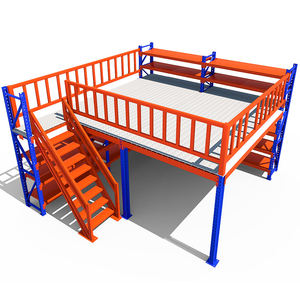
Now a subsidiary of steel giant Voestalpine, Nedcon focuses on complex, bespoke engineered storage systems. They excel in rack-supported multi-tier platforms, complex automated mini-load systems, and high-precision warehouse racking. Nedcon is the engineering contractor of choice when warehouse layouts feature irregular column layouts, extreme ceiling height variations, or unique building footprints.
BITO is known for extreme structural precision in cold-formed shelving, flow racks, and heavy-duty pallet racking systems. Their PRO pallet rack system emphasizes simplified, boltless assembly, ergonomic picking accessories, and high-efficiency dynamic flow lanes. BITO maintains strong market penetration across industrial manufacturing assembly lines, retail distribution, and pharmaceutical packaging facilities.
Benchmarking core production metrics, material specifications, standard compliance, and lead times across the leading industrial pallet rack manufacturers.
| Manufacturer | Primary Steel Grade | Core Standards | Factory Footprint | Monthly Output | Procurement Route |
|---|---|---|---|---|---|
| HEDA Shelves | Q235B / Q355B | CE, ISO 9001:2015, RoHS | 30,000 m² (Guangzhou) | 30,000 Tons | Direct Factory OEM/ODM |
| SSI Schaefer | S235JR / S355MC | EN 15512, FEM 10.2.02 | Multi-Continental | 50,000+ Tons | Turnkey EPC Integrator |
| Mecalux | S275JR / Structural ASTM | RMI MH16.1, EN 15512 | 11 Facilities Globally | 40,000 Tons | Direct & Dealer Network |
| Dexion (GMH) | High-Yield Cold Formed | FEM, EN 15512, AS 4084 | Germany, Romania, Malaysia | 25,000 Tons | Certified Distributors |
| Daifuku | SS400 / High-Tensile JIS | JIS B 8941, ISO 9001 | Japan, China, USA | Proprietary Integration | Direct Automation Division |
| Frazier Industrial | Hot-Rolled Structural C-Channel | AISC, RMI MH16.1 | 10 Plants Across USA/MX | 20,000 Tons | Direct Enterprise Contract |
| Stow Group | Cold-Rolled Structural Coil | EN 15512, ISO 9001 | 9 European Facilities | 35,000 Tons | Distribution & Direct |
| Jungheinrich | DIN EN 10025 Certified | FEM, RAL-RG 614 | Moosburg, Landsberg | 15,000 Tons | Direct System Sales |
| Nedcon (Voestalpine) | Custom European Structural | EN 15512, Eurocode 3 | Netherlands, Pardubice | 18,000 Tons | Custom Engineering Bid |
| BITO-Lagertechnik | High-Grade Cold-Strip Steel | RAL Quality Mark, FEM | Germany, Poland | 12,000 Tons | Catalog & Direct Sales |
Bridging the gap between strict Western structural design codes and cost-optimized, high-capacity Chinese manufacturing pipelines.
Established in 2001, HEDA Shelves maintains a staff of 300+ structural engineers, CAD technicians, and certified welders. Having successfully delivered over 10,000 warehouse projects across 120+ countries, our engineering department designs tailored solutions based on actual warehouse floor slabs, seismic zone mapping, and dynamic forklift characteristics.
HEDA's manufacturing pipeline is governed by audited quality management systems. We hold authentic CE Certification (No. 2435-CPR-8605159), ISO 9001:2015 (No. 18624Q00169R0M), and RoHS compliance. Every production run undergoes tensile testing, weld penetration ultrasonic checks, and dry-film thickness (DFT) verification before container dispatch.
From the uncoiling of certified steel coils to CNC cold-roll profile bending, automated hole pitch punching (50mm/75mm adjustable pitch), robotic welding of connector claws, and an automated continuous powder-coating line, our 30,000 m² factory eliminates third-party manufacturing dependencies and price markups.
Unlike trading entities that outsource production to disparate workshops, HEDA enforces strict metallurgical traceability across 10 distinct in-house manufacturing stages:
Certified mill test certificates (MTC) verification and spectrometry checks for Q235B/Q355B coil yield strength.
Continuous automatic punching of teardrop or diamond upright slots with sub-millimeter pitch accuracy.
Gradual multi-roller profiling of omega upright sections and interlocking box beams to maximize section modulus.
8-stage chemical immersion bath eliminating mill scale and rust, creating a microscopic phosphate bonding layer.
Automated gas metal arc welding (GMAW) of 3-prong and 4-prong high-tensile beam end connectors.
Automated powder application curing at 200°C for a durable, impact-resistant 60–80μm protective finish.
Hydraulic test rigs evaluate beam deflection limits (L/200 standard) and upright residual stress points.
Specialized bundling designs maximizing container payload (20GP/40HQ), saving 18–25% in ocean freight costs.
How corporate procurement managers, supply chain directors, and warehouse architects are transforming their equipment sourcing strategies.
Global logistics operators are moving away from traditional local turnkey dealers who add 35% to 60% margins on steel structures. Large-scale 3PLs and distribution centers now work directly with certified overseas manufacturing plants like HEDA Shelves. By pairing digital BIM models and cloud CAD exchanges with direct ocean freight, enterprises achieve substantial capital expenditure reductions without sacrificing structural safety.
Standard solvent spray coatings are proving inadequate in coastal, tropical, and sub-zero cold chain facilities. Industrial buyers now demand audited pretreatment specifications. Chemical pickling and phosphating prior to electrostatic powder application—or continuous pre-galvanized / hot-dip galvanized finishes (HDG)—are becoming baseline requirements to prevent structural corrosion from coastal humidity, condensation, and chemical vapors.
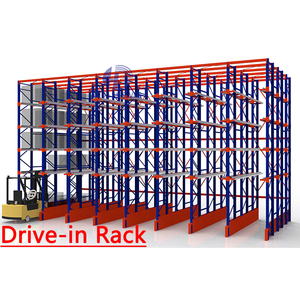
Full ASRS automation carries high capital costs and rigidity. Procurement trends are pivoting toward "Automation-Ready" selective and drive-in racks that can be retrofitted with autonomous radio shuttles, AGV reach trucks, or continuous conveyor spurs. Specifying rack uprights with tight roll-forming tolerances (±0.5mm) and standardized pallet rail supports protects capital investments against future operational changes.
The global steel industry has advanced significantly beyond generic hot-rolled carbon steel. Advanced pallet rack roll-formers now utilize high-strength micro-alloyed steels (such as Q355B, S355MC, and ASTM A1011 Grade 50) enriched with trace amounts of niobium, vanadium, and titanium. These micro-alloys enhance yield strength to over 355 MPa while retaining sufficient ductility for complex cold-forming bends without micro-fracturing along the profile corners. This allows manufacturers to reduce overall structural deadweight while increasing total frame load-carrying capacity.
Physical prototype destructive testing is now supported by advanced non-linear Finite Element Analysis (FEA). Software models simulate complex structural phenomena, including second-order P-Delta sway effects, torsional-flexural buckling, beam end connector rotational stiffness, and seismic base plate uplift. At HEDA Shelves, structural engineers use advanced simulation suites to optimize column slot patterns and baseplate anchoring configurations for project-specific seismic ground accelerations.
Forklift impacts represent the single greatest operational threat to industrial rack safety. Next-generation facilities are integrating IoT-enabled wireless strain gauges and 3-axis accelerometer impact sensors directly onto lower upright column guards. When an impact exceeds allowable threshold values (typically exceeding 50 Joules of kinetic energy absorption), the sensor instantly flags the damaged bay via telemetry to the facility management system, initiating immediate inspection before structural failure can occur.
Key structural, logistics, compliance, and installation questions answered by HEDA's Senior Technical Engineering Department.
Allowable beam capacity is governed by both structural yield strength and serviceability deflection criteria. Under European standard EN 15512 and RMI MH16.1, maximum allowable vertical deflection under uniformly distributed load (UDL) must not exceed L/200 (span length divided by 200). A safety factor of at least 1.5 to 1.95 against structural yield failure is factored into calculation sheets, accounting for dynamic loading effects during pallet drop cycles.
Before issuing structural shop drawings, engineers require: (1) Concrete slab compressive strength (typically C20/25 to C30/37 or 3,000 to 4,000 PSI), (2) Concrete slab thickness (commonly 150mm to 250mm), (3) Single or double layer rebar mesh layout, and (4) Maximum allowable point-load capacity (kN per baseplate). This data governs baseplate dimensions, anchor bolt diameter, chemical vs. mechanical expansion anchoring, and load-spreading shim design.
Bare cold-rolled steel carries drawing oils and surface oxidation. If powder coating is applied directly over untreated steel, moisture penetrates micro-pores, causing filiform corrosion and premature coating delamination. Quality manufacturers use a multi-stage automated immersion bath process: degreasing, hot water rinse, acid pickling (rust removal), cold water rinse, phosphate conversion coating (creating an insoluble crystalline iron/zinc phosphate substrate), and final passivation before electrostatic powder application.
To clear customs and meet local building safety regulations, buyers must verify: (1) Mill Test Certificates (MTC) showing raw steel chemical composition and tensile yield, (2) Authentic CE Declaration of Conformity and ISO 9001:2015 registration, (3) Stamped structural calculation sheets, (4) Detailed CAD assembly drawings with clearly numbered profiles, and (5) Non-wooden or fumigated pallet packing declarations under ISPM 15 standards.
Pallet rack components are dense and lengthy. Inefficient packing can result in empty container space or exceed 40HQ payload weight limits (typically 26–28 metric tons). HEDA's engineering team prepares specialized 3D container loading diagrams for every export project. Uprights and box beams are bundled in custom steel bands with protective corner angles, allowing safe mechanical loading and unloading via forklift booms while maximizing container volume utilization.
In high seismic zones (such as UBC Zone 3/4 or Eurocode 8 high-ground acceleration areas), pallet racks experience large horizontal lateral shear forces. Structural adjustments include: (1) Enlarged footplates with multiple heavy-duty anchor embedments, (2) Heavier steel gauge on lower upright sections, (3) Vertical and horizontal spine bracing trusses, and (4) Upgraded 4-hook or bolted connector assemblies with enhanced rotational moment resistance.