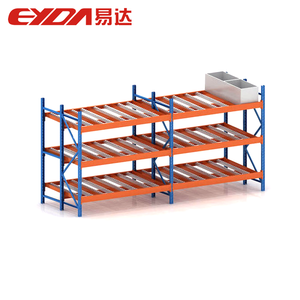
High Quality Steel 5 Layer Adjustable Warehouse Carton Flow Racking
Multi-tier gravity roller track picking system designed for rapid split-case dispatch. Integrated aluminum roller beds provide seamless FIFO order fulfillment.
High-density gravity flow racks, heavy-duty carton live picking rails, and structural pallet solutions manufactured to custom technical parameters for high-velocity distribution centers and cold chain hubs.
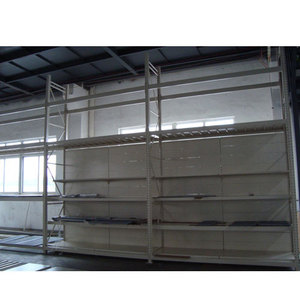
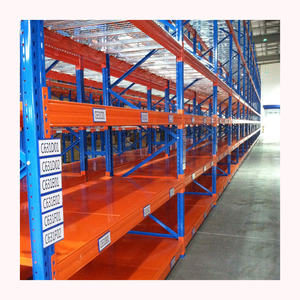
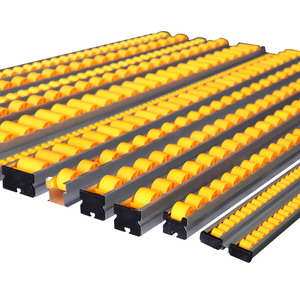
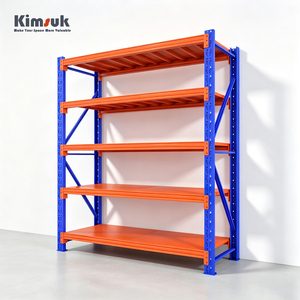
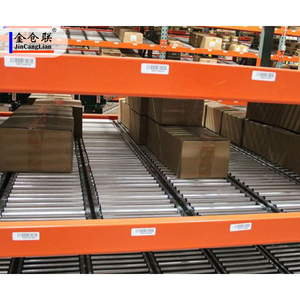
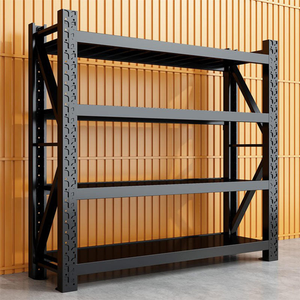
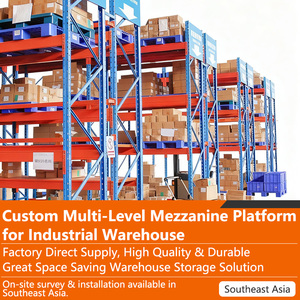
In high-throughput distribution environments where inventory freshness, stock velocity, and cubic storage density are mission-critical, conventional selective racking fails to maximize floor space. Roller pallet racking systems—frequently referred to across material handling disciplines as gravity pallet flow systems, dynamic live storage, or roller conveyor racking—operate on a zero-energy, gravity-driven First-In, First-Out (FIFO) paradigm.
As an OEM/ODM manufacturing partner, engineering a robust gravity flow system requires far more than merely fastening steel channels together. The dynamic interaction between rolling friction, pallet bottom deflection, gradient deceleration, and hydraulic brake dampening demands strict kinetic calculation:
Kinetic Gradient Optimization Rule: For standard wooden pallets weighing between 500 kg and 1,500 kg, the optimal incline slope is calibrated precisely between 2.8% and 3.5% (1.6° to 2.0°). Sub-optimal inclines result in pallet stagnation (lane jamming), while excessive angles induce uncontrolled velocity escalation that endangers personnel and racking upright stability.
Direct internal gear-driven magnetic or hydraulic speed controllers ensure pallets glide at a controlled descent velocity of less than 0.3 meters per second, irrespective of weight variations along the dynamic lane.
Mechanical time-delay or foot-pedal separators hold back queue pallets, removing line pressure from the discharge pallet. This enables lift truck operators to extract the lead unit smoothly without hazardous back-pressure.
Full-width cylindrical steel rollers vs. split three-track wheel beds are custom engineered based on pallet base geometries—whether 2-runner, 3-runner Euro pallets (800x1200mm), or perimeter-base ISO GMA pallets (1000x1200mm).
Our OEM/ODM manufacturing capability ensures that structural upright frames (fabricated using certified Q235B or Q355B high-tensile cold-rolled coil steel) resist dynamic live loads according to European Standard EN 15512 and American RMI (Rack Manufacturers Institute) guidelines. Every roller bed incorporates structural entry funnel guides to assist forklift alignment, protecting critical moving roller hardware against severe warehouse collision forces.
Operating a modernized 30,000 square meter factory base with automated production technology in Guangzhou, South China, we deliver end-to-end manufacturing oversight. Unlike regional trading brokers, we execute cold roll-forming, continuous precision punching, multi-axis robotic welding, chemical surface passivation, and automated electrostatic powder coating directly under our own roof.
Every roller pallet racking assembly undergoes an exhaustive 10-stage manufacturing sequence designed to prevent micro-cracking, weld fatigue, and tropical paint peeling:
Raw steel coil inspection, hydraulic slitting, and continuous high-speed CNC punching for millimeter-accurate connector pitch.
Multi-roller cold bending creates rigid omega profile uprights and interlocking box beams, welded via precision OTC robotic arms.
Rigorous multi-stage pickling and phosphating pre-treatment strips all mill oils, creating a rust-resistant nano-crystalline zinc bond.
Automated powder spray cured at 200°C for high impact resilience, followed by ultrasonic weld testing and containerized bundle packing.
We provide full structural certification including CE Certificate No. 2435-CPR-8605159, ISO 9001:2015 Quality Management System Certification No. 18624Q00169R0M (valid through 2027), and complete RoHS material compliance. Custom colors (RAL color matching), client-branded embossing on steel uprights, and custom roll patterns are standard parts of our contract OEM services.
The global intralogistics landscape is experiencing a fundamental transition toward autonomous operations and sustainable supply chains. Warehouse operations teams moving forward will no longer treat racking as mere passive structural steel. Based on global purchasing metrics, our engineering division highlights five major structural trends shaping upcoming procurement cycles:
Integration of powered discharge rollers and optical dock-lock systems interfacing directly with Autonomous Mobile Robots (AMRs) for touchless end-of-line pallet intake without manual reach trucks.
Rapid expansion of temperature-controlled logistics for biopharmaceuticals and frozen prepared foods requiring specialized low-temperature synthetic lubricants inside roller bearings operating down to -30°C.
Next-generation dynamic beds are testing vibration-powered micro-sensors to track pallet transit velocity, automatically flagging roller wear, speed dampener failure, or thermal fatigue in real time.
Procurement mandates demanding lower embedded carbon (Scope 3 emissions) are shifting design specifications toward ultra-high-yield micro-alloyed steels, reducing total steel weight by 12% without sacrificing capacity.
Replacing monolithic automated high-bay warehouses with modular live gravity lanes combined with multi-tier mezzanine floors, delivering 85% of automated density at less than 30% of total capital expenditure.
Universal multi-track roller designs accommodating both perimeter-base North American GMA pallets and open-base European skids in identical flow channels without mechanical modification.
Before issuing an OEM/ODM Request for Proposal (RFP), warehouse engineers and procurement officers must match inventory turnover characteristics with the correct storage architecture. The following engineering comparison guides system specification:
| Racking Topology | Rotation Logic | Space Density | Throughput Speed | Energy Requirement | Primary Industry Fit |
|---|---|---|---|---|---|
| Gravity Pallet Flow | Strict FIFO | Ultra-High (85%) | Very High (Continuous) | 0 kW (Passive Gravity) | Dairy, Food, Cold Storage, Pharma |
| Carton Live Flow | Strict FIFO | High (70%) | Rapid Manual Picking | 0 kW (Passive Gravity) | E-Commerce, Automotive Parts, Retail |
| Radio Shuttle Racking | FIFO / LIFO | Ultra-High (90%) | Moderate to High | Battery Electric Shuttles | Bulk Beverage, Seasonal Agri-Produce |
| Push-Back Racking | Strict LIFO | High (75%) | Moderate | 0 kW (Gravity Carts) | Raw Materials, Medium-Turnover SKUs |
| Drive-In Racking | Strict LIFO | High (75%) | Low (Slow Forklift Access) | 0 kW (Structural Only) | Low-SKU Homogeneous Commodities |
| Standard Selective | Random Access | Low (40-45%) | High Direct Access | 0 kW (Structural Only) | General 3PL Distribution, High SKU Count |
Comprehensive technical guidance compiled by our senior structural engineering team addressing core mechanical, logistic, and structural questions raised during turnkey international procurement:
The engineering rule of thumb dictates that at all times, a minimum of three rollers must be in continuous contact with the pallet bottom runner. For a standard 1200mm depth pallet with perimeter base boards, a roller center-to-center pitch of 150mm or 100mm is specified. If low-grade pallets with bottom deflection are utilized, a denser 75mm roller pitch is recommended to prevent localized sagging and line arrest.
For high-humidity coastal hubs (such as Chennai, Chattogram, Colombo, and Karachi) or frozen warehouses down to -30°C, we supply heavy galvanized roller steel tubes with double labyrinth-sealed, stainless-steel ball bearings. Structural frames undergo our proprietary 8-stage pickling and phosphating wash followed by 80-120 micron thermosetting epoxy-polyester electrostatic powder coating, exceeding 500-hour ASTM B117 salt-spray corrosion resistance standards.
To produce an authoritative structural CAD layout, 3D visualization, and load calculation sheet within 24 hours, our engineering department requires: (1) Warehouse building DWG drawing showing column grids and clear ceiling height; (2) Maximum pallet dimensions including overhang (L x W x H); (3) Gross pallet weight range (minimum and maximum for brake calibration); (4) Bottom runner orientation; and (5) Operating forklift mast specifications and reach clearance.
Structural pallet racking is steel-intensive and voluminous. Our logistics design team uses specialized container packing algorithms to nest roll-formed omega uprights and box beams. Accessories (base plates, frame spacers, safety pins, roller segments) are palletized in heavy timber-reinforced bundles, consistently achieving 95%+ volumetric utilization in standard 40HQ ocean containers. This significantly lowers landed freight expense per pallet position.
Centrifugal speed controllers are non-powered hydraulic/gear brake rollers positioned along the flow lane at regular intervals (typically every two or three pallet depths). When a pallet glides down the incline, the brake mechanism senses the rotational speed and applies proportional braking torque. Brake rollers are mandatory on any gravity lane exceeding 3 to 4 pallets in depth (greater than 5 meters) to prevent destructive runaway impact.
Yes. Our in-house tooling workshop manufactures proprietary cold-forming rollers, stamping dies, and punching heads. Whether your local market standard utilizes teardrop profiles, 50mm pitch European patterns, 76.2mm (3-inch) pitch Australian profiles, or custom hook connectors, our technical team provides full OEM contract fabrication, custom color matching, and private-label embossing on uprights and beams.
Connect directly with our senior racking structural engineering division. Share your warehouse dimensions or architectural CAD file to receive a complimentary 3D layout, static load calculations, and competitive factory FOB/CIF pricing within 24 hours.