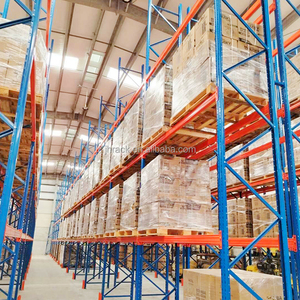
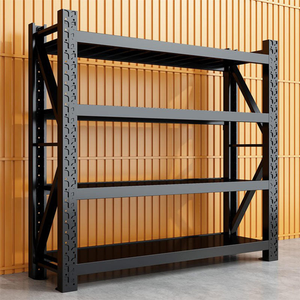
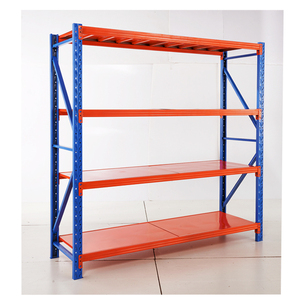
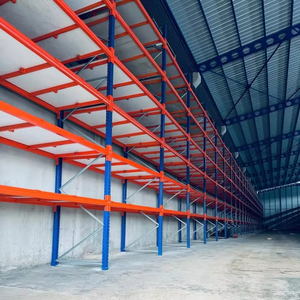
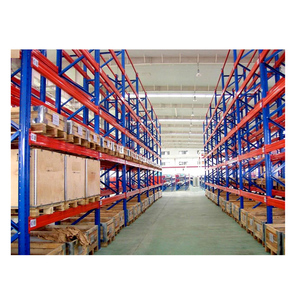
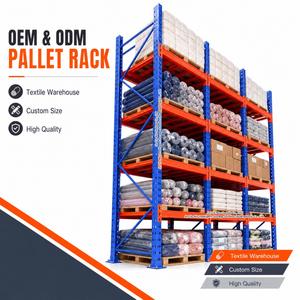
Standard & Custom Heavy-Duty Pallet Racking Systems
Precision-manufactured with premium cold-rolled Q235B/Q355B structural steel, engineered to meet strict international storage regulations including FEM 10.2.02, EN 15512, and RMI standards.
Why Global Supply Chains Rely on HEDA OEM/ODM Engineering
Direct from our manufacturing complex in Guangzhou, China, we operate as a full-tier OEM/ODM contract manufacturer and export authority. We control the complete metallurgy and fabrication value chain.
In modern industrial storage, pallet racking is not merely steel shelving; it is a critical structural asset subject to dynamic forklift impacts, complex static slab loads, high seismic horizontal shears, and demanding material handling throughput. As a global OEM/ODM storage system factory, Guangzhou HEDA Shelves Co., Ltd. (founded in 2001) operates with over 300 experienced engineers, CNC machine operators, and certified international logistics specialists.
Direct Mill-Certified Steel Metallurgy
Every beam, column, bracing chord, and base plate produced in our factory originates from verified prime coil stock (primarily Q235B and Q355B high-tensile structural grades). Steel coils undergo rigorous incoming inspection including ultrasonic thickness checks, yield strength tensile testing, and elongation analysis to ensure compliant deflection ratios (standard $L/200$ to $L/250$ under full SWL load conditions).
Our upright sections are cold roll-formed through 22 sequential automated roll stations, producing rigid Omega (Ω) profiles with uniform cross-sectional thickness, continuous longitudinal seam integrity, and minimal residual stress.
Compliance & Independent Certification
- CE Certification: Certificate No.
2435-CPR-8605159(Execution of Steel Structures & EN 15512) - Quality Management: ISO 9001:2015 Certificate No.
18624Q00169R0M - Material Safety: Full RoHS Compliant Finishes & Lead-Free Powder Formulations
- Seismic Calculations: Australian AS 4084, European FEM 10.2.02, and US RMI design standards
The 10-Stage High-Precision Manufacturing Workflow
Prime Raw Material
Direct procurement of certified Q235B/Q355B structural steel coils with chemical batch tracing.
Precision Slitting
Automated CNC longitudinal decoiling and edge trimming to sub-millimeter tolerances.
High-Speed Punching
Continuous CNC punching for exact 50mm, 75mm, or 76.2mm hole pitch repeatability.
Cold Roll-Forming
Multi-station roll forming line creating reinforced Omega upright and step-beam profiles.
Length Cut-Off
Synchronous hydraulic flying shear cutting profiles to programmed lengths without burrs.
Robotic Welding
Automated GMAW welding of beam end connectors and heavy base plates with gas shielding.
Mechanical Calibration
Laser measurement of beam straightness, cam deformation, and connector perpendicularity.
Chemical Pretreatment
9-stage immersion: degreasing, acid pickling, rinsing, and zirconium phosphating.
Electrostatic Powder
Thermosetting epoxy-polyester coating baked at 180–200°C (60–90μm thickness).
Export Bundling
Corner-protected strapping, moisture-barrier wrapping, and 40HQ container packing.
Future Pallet Rack Procurement Trends (2025–2035)
Global supply chain disruptions, rising land costs, and evolving logistics models are fundamentally shifting how multinational corporations and 3PL providers source industrial racking.
TCO Over Initial CapEx
Procurement directors are shifting focus away from nominal per-ton steel costs toward Total Cost of Ownership (TCO). Buyers prioritize high-durability epoxy coatings that resist forklift scrapes, universal hole configurations that allow modular reconfiguration, and structural designs that minimize maintenance shut-downs over a 15-to-20-year operational life.
Container Cube Optimization
With volatile maritime shipping rates, direct-from-factory procurement demands containerized volumetric engineering. HEDA provides precision nesting diagrams for 40HQ shipping containers, optimizing steel weight-to-volume ratios to consistently hit 26–28 metric tons per container, drastically reducing the landed cost per pallet position.
Nearshore & Modular Commonality
Global 3PL enterprises are standardizing profiles across regional hubs. A standardized upright and connector geometry allows components to be interchanged between facilities in Europe, Southeast Asia, the Middle East, and North America, reducing localized replacement lead times from months to days.
Technological Development Trends in Industrial Storage
From static steel frames to intelligent automation-ready structures: how modern racking is evolving to support high-throughput robotics, AI warehousing, and sustainability directives.
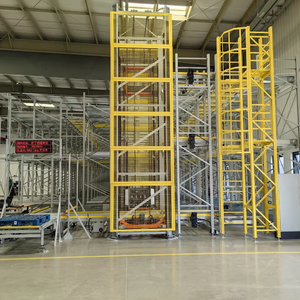
Convergence of Racks & Automation (AS/RS)
Traditional static racking is increasingly integrating directly with Autonomous Mobile Robots (AMRs), automated pallet shuttles, and stacker cranes. Racking tolerances have tightened from EN 15512 Class 400 (manual forklifts) to Class 100/200 (fully automated AS/RS), demanding installation plumbness tolerances within $\pm 1.5\text{ mm}$ over 20-meter vertical spans.
High-Yield Micro-Alloy Steel Metallurgy
Through cold-work hardening and micro-alloying (Vanadium and Niobium grain refinement), structural sections achieve higher yield points (up to 450 MPa) while decreasing linear deadweight. This reduces structural floor loads on existing warehouse concrete slabs while boosting overall system seismic resilience in earthquake-prone regions.
IoT Structural Health Monitoring
High-bay distribution centers are adopting real-time load cell sensors and 3-axis accelerometer impact monitors affixed directly to rack upright base assemblies. When a forklift impacts a perimeter frame, immediate alert packets transmit to the warehouse management system (WMS) to prevent progressive collapse catastrophes.
Engineering Specification & Application Guide
Compare core mechanical parameters, access selectivity, and spatial volumetric utilization across our primary structural storage configurations.
| Racking System | Pallet Selectivity | Floor Space Efficiency | Rotation Principle | Typical Max Bay Load | Forklift Compatibility |
|---|---|---|---|---|---|
| Selective Pallet Racking | 100% Direct Access | 40% – 50% | FIFO / Any | Up to 24,000 kg | Counterbalance, Reach Truck |
| Double Deep Racking | 50% Direct Access | 60% – 65% | LIFO | Up to 20,000 kg | Deep-Reach Pantograph Truck |
| Drive-In / Drive-Through | Lane Selective | 70% – 80% | LIFO / FIFO | Lane Dependent | Narrow Counterbalance |
| Push-Back Pallet Rack | 2–6 Pallets Deep | 65% – 75% | LIFO | Up to 1,500 kg/cart | Standard Counterbalance |
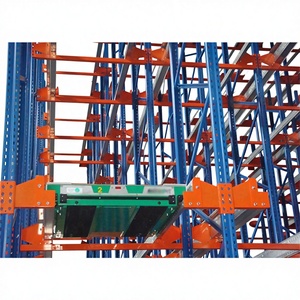
| Radio Shuttle System | Lane Automated | 80% – 88% | FIFO or LIFO | Unlimited (System) | Standard (Shuttle Carried) |
| Very Narrow Aisle (VNA) | 100% Direct Access | 60% – 70% | FIFO / Any | Up to 26,000 kg | VNA Turret Truck / Rail Guided |
Frequently Asked Questions by Industrial Storage Buyers
Clear, engineering-grounded responses covering structural engineering, quality compliance, international logistics, and installation management.
Partner with a Tier-1 OEM/ODM Racking Manufacturer
Whether you require standardized selective racking containers, custom-engineered profiles under your brand name, or turnkey 3D warehouse layout optimization, our engineering team is ready to assist with full structural verification and rapid factory quotations.