High-Density Dynamic Storage Engineering & Global OEM Integration
Live pallet racking—frequently designated as gravity flow pallet racking—represents the pinnacle of mechanical First-In, First-Out (FIFO) material handling. By harnessing calibrated gravity gradients, heavy-duty wheel beds, and integrated hydraulic speed controllers, dynamic storage lanes compress horizontal footprint requirements while ensuring rapid inventory rotation across cold chains, food distribution centers, FMCG distribution hubs, and automated manufacturing buffers.
In an economic environment defined by rising real estate acquisition costs, accelerating SKU velocity, and strict corporate sustainability mandates, conventional static selective racking often exhibits crippling volumetric inefficiencies. Traditional selective layouts dedicate upwards of 60% of warehouse floor footprint strictly to forklift access aisles. Custom OEM live pallet racking systems solve this geometric bottleneck by packing pallets into continuous deep lanes (from 2 up to 25 pallets deep), reducing travel corridors to a single loading face and a single dedicated picking aisle.
As a specialized OEM and ODM manufacturer with over two decades of production experience since 2001, Guangzhou Heda Shelves Co., Ltd. designs, stress-simulates, roll-forms, and coats structural live storage racking systems compliant with international structural codes including EN 15512:2020, FEM 10.2.02, and RMI (Rack Manufacturers Institute) guidelines. Every lane configuration is dynamically matched to unit load footprints, pallet undercarriage topography, brake roller friction coefficients, and seismic safety requirements.
Featured Industrial Storage & Live Pallet Racking Configurations
Explore our precision-manufactured OEM product lines engineered for heavy manufacturing, cold storage, e-commerce distribution, and raw material handling.
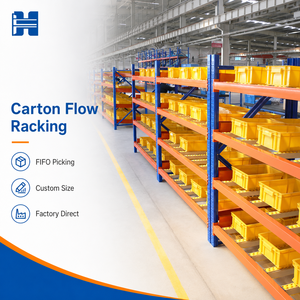
Carton Flow Rack System Gravity Roller Shelf Pick to Light Order Picking OEM Factory
- High-speed split-case order fulfillment
- Pick-to-Light (PTL) sensor bracket integration
- Cold-rolled zinc roller tracks
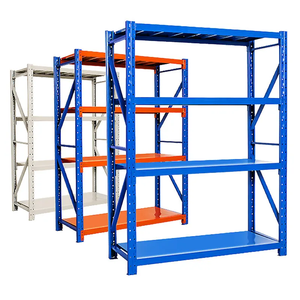
Factory Custom Adjustable Storage Shelves Heavy Duty Shelving Unit Rack Warehouse Storage
- Up to 1,500 kg per level capacity
- 50mm/75mm adjustable pitch pattern
- High-yield Q235B cold-formed uprights
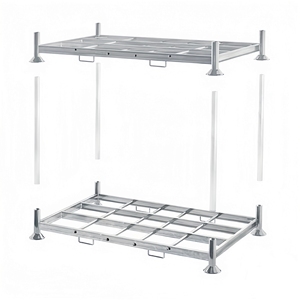
Heavy Duty Detachable Pallets Loading Stacking Storage Galvanized Steel Rack Removable Post
- Hot-dip galvanized anti-corrosive finish
- Nestable frame structure saves return freight
- Ideal for cold storage and agricultural bulk
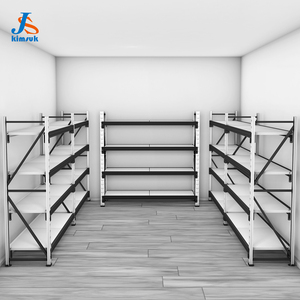
Racking Warehouse Storage Solutions Cantilever Stacking Racks Selective Pallet Rack
- Comprehensive multi-SKU intralogistics
- 100% immediate individual pallet access
- Custom upright profiles from 80mm to 120mm
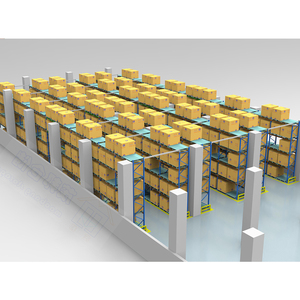
CE Certified Warehouse Racking Conventional Steel Pallet Rack with One-stop Service
- Certificate No. 2435-CPR-8605159
- Engineered to FEM 10.2.02 and EN 15512
- High-durability electrostatic powder coating
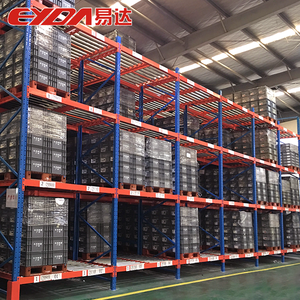
5 Layer Metal Pallet Flow Rack Gravity Storage Heavy Duty Multi-Level Cargo Racks
- True FIFO dynamic gravity roller lanes
- Centrifugal brake rollers & end-stop dampers
- Accommodates 1,000 to 1,500 kg per pallet
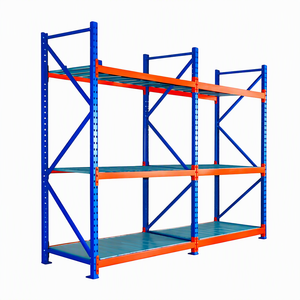
Heavy Duty Wide Span Pallet Rack Industrial Storage Pallet Racking for Bulk Goods
- Clear span spans from 2,300mm to 3,900mm
- Galvanized wire decking or solid steel panels
- Interlocking beam connectors with safety pins
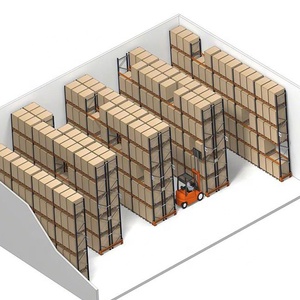
Heavy Duty Pallet Beam Racking Industrial Warehouse Storage Shelf Rack
- Twin-C cold roll-formed box beam profiles
- High seismic resistance calculation included
- Fast modular boltless assembly design
Kinematics of Live Pallet Flow: Gradient Slopes, Friction Ratios & Brake Control
In standard static storage, gravity is a passive load factor that engineers reinforce against through upright buckling resistance and beam deflection calculations (typically $L/200$ according to FEM standards). In Live Pallet Racking, gravity becomes the dynamic propellant. Transforming an unpredictable gravitational acceleration into a smooth, safe, self-regulating conveyance flow requires meticulous mechanical calibration.
The standard incline gradient of an OEM live flow bed is calibrated between 3.0% and 4.0% (approximately 1.7° to 2.3°) depending on pallet bottom construction (wooden Euro-pallets, ISO/GMA perimeter-base pallets, or ribbed industrial plastic skids). If the slope is less than 3%, cold-storage lubricants or deformed timber runners may cause the pallet to stall inside the lane, causing upstream blockages. If the slope exceeds 4.5%, heavy pallet loads generate excessive momentum, risking violent impact against the discharge face.
Centrifugal Brake Rollers
Internally geared hydraulic or planetary centrifugal brakes engage automatically when pallet speed exceeds 0.25 m/s, maintaining a steady, governed descent regardless of pallet weight variations from 300 kg to 1,500 kg.
Dynamic Pallet Separators
Mounted at the discharge end, the mechanical separator arrests the line pressure of rear queued pallets. It isolates the lead pallet by 400–500mm, allowing the forklift operator to extract the target load with zero back-pressure friction.
Multi-Track Roller Configurations
Engineered with dual, triple, or full-width pre-galvanized roller tracks featuring sealed ball bearings rated down to -30°C, ensuring frictionless operation in blast freezers, ambient warehouses, and chemical facilities.
Calculated Line-Pressure Dynamics on Deep-Lane Flow
In deep-lane systems storing 15 to 20 pallets per lane, the total cumulative static mass resting on the track can reach 20 to 30 metric tons. Without mechanical load separation, extracting the front pallet forces the forklift to drag against the kinetic friction of the entire queue, causing product tipping, broken timber bottom boards, and premature mast cylinder wear. HEDA Shelves engineers our OEM lanes with automated spring-loaded or pneumatic release separators that re-engage only after the front pallet has completely cleared the exit threshold.
Live Pallet Flow vs. Alternative High-Density Warehouse Systems
A technical side-by-side comparison illustrating volumetric density, throughput, equipment wear, and capital expenditure across standard intralogistics configurations.
| Storage Architecture | Space Utilization | Stock Rotation Rule | Pallet Throughput Rate | Forklift Aisle Dependency | Operating Cost (Labor) | Cold-Store Viability |
|---|---|---|---|---|---|---|
| Live Pallet Flow (OEM Gravity) | 85% - 90% (Ultra-High) | Strict FIFO (Automatic) | Fastest (Dedicated Faces) | 2 Aisles (1 Charge, 1 Pick) | Lowest (Minimal Travel) | Excellent (High Thermal Mass) |
| Radio Shuttle Racking | 85% - 90% (Ultra-High) | FIFO or LIFO (Semi-Auto) | Moderate to Fast | 1 to 2 Aisles | Moderate (Battery Managed) | High (Battery Prep Needed) |
| Drive-In Pallet Racking | 70% - 75% (High) | Strict LIFO | Slow (Mast Enters Lane) | 1 Aisle Per Block | High (Slow Mast Maneuvering) | Moderate (High Rack Impact Risk) |
| Push-Back Pallet Racking | 70% - 75% (High) | Strict LIFO (Nested Carts) | Moderate (2-6 Deep) | 1 Aisle Per Face | Moderate | Good (Mechanical Only) |
| Selective Pallet Racking | 40% - 45% (Low) | Random / Manual FIFO | Moderate (Long Travel) | 1 Aisle per 2 Racks | Highest (Excess Forklift Miles) | Poor (Wasted Cooled Air) |
Future Procurement Trends in High-Density Dynamic Warehousing
How Fortune 500 supply chains, 3PL logistics giants, and cold chain operators are specifying next-generation live racking systems for 2026 through 2030.
AMR & AGV Pick-Face Interfacing
Modern live pallet racking discharge ends are increasingly integrated with precision roller-stop docks designed for Autonomous Mobile Robots (AMRs) and automated counterbalanced AGVs, eliminating human-operated reach trucks entirely at the dispatch face.
Cold-Chain Volumetric Compression
With industrial refrigeration energy tariffs surging globally, operators are replacing static racking with 15-deep live pallet flow in freezer facilities. Maximizing thermal density per cubic meter slashes ongoing refrigeration compressor power draw by up to 35%.
Direct-from-Factory Containerization
Global supply chain executives are hedging against domestic distributor markups by engaging in direct-to-factory OEM procurement. Knock-down modular roll-formed frames and pre-assembled roller cassettes maximize 40HQ maritime container cubic fill rates.
IoT Sensorized Brake Rollers
Procurement bids now frequently demand smart eddy-current roller assemblies embedded with vibration and thermal sensors that transmit bearing wear metrics to the warehouse maintenance software prior to roller seizure.
R&D Frontiers: Magnetic Brakes, Surface Chemistry & Seismic Damping
Continuous technical refinements at HEDA Shelves deliver higher safety margins, zero fluid leakage, and extreme thermal resilience.
Historically, the Achilles' heel of live pallet flow systems has been the maintenance overhead associated with hydraulic centrifugal speed controller rollers. Conventional speed controllers rely on viscous internal hydraulic fluids. Under prolonged operation in low-temperature cold rooms (-25°C), hydraulic fluid viscosity increases sharply, stiffening the rollers and halting pallet flow. Conversely, in hot equatorial climates (such as South Asia and the Middle East), thin fluid leads to uncontrolled pallet acceleration.
To overcome this limitation, HEDA Shelves has integrated Eddy-Current Magnetic Non-Contact Brake Rollers. Utilizing high-coercivity neodymium permanent magnets, the brake generates a magnetic resistance torque strictly proportional to roller rotational speed without internal fluids or mechanical friction pads. The result is a maintenance-free lifespan exceeding 10 years across ambient, tropical, and deep-freeze operational extremes.
Furthermore, upright column engineering has progressed from traditional open-channel C-sections to Omega-profile cold roll-formed uprights with up to 12 structural bends. This complex geometry concentrates steel mass away from the neutral axis, dramatically improving cross-sectional radius of gyration ($r$) and torsional resistance during high-bay seismic excitation.
Guangzhou Heda Shelves: 10-Stage Precision Manufacturing Workflow
From certified prime structural steel coils to containerized ocean dispatch, every structural component undergoes strict ISO 9001:2015 traceability.
Prime Steel Slitting
Certified Q235B & Q355B coils tested for tensile yield strength.
Automated Punching
CNC lines punch column hole pitches (50/75mm) within ±0.1mm tolerance.
Cold Roll-Forming
Multi-stand roller dies shape 12-bend heavy-duty Omega upright profiles.
Precision Beam Sizing
Box beams formed with interlocking double-C profiles for maximum stiffness.
Robotic Connector Welding
CO2 gas-shielded automated robots weld multi-claw beam connectors.
Track Bed Fabrication
Heavy gauge galvanized roller rails pressed and punched for cassette drop-in.
Shot Blasting & Pickling
Acid pickling, phosphating, and surface passivation eliminate oxidation.
Electrostatic Powder Coat
Automated Swiss Gema guns apply 60-80 micron epoxy-polyester powder.
200°C High-Bake Curing
Curing tunnels polymerize the coating into an impact-resistant finish.
QC Audit & Export Bundling
Deflection load-testing, protective wrapping, and container optimization.
Engineering Leadership & Turnkey OEM Reliability
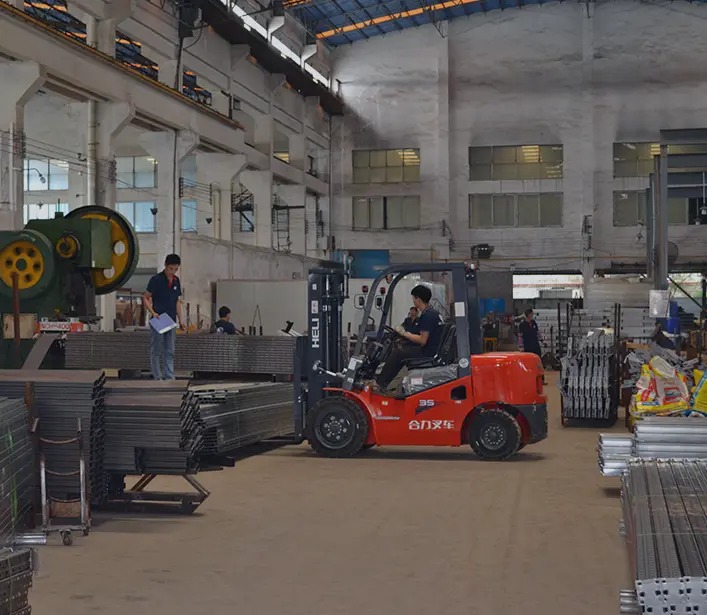
Founded in 2001, Guangzhou Heda Shelves Co., Ltd. operates a modernized 30,000 m² primary manufacturing facility in South China with a monthly output exceeding 30,000 metric tons. Supported by a team of over 300 structural engineers, project managers, and certified welders, HEDA provides complete OEM and ODM private label fabrication for storage integrators, warehouse developers, and end-users worldwide.
Exporting to more than 120 countries, HEDA optimizes containerized shipping profiles to major global ports—including Nhava Sheva, Chennai, Mundra, Chattogram, Colombo, Karachi, Rotterdam, and Los Angeles—delivering certified storage racks with verified landed cost advantages.
Frequently Asked Questions for Project Directors & Warehouse Engineers
Detailed answers addressing load tolerances, environmental resistance, slab engineering, and system commissioning.
How do you calibrate the slope gradient for mixed pallet weights?
Our engineering team performs dynamic testing based on your specific pallet samples. For variable loads ranging from 400 kg to 1,200 kg in the same lane, we specify a nominal gradient of 3.5% paired with magnetic or centrifugal brake rollers installed at 1.2m intervals. The brake rollers apply braking resistance proportional to the square of the rotational speed, decelerating 1,200 kg loads while allowing 400 kg loads to flow smoothly without stalling.
What pallet bottom criteria are required for gravity live flow?
Live pallet flow tracks require consistent bottom contact. Standard wooden EUR-pallets (800x1200mm) with 3 or 5 bottom runners travelling in runner direction, or perimeter-base ISO 1000x1200mm pallets perform best. Bottom boards must have less than 5mm deflection under maximum static load. Plastic pallets with grooved or cross-ribbed undercarriages require full-width cylindrical steel rollers rather than twin-wheel skate tracks to prevent rib interlock.
How does HEDA protect live flow systems against monsoon and coastal humidity?
For installations in tropical or maritime environments (such as South Asia, Southeast Asia, or coastal Americas), all structural uprights and beams undergo a rigorous 10-stage chemical pretreatment, including hot acid pickling and zinc phosphating, followed by 60–80 microns of thermosetting electrostatic powder coating. Roller track beds, axles, and brackets are cold pre-galvanized or hot-dip galvanized to withstand 500+ hours of continuous salt spray testing.
Can HEDA live pallet flow lanes integrate with automated WMS and Pick-to-Light?
Yes. OEM clients frequently specify pre-punched beam channels to route low-voltage DC bus wiring for Pick-to-Light (PTL) LED modules. We can also integrate mechanical and inductive optical limit switches at the discharge face to transmit pallet availability signals directly to your Warehouse Management System (WMS) or AGV fleet coordinator.
What concrete slab data is required before designing high-density racking?
Because live pallet racking concentrates high dead and live loads on minimal floor points, we require your concrete slab thickness (typically 180mm to 250mm), compressive cube strength (e.g., C25/30 or C30/37), subgrade modulus ($k$), and reinforcing rebar mesh layout. Our structural calculation package determines the exact baseplate dimensions, anchor bolt embedment depths, and seismic bracings compliant with Eurocode 3 and RMI guidelines.
How are replacement parts and roller cassettes serviced over time?
HEDA Shelves manufactures modular, drop-in roller cassettes. In the event of a foreign object denting a roller or an operator damaging an entry guide, individual roller axles can be unhooked and swapped in less than 5 minutes without dismantling the structural beam frame. Standardized replacement components are stocked for fast global air or LCL ocean freight.
Request Your Custom CAD Layout & OEM Proposal Within 24 Hours
Provide your warehouse clear height, building column grid, pallet specifications (dimensions and weight range), and target throughput. Our senior structural engineers will generate a complimentary 2D AutoCAD layout, 3D dynamic rendering, and a competitive factory-direct price quotation.