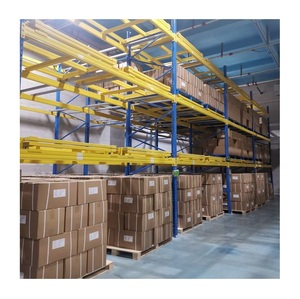
High Storage Density and Efficiency Industrial Racks Warehouse Shelves Storage Racks Push Back Racking for Pallet
2-6 Pallets Deep
Q235B / Q355B Steel
LIFO System
Explore our export-certified push back pallet racking lines engineered for 2-deep to 6-deep configurations, cold-formed structural steel profiles, and low-friction telescoping carrier carriages.
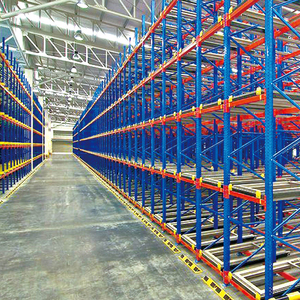
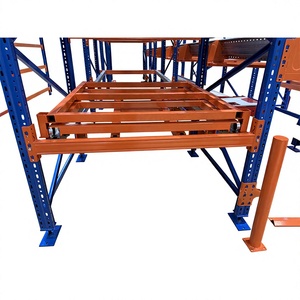
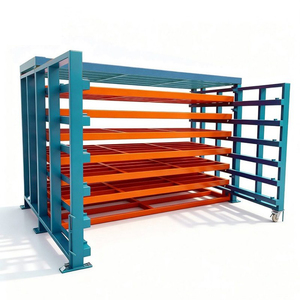
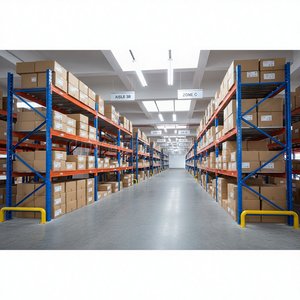
A comprehensive technical analysis for warehouse operations directors, structural consultants, and material handling procurement executives.
Dynamic push back racking represents an engineering pinnacle within high-density warehouse storage systems. Operating on an inclined rail framework nested with telescoping structural carts, a push back system eliminates dedicated interior operating aisles by utilizing a single front-access face for both product induction and retrieval. Unlike static selective racking that commands 50% to 60% of warehouse floor footprint for forklift transit corridors, push back racking systems achieve storage densities comparable to drive-in configurations while dramatically surpassing them in picking throughput, SKU selectivity, and operational safety.
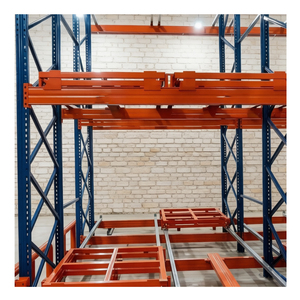
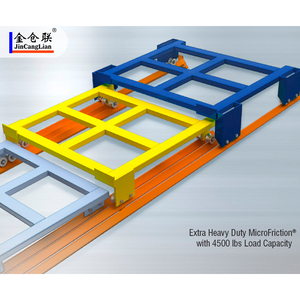
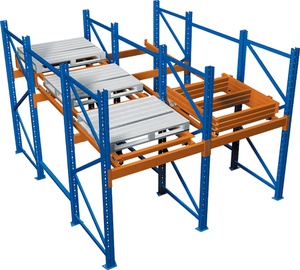
The core operating mechanics rely on a low-gradient gravitational incline (typically engineered between 1.5° and 3.0° or approximately 2.5% to 5.0% slope). The initial pallet is placed directly upon the top nested cart by a counterbalance or reach forklift truck. When the forklift operator introduces the subsequent pallet, the truck uses the new pallet load to gently push against the existing pallet, rolling the top cart rearward along the structural steel guide channels to reveal the next nesting cart beneath. This telescoping action repeats up to 6 pallets deep. During retrieval, the process is reversed under controlled gravitational acceleration: as the front pallet is lifted and backed away, the subsequent pallets roll gently forward to the picking face, stopped smoothly by front structural arrestors.
F_p = \sum_{i=1}^{n} m_i \cdot g \cdot (\sin\theta + \mu_r \cdot \cos\theta) + F_i
Structural integrity depends heavily on upright steel quality and sectional modulus design. Manufactured from high-tensile hot-rolled micro-alloyed strip steel (Q235B and Q355B grades), upright columns are cold roll-formed through continuous multi-pass rolling mills to prevent residual internal stresses. Upright profiles feature our proprietary Omega (\(\Omega\)) 11-fold geometry, which dramatically boosts torsional stiffness and resistance to local buckling compared to conventional open C-sections. Beam-to-column connections utilize 4-hook or 5-hook cold-stamped connectors secured with high-grade drop-forged steel safety locking pins (safety lock pins rated at minimum 1,200 kg shear capacity).
| Storage System Type | Floor Space Utilization | SKU Selectivity Level | Pallet Depth Capability | Forklift Damage Risk | Inventory Flow Logic |
|---|---|---|---|---|---|
| Push Back Racking (HEDA) | 70% - 85% Active Footprint | High (Lane-Level Selectivity) | 2 to 6 Pallets Deep | Negligible (No Truck Entry) | LIFO (Last-In, First-Out) |
| Selective Pallet Racking | 35% - 45% (Aisle-Dominated) | 100% (Direct Access) | 1 Deep (2 Deep in Double-Reach) | Low to Moderate | FIFO or LIFO |
| Drive-In Racking | 65% - 80% High Density | Very Low (Tunnel Lockout) | Up to 10+ Deep | Extremely High (Mast in Lane) | LIFO (Strict Batch Run) |
| Pallet Flow (Gravity Roller) | 75% - 90% High Density | Moderate (Face-Level Selectivity) | Up to 20+ Deep | Low (Separate In/Out Aisles) | FIFO (First-In, First-Out) |
| Radio Shuttle Racking | 80% - 90% Semi-Automated | High (Automated Extraction) | Up to 40+ Deep | Low (Robot In-Tunnel) | FIFO & LIFO Flexible |
Market analysis on how global supply chain volatility, urban real estate appreciation, and cold-chain expansions are transforming B2B racking procurement.
Global warehouse rent in core hub markets (Singapore, Mumbai, Rotterdam, Los Angeles, Dubai) has escalated by 28% to 65% over the past 36 months. Enterprise procurement officers are shifting CapEx from warehouse horizontal expansion to vertical and dense volumetric push back racking installations that triple existing cube yield.
Operating a refrigerated or frozen warehouse (-25°C to -30°C) consumes tremendous electrical power per cubic meter. Drive-in systems cause severe bottlenecks and product defrosting due to slow forklift maneuvering. In contrast, push back carts allow rapid pallet push-in/pull-out, cutting forklift refrigeration door time and eliminating drive-in collision risks.
Procurement teams are bypassing domestic racking redistributors to contract directly with premier Chinese manufacturing hubs. By acquiring standardized, certified modular push back frames packaged with pre-assembled cart trays and precision laser-aligned rails, enterprises slash overall landed project CapEx by up to 35%.
How next-generation metallurgical treatments, telemetry sensors, and automated guided vehicles (AGVs) are redefining dynamic push back operations.
Integrating mechanical eddy-current or micro-centrifugal dampeners directly inside nested cart wheel sets. Regardless of pallet weight discrepancies (300 kg vs 1,500 kg), the cart gravity return descent speed remains constant at 0.25 m/s, eliminating shock loads on front end stops.
Design iteration adapting front rack beams with laser targets and retro-reflective fiducial markers. This allows Autonomous Mobile Robots (AMRs) and automated high-reach guided forklifts to perform millimeter-accurate push back indexing without human operators.
Ultrasonic and LiDAR cart-occupancy sensors embedded within rail profiles connected via LoRaWAN/industrial 5G to Warehouse Management Systems (WMS). Real-time visual heatmaps illustrate empty versus occupied carts across 10,000 pallet positions.
Transitioning from pure structural welded plate carriages to structural hybrid aeronautical alloys and ultra-high-molecular-weight (UHMW) polyoxymethylene runners. Reduces tare cart dead-weight by 40%, boosting allowable live pallet cargo payload capacity.
Founded in 2001, we combine over two decades of heavy industrial manufacturing precision, accredited international quality credentials, and complete in-house production control.
As one of China's most trusted manufacturers and wholesale suppliers of push back racking systems, Guangzhou Heda Shelves Co., Ltd. provides comprehensive end-to-end engineering excellence. Our 30,000 square meter state-of-the-art facility in Guangzhou is powered by advanced multi-station automatic roll-forming lines, automated CNC punching systems, robotic welding cells, and an environmental-grade continuous 10-stage powder coating line with automated pickling and phosphating pre-treatment.
Unlike trading entities or regional assembly shops, every component—from vertical upright columns, diagonal cross-braces, heavy-duty box beams, cart channels, low-profile multi-level telescoping carriages, to flanged steel rollers—is fabricated and rigorously tested in our own workshops. We hold official CE Certification (Certificate No. 2435-CPR-8605159), ISO 9001:2015 Quality Management System Certification (No. 18624Q00169R0M, valid through 2027), and complete RoHS material compliance.
With an experienced R&D engineering department of 300+ professionals, we offer free professional 2D CAD layout design, 3D parametric warehouse simulations, structural static and seismic deflection calculations (in strict compliance with FEM 10.2.02 and RMI MH16.1 codes), and complete logistics shipping consolidation to over 120 countries worldwide. Our export solutions include custom container packing optimization for 20GP/40HQ containers to guarantee zero transit deformation and maximize container payload yield.
Zero subcontracting. From raw hot-rolled steel strip inspection to final powder cured hardness testing (pencil hardness ≥ 2H), every phase is audited by our internal QC lab.
Bespoke rail slopes, pallet gauge widths, special cart footprints for European EUR pallets (800x1200mm), American GMA pallets (40x48 in), or Australian standard pallets (1165x1165mm).
Multi-stage chemical degreasing, acid pickling, rust removal, phosphating, and electrostatic epoxy-polyester hybrid powder coating resistant to humid monsoon air and subzero freezer frost.
Detailed color-coded installation schematics, structural calculation packets, video installation guides, and optional on-site supervisor dispatch across international destinations.
Direct technical answers addressing structural sizing, forklift compatibility, maintenance protocols, and international shipping.