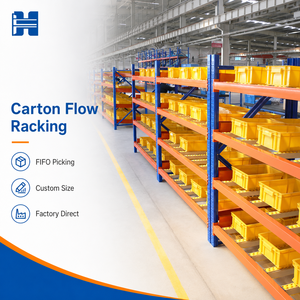
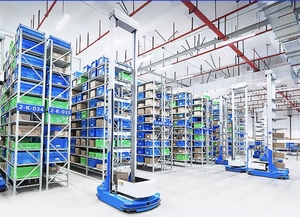
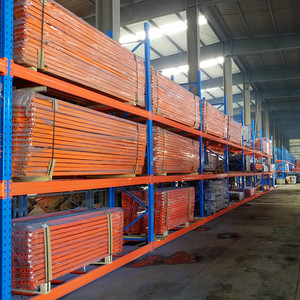
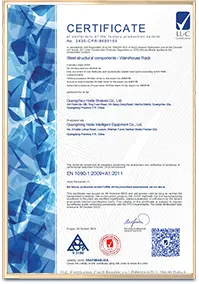
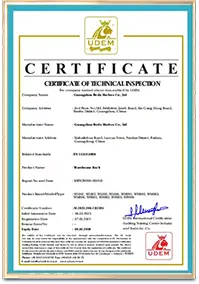
High bay storage racking systems—commonly defined as vertical steel storage architectures extending from 8 meters up to exceeding 30 meters in automated clad-rack buildings—represent the critical structural backbone of modern logistics infrastructure. When procuring from China wholesale manufacturing bases, engineering buyers must differentiate between commodity warehouse shelving and certified, structurally calculated high-bay systems designed in accordance with European standard EN 15512, the Federation of Materials Handling FEM 10.2.02 guidelines, and the American RMI (ANSI MH16.1) specification.
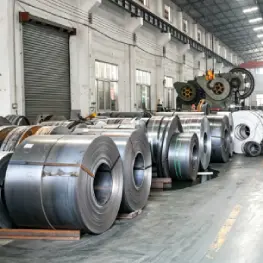
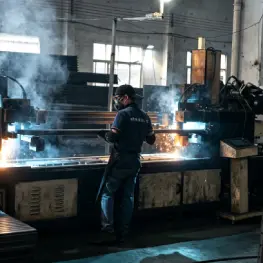
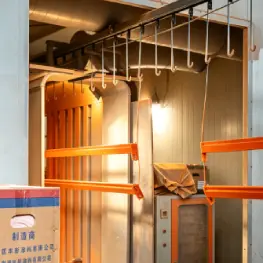
The structural dynamics of high-bay installations are dictated by secondary second-order sway calculations ($P-\Delta$ effects), wherein vertical pallet loads amplify lateral deflections induced by seismic ground acceleration, asymmetric loading patterns, and wind shear in rack-supported structures. At Guangzhou Heda Shelves Co., Ltd., raw carbon steel selection begins with certified prime-grade Q235B and Q355B coils procured strictly from tier-one mills such as Baosteel and Shougang. Q355B steel, offering a minimum yield strength of 355 MPa, is strategically deployed in bottom-tier vertical upright profiles and lower beam elevations where axial compressive stress peaks under dense multi-tier storage configurations.
Deflection Limits & Mechanical Tolerances Under European Class 100-400 Standards
Standard pallet racking permits a maximum horizontal beam deflection limit of $L/200$ under static working load limit (WLL). However, when high-bay systems interface with Narrow Aisle (VNA) turret trucks or fully automated stacker cranes (ASRS), allowable beam deflection must be held rigidly within $L/300$ to $L/400$ to prevent crane sensor faults, optical targeting misalignment, or catastrophic beam displacement during high-velocity retrieval cycles.
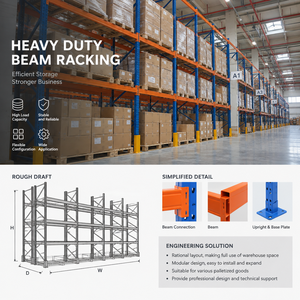
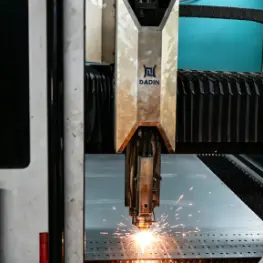
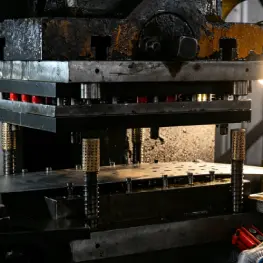
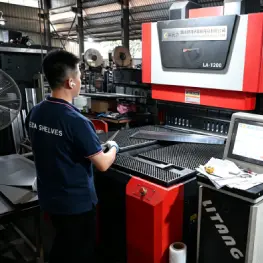
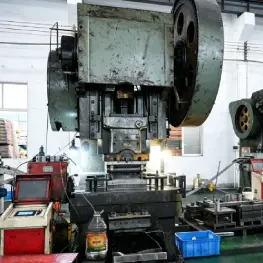
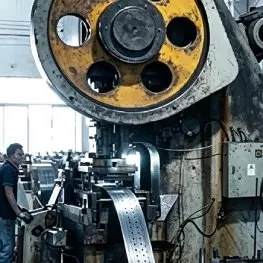
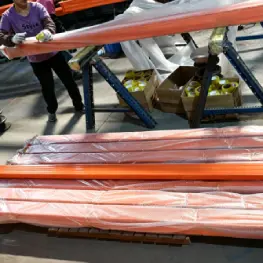
Upright profile geometry is critical. Unlike basic C-channels, HEDA Shelves manufactures multi-bend, cold-formed open-back omega profiles featuring up to 12 distinct bending facets. Each additional bend introduces work-hardening along the section radii, dramatically augmenting torsional rigidity and buckling load thresholds without disproportionately increasing steel deadweight. Column hole pitches are punched using automated CNC multi-station punching presses maintaining spacing tolerances within $\pm0.1\text{ mm}$ across the entire continuous roll-formed profile length.
| Racking Architecture |
Pallet Selectivity |
Floor Space Utilization |
Structural Height Range |
Aisle Width (AST) |
Primary Industry Applications |
| Selective Pallet Racking |
100% Direct Access |
35% – 42% |
Up to 14 Meters |
3.0 – 3.8 Meters |
3PL Facilities, High-SKU Distribution, Spare Parts |
| Very Narrow Aisle (VNA) |
100% Direct Access |
55% – 65% |
Up to 18 Meters |
1.6 – 1.9 Meters |
High-Density High-Value Storage, FMCG Hubs |
| Drive-In / Drive-Through |
Low (LIFO / FIFO Lanes) |
65% – 75% |
Up to 11 Meters |
Drive-in Tunnel |
Seasonal Agriculture, Cold Storage, Homogeneous SKUs |
| Push-Back Cart System |
Moderate (Lane Selectivity) |
60% – 70% |
Up to 9 Meters |
Standard Counterbalance |
Buffer Zones, Food Processing, Medium SKU Volumes |
| Radio Shuttle Automation |
Semi-Automated (FIFO/LIFO) |
75% – 85% |
Up to 22 Meters |
Standard / Reach Truck |
Cold Chain Logistics, Beverage Bottling, Raw Materials |
| Automated AS/RS Clad-Rack |
Automated Computerized |
85% – 95% |
Up to 40 Meters |
Crane Dedicated (~1.4m) |
Mega-eCommerce, Smart Manufacturing, Mega 3PL |
Equally paramount is the structural design of column base plates and floor anchoring systems. Under static and dynamic conditions, high bay racks exert substantial point loads—frequently exceeding 150 kN to 250 kN per column footplate onto the concrete slab. Our engineering structural calculations cross-verify concrete foundation compressive strength ($f'c \geq 25\text{–}30\text{ MPa}$), anchor pull-out shear vectors, and crack-isolation joints, deploying heavy-duty structural baseplates with double seismic wedge anchor bolts to guarantee stability in global seismic zones conforming to UBC Seismic Zones 1 through 4 and Eurocode 8.