Wholesale High Bay & Specialized Racking Solutions
From Very Narrow Aisle (VNA) high-bay configurations and push back gravity feeds to heavy-duty industrial roll framing, explore our factory-direct modular systems manufactured with robotic cold-roll tolerances.
Structural Engineering Specifications of High Bay Racking Systems
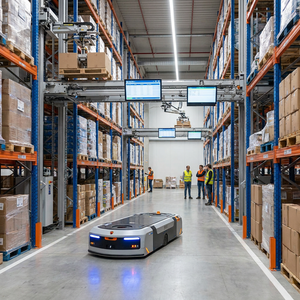
High bay warehousing—defined as storage envelopes exceeding 12 meters and scaling up to 40 meters in Automated Storage and Retrieval Systems (AS/RS)—requires significantly tighter structural tolerances than conventional floor-anchored racks.
Structural Deflection Thresholds Under FEM 10.2.02 & EN 15512 Standards
In high bay installations, minor base-plate settlement or upright deflection is multiplied exponentially across vertical height. While standard selective racking accommodates a beam deflection of L/200, high-bay automated racking demands limits of L/300 or L/400 to avoid mast-collision errors with stacker cranes and articulated VNA turrets. Our structural designs utilize Finite Element Analysis (FEA) to confirm sway stability, local web buckling margins, and second-order (P-Delta) seismic displacement.
| Racking System Type | Operational Clear Height | Aisle Width Requirement | Floor Area Utilization | Handling Equipment Matching | Direct Selectivity |
|---|---|---|---|---|---|
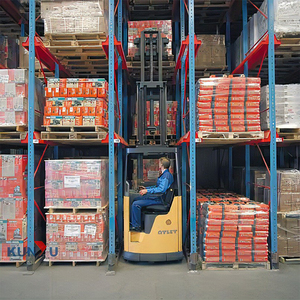
| High Bay VNA (Very Narrow Aisle) | 12m – 18m | 1,600mm – 1,900mm | Up to 60% | Man-up / Man-down VNA Turret Truck | 100% (Instant Single Pallet Access) |
| Clad-Rack AS/RS (Building Integrated) | 18m – 40m | 1,400mm – 1,650mm | Up to 85% | Automated Stacker Crane (SRM) | 100% (Computer Controlled) |
| Radio Shuttle High Bay | 10m – 22m | 2,800mm – 3,200mm (Transfer Aisle) | Up to 80% | Standard Reach Truck + Wireless Shuttle Cart | Lane-based (LIFO / FIFO Dynamic) |
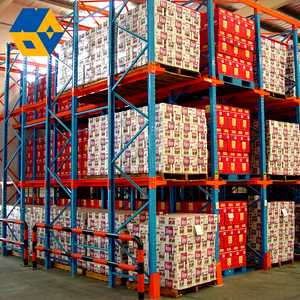
| Drive-In Deep Storage | 6m – 12m | Forklift Entry Lanes | Up to 70% | Counterbalanced / Narrow Reach Truck | Low (Batch SKU Storage) |
| Double-Deep High Reach | 8m – 14m | 2,900mm – 3,200mm | Up to 55% | Deep-Reach Pantograph Forklift | 50% Immediate Access |
When evaluating high-bay infrastructure, engineering decisions hinge on the balance between floor footprint and vertical cubic capacity. In land-constrained logistics hubs, expanding upward rather than outward reduces ground lease overhead by up to 60%. However, high bay steel frames must absorb substantial live dynamic loads: decelerating stacker cranes exert horizontal thrust loads that can induce torsional flex on standard open-profile uprights. HEDA Shelves addresses this by deploying multi-bend, closed-omega column geometries and high-tensile 8.8 grade structural connecting bolts, ensuring zero frame loosening over decades of continuous 24/7 duty cycles.
Our 10-Stage Precision Heavy Racking Production Process
Every structural beam, connector claw, and omega upright manufactured in our 30,000 m² facility is tracked via strict quality checkpoints to ensure field-assembly accuracy across global sites.
01. Certified Steel Coils
Direct procurement of premier Baosteel and Shougang Q235B and Q355B hot-rolled strip steel, pre-tested for tensile yield strength and chemical metallurgical consistency.
02. CNC Slitting & Cutting
High-speed slitting lines cut coil mother-rolls to exacting strip widths with dimensional tolerances constrained within ±0.1mm, eliminating profile camber.
03. Automated CNC Punching
Fully synchronous multi-stage hydraulic die punching stations punch teardrop, diamond, or 50mm/75mm Euro-pattern adjustment slots at zero cumulative pitch error.
04. Cold Roll-Forming
Continuous 20-to-26 pass roll forming lines shape columns into complex omega sections, optimizing work hardening and moment-of-inertia strength.
05. Robotic Laser Clamping
Beam end-connectors undergo multi-point MIG robotic welding, providing deep weld-root penetration without thermal distortion or micro-porosity.
06. Degreasing & Derusting
Immersion through ultrasonic alkaline baths to strip industrial rolling lubricants and mill scale, exposing clean virgin steel before chemical bond formation.
07. Pickling & Phosphating
High-density chemical phosphating creates a micro-crystalline iron phosphate barrier, inhibiting galvanic corrosion and increasing powder adhesion tenfold.
08. Electrostatic Powder Curing
Nordson electrostatic spray booths apply non-toxic thermoset polyester powder, baked at 200°C to achieve a resilient 60-90μm smooth finish.
Future Procurement Trends for Warehouse High Bay Racking (2025–2030)
Procurement executives are shifting from unit-cost metrics to Total Cost of Ownership (TCO), operational agility, and automation compatibility. Here are the core vectors driving international supply contracts.
1. Modular Automation-Ready Racking
Buyers now demand manual VNA systems pre-drilled and structurally reinforced for future retrofit with autonomous mobile robots (AMRs), automated guided vehicles (AGVs), or top-running crane tracks. This future-proof approach avoids costly dismantling when warehouses migrate from semi-manual picking to lights-out 24/7 automation.
2. Carbon-Audited & Green Steel Supply
Multinational enterprise 3PLs require Scope 3 emissions reporting on structural steel products. Exporters must provide full traceability from electric arc furnace (EAF) or blast furnace mills, using heavy metals-free, low-VOC TGIC polyester powder coatings compliant with EU RoHS and REACH environmental directives.
3. Turnkey Engineering & BIM Integration
International procurement contracts have evolved beyond structural part supply to demand full Building Information Modeling (BIM Level 2 / Revit) integration. Detailed 3D clash-detection coordinates rack uprights with in-rack NFPA fire sprinkler pipes, HVAC ducting, smoke baffles, and LED lighting channels prior to production.
Industry & Technology Trends Reshaping High Bay Facilities
As artificial intelligence merges with real-time supply chain orchestration, high bay warehouse systems are evolving into intelligent, responsive assets.
IoT Structural Health Monitoring
Next-generation high bay racks feature integrated wireless strain gauges and tilt sensors within high-risk lower upright sections. These send real-time alerts to the WMS when accidental forklift mast impacts exceed structural thresholds, enabling proactive maintenance before catastrophic frame failure occurs.
Clad-Rack Building Architecture
Clad-rack engineering treats the racking frame itself as the primary building superstructure, directly supporting the roof trusses, exterior insulated sandwich wall panels, and wind bracing. This eliminates the expense of a separate structural steel warehouse building, reducing overall civil construction timelines by up to 35%.
Ultra-Low Temperature Cold Chain Alloys
With the global expansion of biological pharmaceuticals and frozen grocery fulfillment, racks must operate consistently down to -30°C. Conventional carbon steels suffer low-temperature brittle fracture under dynamic forklift impacts. Modern cold bay racking specifies micro-alloyed fine-grain steel with verified Charpy V-notch impact toughness at sub-zero temperatures.
Guangzhou HEDA Shelves Co., Ltd. Enterprise Advantages
As a recognized China wholesale manufacturing leader for more than two decades, we deliver structural reliability, audited compliance, and container-optimized sea freight logistics to world markets.
CE & ISO 9001 Certified
Full production traceability backed by CE Certificate No. 2435-CPR-8605159, ISO 9001:2015 Quality Management Certificate No. 18624Q00169R0M (valid through 2027), and RoHS environmental compliance.
25+ Years Industrial Heritage
Founded in 2001, our team of 300+ structural engineers, precision machinists, and international project managers has completed over 10,000 warehouse installations across Europe, the Americas, the Middle East, and Southeast Asia.
Free CAD & 3D Modeling
Submit your warehouse layout, clear building height, column grid coordinates, and pallet specifications. Our senior design team returns free structural CAD layouts, 3D renderings, and pallet-count optimization within 24 hours.
Export Packing & Ocean Logistics
Specialized steel-banding, foam wrapping, and nested container-bundling protocols maximize 40HQ container volumetric capacity, protecting coatings during ocean transit and lowering landed freight cost per pallet position.
High Bay Racking Procurement & Technical FAQ
Clear, engineering-driven answers to the most common questions raised by warehouse operators, procurement directors, and civil engineering consultants.
What concrete slab specifications are required for high bay racking?
High bay racks exceeding 12m vertical height concentrate immense point loads onto base plates (often exceeding 150 to 250 kN per leg). Slabs must be engineered from minimum Grade C30/37 or C35/45 fiber-reinforced or rebar-reinforced concrete with a thickness of 200mm to 300mm. For VNA operations, floor flatness must conform strictly to DIN 18202 Table 3 Line 4 or TR34 Superflat (DM1/DM2) standards to prevent mast oscillation.
How are high bay racking structures calculated for seismic zones?
We execute 3D finite element dynamic modal analyses under European EN 16681, American RMI ANSI MH16.1, or local seismic codes (such as IS 1893 or AS 4084). Depending on your project location's peak ground acceleration (PGA) and soil class, we design heavy-duty back portal bracing, top spine ties, oversized base plates, and chemical M16-M20 anchor embedments to dissipate seismic shear forces.
What is the typical production and shipping lead time for export orders?
Standard production cycles range from 20 to 35 business days depending on overall steel tonnage (averaging 5 to 20 shipping containers). Ocean transit from Guangzhou or Shenzhen ports takes approximately 12 to 18 days to South/Southeast Asian ports, 22 to 30 days to Europe, and 20 to 28 days to the US West/East Coasts.
How do you guarantee corrosion protection in high-humidity or cold warehouses?
All steel components undergo a multi-stage automated immersion sequence including ultrasonic degreasing, acid pickling, and chemical iron phosphating prior to electrostatic powder application. This creates an impermeable barrier exceeding 500 hours of continuous salt-spray testing (ASTM B117). For cold storage facilities down to -30°C or outdoor coastal staging yards, continuous pre-galvanized or hot-dip galvanized finishes can be specified.
Can HEDA Shelves manufacture custom profiles compatible with existing racking?
Yes. We provide complete OEM/ODM profile-matching services. By analyzing engineering drawings or physical cross-section samples of your existing uprights and beam connectors (including teardrop, Speedlock, Dexion, or European 50mm hook patterns), our tooling workshop can custom-mill roll-forming dies to deliver seamless extensions or replacement components.
What installation support do you provide for overseas projects?
Every export project is accompanied by 3D isometric assembly blueprints, component piece-mark schedules, and step-by-step video guidance. For major international logistics centers, we dispatch senior erection supervisors to guide local labor, coordinate laser optical vertical alignment, verify anchor torque settings, and supervise final handover load tests.