Engineered Pallet Racking & Industrial Systems
Manufactured directly inside our 30,000 m² Guangzhou production facility. Tested against strict FEM 10.2.02, EN 15512, and RMI MH16.1 international racking standards.
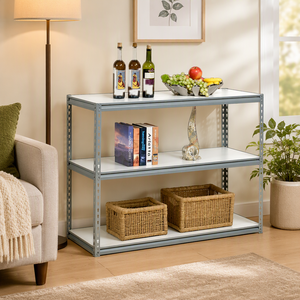
3-Tier Slotted Angle Storage Shelving Unit
Adjustable metal frame slotted shelving with powder-coated corrosion resistance. Ideal for light industrial parts rooms, utility retail, and archive depots.
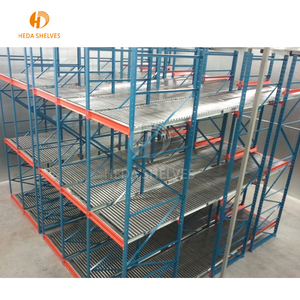
FIFO Order Picking Gravity Carton Flow Rack
High-efficiency gravity roller tracks engineered for continuous split-case picking, assembly lines, and high-turnover pharmaceutical or FMCG inventory.
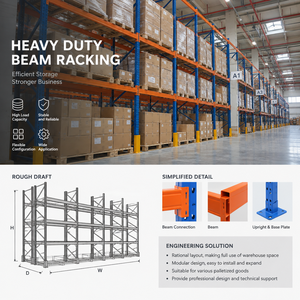
Custom Selective Pallet Rack System
Heavy-gauge Q235B roll-formed box beam configuration ensuring 100% direct selectivity to every single pallet position in distribution hubs.
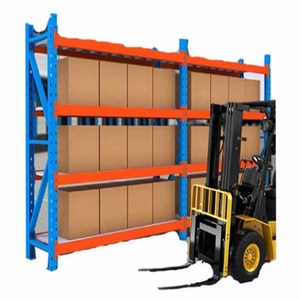
Selective Heavy Duty Pallet Rack (4000kg)
Ultra-reinforced upright columns paired with dual-C interlocked step beams, specifically built to handle intense concentrated mechanical loading.
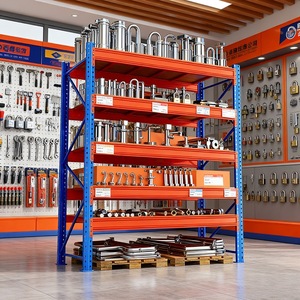
Warehouse Pallet Rack Beam Shelving 5-Layer
Multi-tiered vertical industrial racking supporting 1,000 to 5,000 kg total structure ratings. Compatible with wire mesh decking or steel shelf panels.
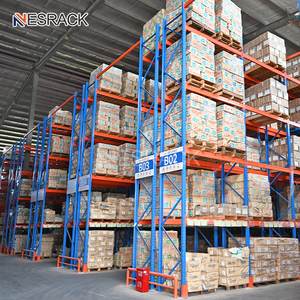
Industrial Boltless Warehouse Storage Rack
Factory-priced, keyhole-lock adjustable racking delivering tool-free installation, versatile bay reconfiguration, and rugged steel load reliability.
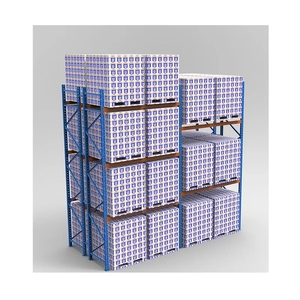
Heavy Duty Industrial Stacking Pallet System
Industrial-grade certified racking engineered for high-density palletised cargo storage, dynamic manufacturing staging, and regional distribution facilities.
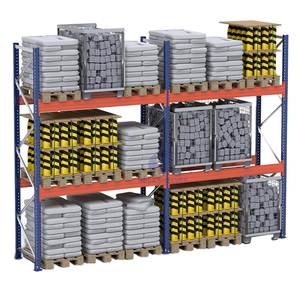
Peterack PT-HD Corrosion Protected Rack
Engineered with specialized pre-treatment, hot-dip galvanizing or dual powder barrier finish to withstand humid coastal ports and cold room refrigeration.
Engineering Whitepaper: Structural Analysis of Drive-In Racking
Drive-In and Drive-Through racking systems eliminate traditional access aisles, providing high-density cubic storage (up to 75-80% volumetric efficiency). Below is a comprehensive mechanical breakdown for warehouse directors and structural engineers.
Structural Anatomy & Load Vectors
Unlike standard selective racking that relies on horizontal box beams spanning upright frames, Drive-In systems use cantilevered support arms fastened to vertical uprights to carry continuous pallet runner rails.
- Upright Profiles: 90mm to 140mm omega cold-rolled steel columns.
- Continuous Support Arms: Stamped tapered brackets dissipating moment stresses.
- Top Beam & Portal Bracing: Rigid overhead framing preventing lane spreading.
- Pallet Guide Rails: Flanged Z-profiles or heavy angle guides centering forklift trucks.
LIFO vs. FIFO Flow Mechanics
Drive-in systems operate on a Last-In, First-Out (LIFO) single-entry principle, while Drive-Through configurations utilize dual-entry access allowing strict First-In, First-Out (FIFO) material movement.
- Drive-In (LIFO): Single access aisle; closed back with heavy diagonal X-bracing.
- Drive-Through (FIFO): Loading side opposite picking side; requires overhead structural portals.
- SKU Consolidation: Engineered for high-volume, homogenous palletized goods.
- Floor Space Recovery: Recovers up to 35% more floor space than selective layouts.
Impact Mitigation & Safety Factors
Because counterbalanced or reach forklifts physically enter the storage lanes, dynamic impact protection is critical to maintaining structural integrity and preventing catastrophic column buckling.
- Floor-Anchored Guide Rails: Continuous heavy-duty C-channels or angle rails.
- Wrap-Around Column Protectors: High-yield 5mm to 8mm manganese steel shields.
- Pallet Stops & Backstops: Mechanical end-of-lane travel limiters.
- Safety Clearance Ratios: Sized with 75mm to 100mm pallet clearance per side.
| Component Parameter | Standard Specification | Cold Storage Heavy Option | Engineering Compliance Code |
|---|---|---|---|
| Base Steel Raw Material | Q235B Cold-Rolled Carbon Steel | Q355B Low-Alloy High-Strength Steel | GB/T 700 / ASTM A36 Equivalent |
| Column Upright Widths | 90mm, 100mm, 120mm (Thickness: 2.0 - 2.5mm) | 120mm, 140mm (Thickness: 2.5 - 3.2mm) | EN 15512 / RMI MH16.1 Design Specs |
| Surface Protection System | Automated 9-stage phosphate + Powder Coat | Hot-Dip Galvanized (>65μm) or Epoxy Barrier | ISO 12944 C3/C4 Corrosion Class |
| Lane Depth Capability | 2 to 7 Pallets Deep (LIFO Typical) | Up to 10 Pallets Deep (With Guided Rail) | FEM 10.2.02 Structural Deflection Limits |
| Vertical Beam Pitch Adjustment | 50mm or 75mm CNC punched pitch | 75mm heavy slotted pitch | Universal connector compatibility |
| Pallet Load Capacity | 500 kg to 1,500 kg per pallet level | Up to 2,000 kg per pallet position | Factor of Safety ≥ 1.65 to 1.95 |
Future Procurement Trends in Drive-In Racking Systems
Global supply chain disruptions, rising commercial land rates, and high industrial electricity costs are reshaping how enterprise buyers evaluate, procure, and install high-density racking.
1. Cold Chain Cube Optimization Boom
Refrigerated warehouse space incurs roughly 3 to 4.5 times the operating cost of ambient facilities due to continuous thermal management. Modern cold storage operators are aggressively replacing standard selective bays with 5 to 8-deep Drive-In systems.
By eliminating aisle air volume, refrigeration duty cycles drop by 22% to 31%, delivering major thermal efficiency gains for frozen meat, seafood, dairy, and pharmaceuticals.
2. Hybrid "Shuttle-Ready" Conversions
A growing trend among Tier-1 logistics providers is procuring Drive-In upright frames manufactured with dual-compatible punching geometry. This allows warehouses to deploy cost-effective manual Drive-In racking today, and convert lanes into semi-automated Radio Shuttle Racking later.
Upgrading requires merely swapping out cantilever brackets for shuttle guide profiles without dismantling the structural upright matrix.
3. Factory-Direct Container Cube Engineering
With volatile maritime container shipping rates, international buyers now evaluate the "Nested Packaging Ratio" of racking manufacturers. HEDA Shelves optimizes the roll-forming radius of drive-in pallet rails and upright frames so profiles nest tightly.
A single 40HQ container holds up to 22 to 26 metric tons of packed racking components, slashing the landed freight cost per pallet position by up to 18%.
Technical Evolution & Material Science Advancements
Structural safety in Drive-In racking depends directly on the metallurgical composition of cold-rolled coils, precision profile forming, and advanced surface coating technologies.
High-Yield Q355B Steel Transitions
Traditional racking fabrication predominantly used standard Q235B carbon steel. As warehouses increase clear building heights to 12m-16m, upright buckling risks under high axial compression multiply.
Our engineering lines utilize certified micro-alloyed Q355B steel (minimum yield strength of 355 MPa). This increases structural load-bearing capacity by over 30% while maintaining profile ductility, which is essential for high seismic zones across the Pacific Rim, Americas, and South Asia.
Automated Continuous Roll-Forming
Dimensional inconsistencies in upright hole spacing cause uneven arm loading and pallet tilt. HEDA Shelves operates automated continuous CNC rolling lines that integrate automated servo-hydraulic punching before profiling.
This guarantees an upright pitch tolerance within ±0.2mm over an entire 12-meter single column, preventing cantilever arm angular droop and ensuring smooth forklift runner rail alignment.
9-Stage Anti-Corrosive Pre-Treatment
In humid coastal distribution hubs or sub-zero freezing warehouses, standard electrostatic paint quickly delaminates. Our automated finishing line processes steel through 9 distinct chemical immersion stages:
Hot degreasing, twin water washes, acid rust pickling, neutralizing, nano-ceramic phosphating, and deionized rinses prior to curable epoxy-polyester powder spraying. The result is a scratch-resistant finish passing 500+ hour salt-spray testing.
Why Enterprise Buyers Source Direct from HEDA Shelves
Established in 2001, Guangzhou Heda Shelves Co., Ltd. has grown from a specialized tooling workshop into one of China's premier heavy-duty pallet racking and warehouse mezzanine manufacturers.
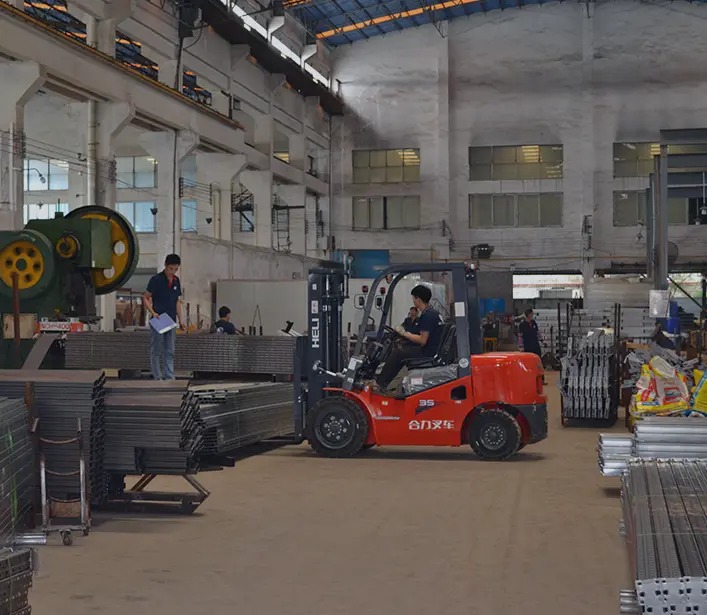
Operating out of our modern 30,000 square meter factory equipped with automatic laser cutters, high-speed roll forming lines, and robotic CO2 welding stations, our 300+ technicians fabricate over 30,000 metric tons of certified steel storage systems every month.
From Warehouse Architectural Drawing to Installation
We ensure transparent communication, zero design guesswork, and rigorous quality tracking at every stage of your custom racking project.
Layout & Civil Survey
We review your warehouse CAD drawing, ceiling truss clear height, floor slab concrete rating, column grid spacing, and forklift mast specifications.
Structural Simulation
Our senior engineers prepare a full 3D layout, lane clearance verification, seismic base plate sizing, and finite element moment deflection calculations.
CNC Roll-Forming & QC
Precision fabrication using certified steel coils. Batch testing covers weld seam penetration, coating thickness (70-90 microns), and hole pitch tolerances.
Export Packing & Dispatch
All uprights and rails are bundled with protective corrugated sheets, steel-strapped for container stuffing, and shipped with detailed numbered installation plans.
Drive-In Pallet Racking: Frequently Asked Questions
Clear, technically rigorous answers addressing structural safety, equipment compatibility, and international logistics.
Q1: How does Drive-In racking affect floor slab load ratings?
Drive-In systems generate concentrated point loads through upright base plates because vertical loads are distributed across fewer floor contact points than in selective racking. We engineer oversized steel base plates (up to 200x200x10mm) and calculate slab punch stress against your concrete grade (e.g., C25/30 or C30/37). Expansion or chemical anchors are specified based on site seismic zone calculations.
Q2: What forklift specifications are required for Drive-In lanes?
Standard counterbalanced forklifts or narrow-chassis reach trucks can be used, provided the overall chassis width is at least 150mm to 200mm narrower than the clear width between lane pallet support rails. Overhead operator guards must be measured to ensure they clear the cantilevers. We strongly recommend installing continuous floor-mounted guide rails to prevent mast-to-upright collisions.
Q3: Can wooden, plastic, and steel pallets be mixed in the same lane?
Because pallets rest solely on narrow side cantilever rails (typically 50-75mm support flange per side) rather than full horizontal beams, all pallets within a lane must share consistent outer base dimensions and good structural stiffness. Bottom deck boards must run perpendicular to the support rails. Damaged or undersized wooden pallets should never be used in drive-in systems.
Q4: What is the maximum recommended lane depth for Drive-In systems?
While systems can theoretically be engineered up to 10 or 12 pallets deep, common logistics practice limits Drive-In lanes to 4-7 pallets deep. Extremely deep lanes increase forklift travel time in reverse, increasing cycle duration and the probability of accidental upright impacts. For storage depths exceeding 8 pallets, a semi-automated Radio Shuttle Racking System is generally more efficient.
Q5: How does HEDA Shelves protect steel against corrosion in cold storage?
Low-temperature freezer environments (-20°C to -30°C) cause severe condensation during defrosting cycles. For freezer warehouses, we provide either Hot-Dip Galvanized (HDG) steel components in accordance with ISO 1461 (>65 microns zinc thickness) or specialized low-cure polyester outdoor powders over nano-ceramic phosphating, preventing micro-crack flaking.
Q6: What export documentation and trade terms do you provide?
HEDA Shelves supplies comprehensive export documentation for customs clearance, including Commercial Invoices, Packing Lists with component marking charts, Certificates of Origin (Form E, Form F, CO), Mill Test Certificates (MTC 3.1), and CE/ISO declarations. We operate under FOB Guangzhou/Shenzhen, CIF, CFR, and DDU/DDP terms worldwide.
Optimize Your Warehouse Density with HEDA Shelves
Send your building dimensions, pallet load requirements, and forklift specs to our structural engineering team. We will produce a complete AutoCAD warehouse layout, 3D rendering, and factory quotation within 24 hours.