Top-Tier Engineered Racking Systems & High-Density Storage Solutions
Procuring warehouse racking directly from premier Chinese OEM/ODM manufacturing facilities ensures uncompromised tensile load capacity, rigorous compliance with FEM 10.2.02 / ANSI MH16.1 specifications, and seamless global containerized delivery.
Strategic Sourcing: Navigating Global Supply Dynamics with Chinese Manufacturers
In the contemporary supply chain environment, international supply chain executives, logistics project directors, and 3PL facility operators face unprecedented pressure to reconcile soaring square-meter facility leasing rates with higher throughput demands. Sourcing industrial shelving and pallet racking systems directly from China's primary manufacturing hubs—particularly the Pearl River Delta industrial corridor centered around Guangzhou—has evolved far beyond a mere unit-price arbitrage maneuver. It is now a comprehensive strategic optimization involving structural reliability, finite element structural validation (FEA), metallurgical consistency, and international code compliance (CE, ISO 9001:2015, FEM 10.2.02, and AS4084).
To establish durable, cost-effective distribution hubs, procurement teams are abandoning standard off-the-shelf catalog racks in favor of engineered project packages. As industrial warehouse developments in India, Bangladesh, Pakistan, Sri Lanka, Southeast Asia, and the Middle East expand into cyclone-prone coastal sectors and high-seismic zones (such as Zone IV and Zone V), Chinese manufacturing partners must deliver documented baseplate engineering, anchor embedment calculations, dynamic moment-resisting beam-to-column connections, and specialized multi-stage pre-treatments.
Future Procurement Trends in Industrial Racking & Logistics Infrastructure
Direct from our chief structural design engineering team, here are the four mega-trends reshaping capital equipment expenditure across global logistics hubs.
1. Transition from Static to Semi-Automated Densification
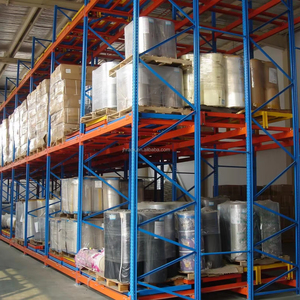
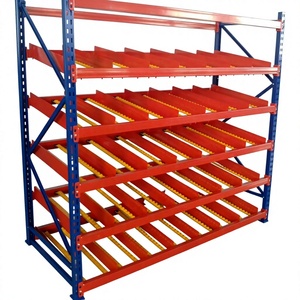
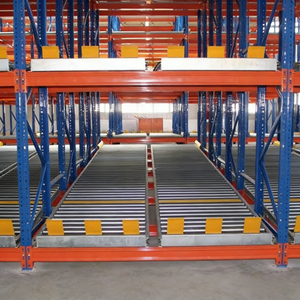
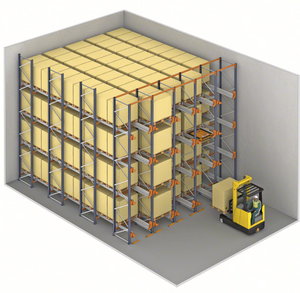
Rising commercial real estate rents in prime distribution nodes (such as Bhiwandi, Gurugram, Chattogram, and Colombo) make standard selective racking insufficient. Global buyers are rapidly adopting semi-automated Radio Shuttle and Carton Flow systems that offer 70% to 85% volumetric density while significantly lowering operator forklift collisions.
2. Anti-Corrosion Engineering for Coastal & Monsoon Climates
Standard solvent coatings quickly degrade in humid marine zones, causing rust along laser-cut perforations. Global buyers now mandate rigorous 9-stage pickling and phosphating pre-treatments followed by 60–80 micron thermo-hardened electrostatic epoxy powder finishes, with optional hot-dip galvanization (HDG) for extreme open-shed and sub-zero cold-store environments.
3. Container-Optimized Modular Engineering
With volatile maritime container freight charges, procurement directors prioritize dimensional pallet engineering that maximizes 40ft High Cube (40HQ) maritime container volume. Chinese engineering teams design interlocking nested column uprights, split-splice beam architectures, and knock-down structural mezzanine beams that minimize dead freight air space by up to 35%.
Structural Engineering & Storage Architecture Matrix
Compare access parameters, capacity ratings, rotation characteristics, and application suitability to match your SKU footprint.
| System Typology | Direct Accessibility | Volumetric Density | Stock Management | Unit Capacity (kg) | Primary Industry Suitability |
|---|---|---|---|---|---|
| Selective Pallet Racking | 100% Direct Picking | Medium (~40-50%) | FIFO / LIFO Flexible | 1,000 – 4,500 / level | Multi-SKU 3PLs, Retail DCs, General Machinery |
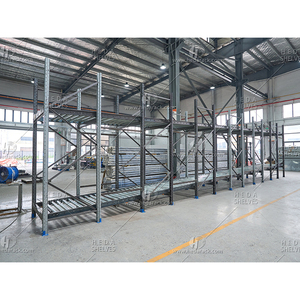
| Gravity Pallet Flow Rack | Lane Picking Face Only | Ultra-High (75-85%) | Strict FIFO | 500 – 1,500 / pallet | Dairy, Fresh Perishables, Beverage Bottling, Pharma |
| Intelligent 4-Way Shuttle | Automated Channel Access | Maximum (>88%) | Dynamic FIFO / LIFO | 500 – 2,000 / pallet | Cold Chain Stores, Deep Buffer Hubs, Dark Stores |
| Carton Live Flow Rack | Continuous Gravity Track | High Floor Density | Strict FIFO | 50 – 300 / lane level | E-Commerce B2C Picking, Automotive Assembly Lines |
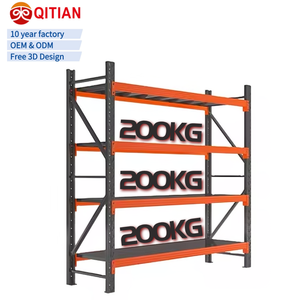
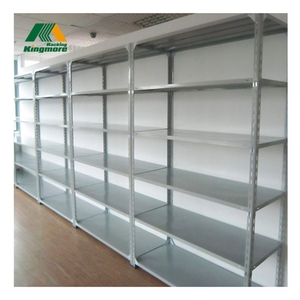
| Heavy Longspan Shelving | Manual Shelf Access | Moderate Floor Density | Manual Selection | 200 – 800 / shelf tier | Spare Parts Depots, Hardware Retail, Archive Storage |
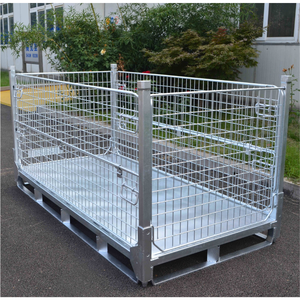
| Stackable Stillage Bins | Bulk Block Stacked | Flexible Scalability | Batch LIFO | 1,000 – 2,000 / cage | Foundries, Heavy Forgings, Stamping Logistics, Recyclers |
Technological Evolution: Smart Warehouse Racking & High-Tolerance Manufacturing
The manufacturing of warehouse shelving and racks in China has undergone a comprehensive technological transformation over the past decade. The industry has shifted from manual welding and basic stamping presses to fully integrated, computerized roll-forming production lines featuring automated servo-driven punching stations. In modern facilities like Guangzhou Heda Shelves Co., Ltd., raw certified hot-rolled coils undergo automated continuous slit-edge shaving, precision cold-bending, and synchronized punch indexing at millimeter-level tolerances. This high degree of precision ensures that beam end-connectors engage seamlessly with upright column teardrop and omega slots without structural binding, micro-fracturing, or residual internal shear stress.
Furthermore, structural engineering design workflows now combine 3D CAD modeling with advanced Finite Element Method (FEM) software simulations. In seismic calculation verifications, each connection node between the upright profile, the bracing diagonals, and the ground anchoring plate is modeled as a semi-rigid joint under varying load states. Chinese structural engineering teams design these assemblies to withstand dynamic horizontal ground accelerations based on the destination facility's specific Eurocode 8 or IS 1893 seismic parameters. This computational approach ensures that when hundreds of tons of dead weight are stored in high-bay structures up to 15 meters tall, the system maintains structural stability under both uniform dead loads and seismic lateral shifts.
Inside the Manufacturing Ecosystem: Guangzhou Heda Shelves Co., Ltd.
From prime steel raw materials to automated coating lines, explore the complete in-house production chain driving our global manufacturing performance.
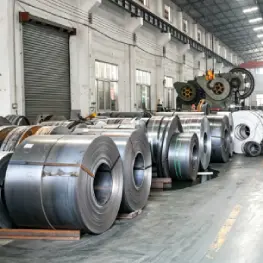
Certified Steel Coils
Direct sourcing of Q235B & Q355B coils verified via mill test chemical & yield certificates.
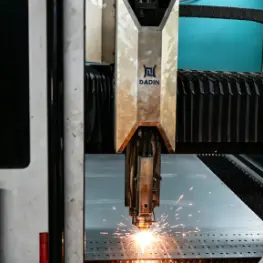
Precision Laser Slitting
Automated cutting and edge slitting ensure zero burrs and precise dimensional consistency.
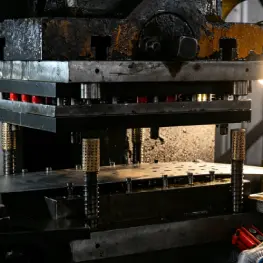
CNC Servo Punching
Continuous CNC punching lines ensure exact 50mm/75mm slot pitch consistency across all heights.
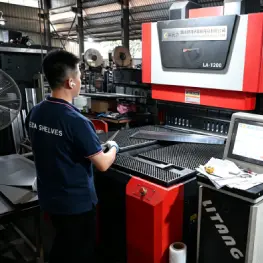
Multi-Pass Roll Forming
Up to 24 roll stations progressively profile high-tensile column sections without micro-fissuring.
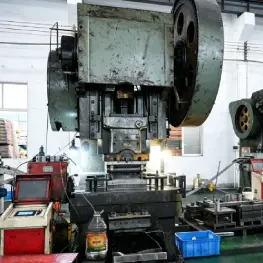
Robotic Beam Welding
Multi-axis automated welding robots apply deep-penetration CO2 welds on beam-to-claw connectors.
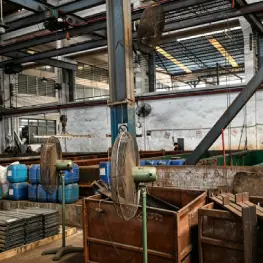
Pickling & Phosphating
Multi-stage immersion cleaning removes scale and oil, leaving a dense phosphate conversion coat.
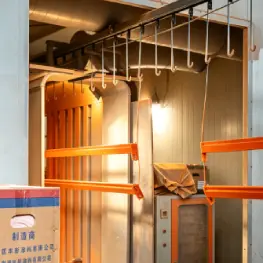
Electrostatic Powder Coat
Automatic reciprocating spray guns apply 60-80μm durable epoxy-polyester cured at 180°C.
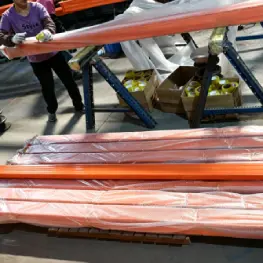
QC Audit & Steel Bundling
Stringent laser straightness audits, paint adhesion cross-hatch tests, and container protection bundling.
Why Leading Multinationals Partner with HEDA Shelves
Founded in 2001, Guangzhou Heda Shelves Co., Ltd. has grown from a specialized metal fabrication workshop into an international manufacturer of heavy-duty pallet racking, industrial shelving, and multi-tier structural mezzanine systems. Operating from our modern 30,000-square-meter facility in Guangzhou, our team of more than 300 experienced engineers, production technicians, and logistics specialists produces up to 30,000 tons of structural steel storage systems each month.
With more than 10,000 completed installations across 120+ countries, HEDA Shelves provides a fully integrated service model: complimentary 2D CAD engineering and 3D architectural renderings, structural calculations, container-optimized packaging, and comprehensive installation documentation. Our verified certifications demonstrate our ongoing commitment to international quality and safety benchmarks:
- CE Certification (Factory Production Control): Certificate No. 2435-CPR-8605159
- ISO 9001:2015 Quality Management System: Registration No. 18624Q00169R0M
- RoHS Compliance: Clean, non-hazardous surface finishing and powder chemistry
- OEM/ODM Capabilities: Custom steel profile cold-roll tool manufacturing & private labeling
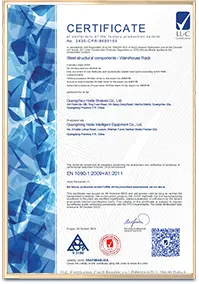
CE Certified
2435-CPR-8605159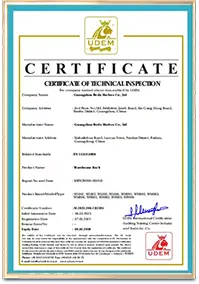
ISO 9001:2015
18624Q00169R0M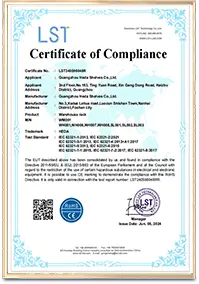
RoHS Verified
Hazardous Free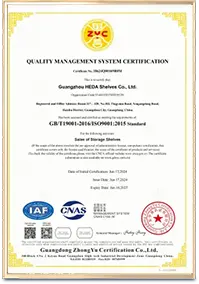
Factory Audited
Global StandardFrequently Asked Questions: Racking Procurement & Engineering
Direct technical answers to common queries submitted by industrial architects, warehouse project managers, and international procurement specialists.
What parameters are required to generate an accurate warehouse layout design and price estimate?
To produce an engineered CAD layout, 3D structural model, and transparent quote, our design team requires: (1) A clean architectural floor plan (DWG CAD or dimensioned PDF) detailing column grids, clear ceiling eaves height, fire-protection sprinkler heads, and rolling shutter door locations; (2) Detailed pallet dimensions including maximum length, width, height, and gross weight inclusive of the pallet base; (3) Operational forklift specifications including turning radius, minimum operating aisle width (AST), and maximum mast lift reach; (4) Total active SKU count and required inventory turnover rotation (FIFO vs. LIFO); (5) Project site geographical location to incorporate relevant seismic and wind-load codes into the structural baseplate calculations.
How do Chinese racking manufacturers safeguard systems against corrosion in tropical and coastal environments?
High relative humidity and coastal salt-spray present significant corrosion risks for structural cold-formed profiles. Premier manufacturers address this by operating automated continuous pre-treatment lines. Before painting, every steel profile passes through automated chemical degreasing, clean water cascades, acid pickling to strip mill scale, and zinc-phosphate immersion. This creates a non-conductive microscopic conversion layer that anchors the subsequent electrostatically applied epoxy-polyester powder coating (60–80 microns thick), preventing capillary under-film rusting. For open transit sheds, outdoor yards, and high-condensation sub-zero cold rooms (-20°C to -30°C), components can be specified with continuous pre-galvanized sheet roll-forming or post-welding hot-dip galvanization conforming to ISO 1461 standards.
What structural safety design codes govern the load capacities of your pallet racking systems?
Our heavy-duty pallet racking and multi-tier structural mezzanine installations are designed and calculated in full alignment with the European Racking Federation standards (FEM 10.2.02 / EN 15512), American National Standards Institute ANSI MH16.1, and the Australian AS 4084 steel storage racking standard. In these engineering calculations, safe working load (SWL) ratings incorporate structural safety factors between 1.4 and 1.65 against material yield strength, with maximum operational beam deflection strictly limited to L/200 (or L/250 upon request) under evenly distributed static loads.
How do you handle shipping logistics, container stowage, and on-site assembly overseas?
Finished structural upright frames, horizontal load beams, and decking components are packaged using heavy steel-band strapping, heavy corrugated wrap, corner edge-protectors, and dedicated wooden dunnage blocks. This bundling strategy protects finished coatings and ensures safe removal by standard reach-truck forks upon container destuffing. Our logistics team builds complete 3D digital container packing simulations to ensure maximum cargo volume utilization inside 40ft High Cube containers. Every exported system includes a comprehensive installation package: numbered component identification tags matching CAD construction layouts, step-by-step assembly drawings, bolt-torque specifications, and multilingual installation videos. For complex installations, large structural mezzanines, and automated shuttle systems, senior HEDA field installation engineers can be deployed on-site to direct local labor teams through commissioning.
What are the standard production lead times and Minimum Order Quantity (MOQ) thresholds?
Our baseline minimum order size typically corresponds to one standard 20-foot or 40-foot full container load (FCL), which optimizes international maritime freight costs per pallet position. Standard selective racking and longspan shelving systems are typically manufactured, inspected, and containerized within 14 to 20 working days following official architectural approval of the CAD layout drawings. Highly custom project orders—such as multi-tier rack-supported mezzanine floors, carton gravity flow systems, or radio shuttle high-density systems—generally ship within 25 to 35 working days, accommodating client-specific color matching, bespoke upright punching profiles, and integrated automated testing.
Ready to Maximize Your Warehouse Storage Capacity?
Connect directly with our senior logistics application engineers. Submit your floor dimensions, pallet parameters, and throughput targets to receive a custom 2D/3D CAD layout, structural calculation package, and competitive factory-direct estimate within 24 hours.
Inquire Now