Optimizing Modern Intralogistics Through Chinese Structural Engineering
In modern industrial real estate, vertical cubic space utilization directly dictates supply chain operational margins. China's premier racking and shelving manufacturing infrastructure delivers an unparalleled confluence of structural steel metallurgical precision, high-efficiency roll forming, and compliant seismic engineering.
Structural Integrity Standardizations: FEM, RMI, and EN Compliant Design
Procuring warehouse racking from top-tier Chinese manufacturers involves navigating rigorous material specifications and compliance certifications. Certified manufacturers utilize premium Q235B and Q355B cold-rolled structural steel, adhering to rigorous design frameworks including European FEM 10.2.02 and EN 15512, American RMI (Rack Manufacturers Institute) MH16.1, and Australian AS 4084 standards. From deflection limit tolerances (typically $L/200$) to frame seismic behavior analysis in seismically active global zones, Chinese heavy engineering ensures total operational safety under maximum rated dynamic and static loads.
High-Efficiency Warehouse Racking & Storage Systems
Review our core heavy-duty racking assemblies, structural platforms, and material handling solutions engineered to maximize storage density, speed picking velocity, and withstand demanding cycles.
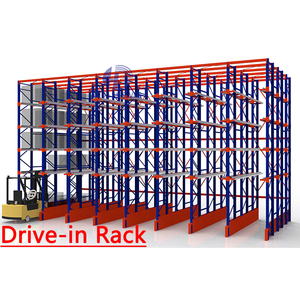
Engineered for bulk items and low SKU variety, eliminating operational aisles to achieve up to 80% spatial footprint efficiency via First-In Last-Out (FILO) flow.
- Load Capacity: 500–1,500 kg/pallet
- Structural Steel: Q235B Cold Rolled
- Pitch Adjustability: 75mm / 50mm increments
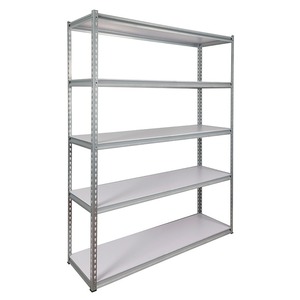
Modular post-pallet stacking stillages with anti-corrosive electrostatic powder coating, providing dynamic post storage for temporary hubs and heavy goods.
- Load Capacity: 1,000–2,000 kg/unit
- Surface Coating: Electrostatic Polyester
- Stacking Limit: Up to 4-tiers high
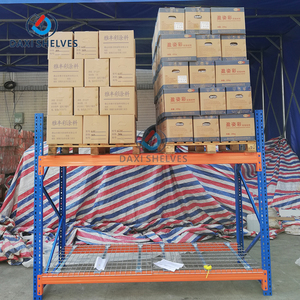
Motorized rail-guided high-density racking mounted on mobile bases. Unlocks single-aisle operational access, perfectly suited for temperature-controlled cold chains.
- Drive Mechanism: PLC-Controlled Motor
- Volume Gain: +100% Pallet Capacity
- Safety System: Photoelectric Light Barriers
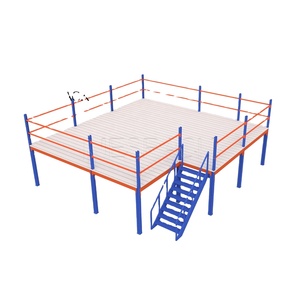
Turnkey multi-tier structural mezzanine systems doubling usable square meters without brick-and-mortar capital expenses. Custom beam spans engineered per floor dead/live load.
- Deck Load Rating: 300–1,000 kg/sq.m
- Decking Medium: Steel / Plywood / Grating
- Accessories: Staircases, Safety Gates
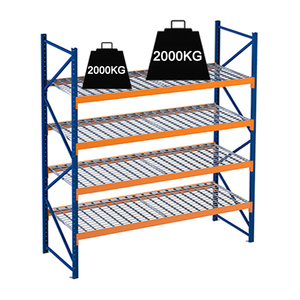
Heavy-duty demountable and stackable storage frames engineered for tire distribution centers, seasonal agri-bulk goods, and dynamic buffer logistics.
- Rated Capacities: 1,000 to 3,000 kg
- Base Construction: Reinforced Box Section
- Space Savings: Nest when empty
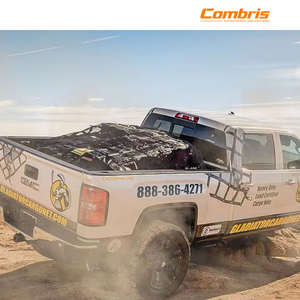
Tear-resistant PVC coated polyester fall-prevention mesh barriers. Essential containment protection across open flue spaces and pedestrian picking walkways.
- Material: High-Tenacity Polyester Mesh
- Properties: Flame & UV Retardant
- Compliance: OSHA Impact Safety Ready
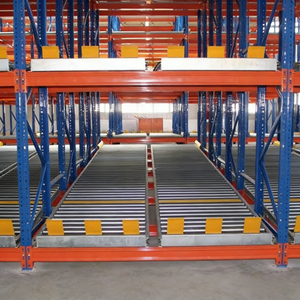
Inclined roller tracks utilize gravitational force for automated pallet transit from loading to retrieval aisles. Guarantees ideal First-In First-Out (FIFO) batch control.
- Load Capacity: 500–1,200 kg/lane
- Speed Control: Centrifugal Brake Rollers
- Incline Ratio: 3%–4% Gradient Angle
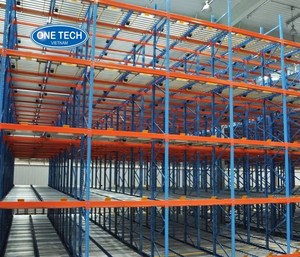
Heavy-duty structural framework equipped with steel brake rollers and entry separators for FMCG, dairy, and cold store distribution hubs requiring strict turnover.
- Frame Profile: Roll-formed Omega Uprights
- Quality Control: ISO 9001:2015 Monitored
- Operational Mode: Strict FIFO Stock Rotation
Quantitative Comparison of Modern Warehouse Racking Systems
A data-backed framework to assist supply chain managers and project engineers in evaluating storage density, pallet selectivity, capital expenditure, and operational velocity.
| Storage System Type | Pallet Selectivity | Floor Space Utilization | Stock Rotation Strategy | Capital Expenditure (CAPEX) | Operating Efficiency |
|---|---|---|---|---|---|
| Selective Pallet Racking | 100% Direct Access | 40% – 50% | FIFO / Random | Low (Baseline) | High (Universal forklifts) |
| Drive-In / Drive-Through | Lane-Level (10%–20%) | 70% – 80% | FILO (Drive-In) / FIFO | Medium | Moderate (Forklift enters lane) |
| Gravity Pallet Flow | Face-Level Selectivity | 75% – 85% | Strict FIFO | Medium-High | Very High (Automatic roll-up) |
| Mobile Pallet Racking | 100% On-Demand Access | 85% – 90% | Flexible | High (Motorized) | Moderate (Aisle open time) |
| Structural Mezzanine Platform | Area Dependent | Up to 200% Usable Space | Manual / Multi-tier | Medium | High for sorting & picking |
| Radio Shuttle Automation | Lane-Level Automated | 80% – 90% | FIFO & FILO Hybrid | High (Robotics) | Extremely High Throughput |
*Note: Storage system capacity modeling is determined by concrete floor slab specification (e.g. C25/30 200mm+ depth), slab deflection ratios, and live dynamic load criteria under seismic acceleration parameters.
Full-Chain Manufacturing Control: From Raw Coil to Coated Steel
Drawing on the core infrastructure of industry pioneers like Guangzhou HEDA Shelves Co., Ltd., we combine 20+ years of industrial rack manufacturing with integrated in-house fabrication, rigorous quality assurance, and seamless global logistics export channels.
10-Stage High-Precision Manufacturing
Every profile undergoes an uncompromised ten-stage fabrication pipeline: raw coil incoming spectroscopic inspection, CNC high-speed punching, continuous cold roll forming, precision robotic welding, automated multi-stage chemical degreasing, zinc-phosphating anti-corrosion bath, and automated electrostatic thermosetting powder curing at 200°C.
Stringent Quality & Certified Auditing
Full conformance with CE Certification (Standard 2435-CPR-8605159) and ISO 9001:2015 Quality Management (Certificate 18624Q00169R0M). Every batch is tested for yield strength, weld seam penetration depth, coating adhesion (cross-cut test), and salt spray corrosion resistance exceeding 500 hours.
Free Turnkey CAD / 3D Layout Design
Our dedicated technical engineering department provides full structural calculation reports, complete warehouse AutoCAD layout planning, 3D photorealistic renderings, and live load simulation within 24–48 hours, eliminating spatial conflicts before steel production begins.
Container Packing & Landed Cost Optimization
Exporting to over 120 countries requires sophisticated container packing algorithms. Steel uprights and horizontal beams are nested, bundle-strapped, and edge-protected to optimize 40ft High Cube (HQ) container cubage, dramatically lowering landed freight costs per pallet location.
Tropical & High-Humidity Engineering
Warehouses across Southeast Asia, South Asia, and the Middle East face severe humidity and saline air. Specialized multi-stage phosphating combined with heavy-micron powder coats and hot-dip galvanized (HDG) treatments guarantee rust prevention for over 15 years.
Complete OEM / ODM System Modularization
Complete custom profiling capability spanning upright beam columns (55mm to 120mm cross-sections), heavy box beams, step beams for wire mesh decking, structural I-beam mezzanines, and custom racking safety accessories with private label distribution support.
Future Trends Shaping Racking Technology & Global Procurement
The global warehousing landscape is undergoing unprecedented transformation fueled by rapid e-commerce expansion, omnichannel fulfillment, escalating industrial land values, and autonomous robotics.
1. Convergence with Autonomous Mobile Robots (AMR) & AS/RS
Static storage racks are rapidly evolving into integrated robotic interfaces. Future racking procurements prioritize tighter millimetric tolerances, flat-floor guide rails, and shuttle running tracks. High-Bay Automated Storage and Retrieval Systems (AS/RS) exceeding 30 meters in height demand ultra-precise cold roll forming tolerances ($<0.5\text{mm}$) to support high-speed robotic cranes.
2. Green Steel Metallurgy & Carbon Neutral Finishes
Global ESG mandates are prompting tier-1 exporters to adopt green steel sourced from electric arc furnaces (EAF) utilizing high-scrap ratios. Concurrently, powder coating lines are switching to low-VOC, heavy-metal-free formulas and lower curing-temperature polymers, directly reducing the embodied carbon footprint of large-scale logistics hub constructions.
3. Digital Twin Modeling & IoT Structural Deflection Sensors
The integration of smart IoT strain sensors into critical upright columns allows real-time structural health monitoring. Warehouses can now dynamically detect forklift impacts, dynamic overweight alerts, and gradual foundation settling, preempting rack collapses and optimizing preventative maintenance through digital twin warehouse models.
Procurement Shift: From Unit Purchase Price to Total Cost of Ownership (TCO)
Enterprise procurement professionals are shifting their evaluation models away from pure initial freight on board (FOB) pricing toward lifecycle Total Cost of Ownership (TCO). A racking system with superior steel yield strength (e.g., minimum yield point $f_y \ge 355\text{ N/mm}^2$), robotic continuous seam welding, and multi-stage anti-corrosion pre-treatment provides a 20+ year service life with negligible downtime. In contrast, under-engineered alternatives present chronic risks of beam deflection, paint delamination, structural fatigue, and catastrophic rack failure under accidental forklift impact.
Frequently Asked Questions by Industrial Buyers & Importers
Authoritative engineering answers addressing load capacities, floor slab requirements, customs clearance, seismic codes, and international freight containerization.
Q1. How do we determine the correct structural steel grade for our heavy pallet racking?
For standard heavy-duty selective and drive-in racks, structural grade Q235B (yield strength $235\text{ MPa}$) provides excellent balance of weldability, elasticity, and load resilience. For high-bay systems, heavy dynamic loading, or automated AS/RS applications with heights exceeding 10 meters, high-tensile Q355B steel is selected to minimize upright section thickness while maintaining exceptional load-bearing margins and preventing column buckling.
Q2. What warehouse floor slab information is required before generating a CAD racking layout?
Engineers require your warehouse concrete slab thickness (typically 150mm to 250mm), concrete compressive strength grade (e.g., C20/25, C25/30), joint placements, reinforcement details (single/double rebar layer or steel fiber), and maximum allowable point load (punching shear). This ensures baseplates, anchor bolt depths (M10–M16 mechanical or chemical wedge anchors), and column footings distribute dead and live weights safely.
Q3. How are overseas shipments packaged to prevent transit damage and maximize container fill rate?
Uprights are nested in heavy bundles interleaved with cardboard protection and corrugated cushioning, secured with heavy-duty PET straps. Horizontal beams and structural components are packed onto steel skids or heavy wooden bearers for seamless slip-sheet and forklift unloading. Fasteners, base plates, row spacers, and safety clips are packed in heavy-duty wooden crates, achieving over 90% 40HQ volumetric utilization.
Q4. What is the standard beam deflection limit under full safe working load (SWL)?
Under international standards including FEM 10.2.02 and EN 15512, the maximum allowable vertical deflection of a loaded rack beam must not exceed $L/200$, where $L$ is the clear span length between upright columns (for instance, a 2,700mm beam can deflect a maximum of 13.5mm under full rated load). Once pallets are removed, the steel beam must return fully to horizontal with zero permanent plastic deformation.
Q5. How does your manufacturing process address coastal corrosion and cold store condensation?
Our steel processing lines utilize an automated 5-stage pre-treatment: alkaline degreasing, hot water rinsing, acid pickling (rust removal), cold rinsing, and dynamic zinc phosphating. This chemically converts the steel surface into an inert crystalline layer that ensures superior adhesion for our thermosetting polyester electrostatic powder coating. For deep-freeze cold storage ($-25^\circ\text{C}$ to $-30^\circ\text{C}$) or humid outdoor coastal ports, hot-dip galvanizing (HDG) to ISO 1461 is applied.
Q6. Can your technical team engineer racking systems for high seismic risk zones?
Yes. By applying seismic acceleration criteria based on your project location’s design response spectrum (PGA / ground acceleration coefficient), our structural team utilizes finite element analysis (FEA) to engineer enlarged heavy-gauge baseplates, reinforced structural cross-bracing, dual-anchor post footings, and specialized beam connector locking mechanisms compliant with Eurocode 8 and AS 4084 seismic design codes.
Accelerate Your Intralogistics Storage Project Today
Looking to build a new distribution center, upgrade your vertical pallet density, or partner with a certified Chinese manufacturing facility? Our structural engineering team is available 24/7 to deliver custom layouts, seismic assessments, and factory-direct quotations.
Send an Inquiry