[email protected] Serving India · Bangladesh · Pakistan · Sri Lanka · Nepal
English (South Asia)
ISO 9001:2015 & CE Certified Structural Engineering

China Top Drive In Pallet Racking System Manufacturer & Exporter

Maximizing Cubic Utilization up to 85% with Custom Cold-Rolled Q235B/Q355B Steel Architectures Engineered for Cold Chains, Bulk Manufacturing, and Global Logistics Hubs.

Engineered Storage Equipment

High-Density Industrial Drive-In & Heavy-Duty Storage Systems

Standardized, seismic-resistant, and high-load storage racking lines manufactured to international FEM 10.2.02 and RMI MH16.1 structural standards.
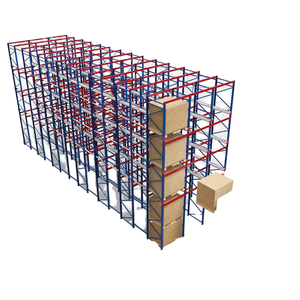
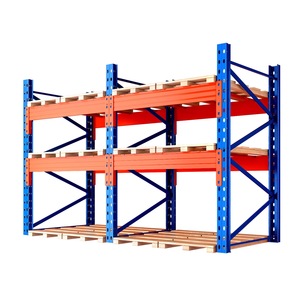
Mracking Heavy-Duty Drive-In Pallet Rack High Density
  • Load: 500–1,500 kg per pallet position
  • Steel Grade: Premium Cold-Rolled Q235B
  • Configuration: LIFO continuous lane lanes
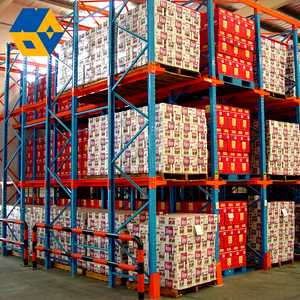
NOVA Customized Warehouse Drive-in Pallet Racking Custom Made
  • Finish: Electrostatic Powder Coated
  • Height: Scalable Upright to 12+ Meters
  • Guide Rails: Bolted ground guidance
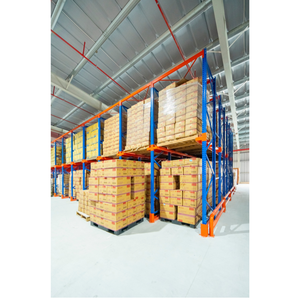
Heavy-Duty Industrial Warehouse Drive-In Storage Racks Thickened Steel
  • Upright Frame: Omega section 90-120mm
  • Cantilever Bracket: Stamped unbacked alloy
  • Design: Top-tie portal stabilization
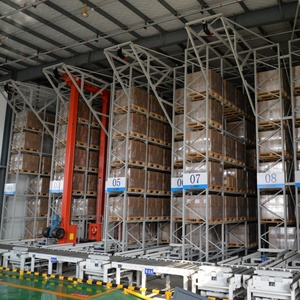
Customized Smart Warehouse ASRS Pallet Racking System Automation
  • Integration: Crane & Stacker compatible
  • Height: High-bay engineered up to 30M
  • Pallet Handling: Autonomous WMS interface
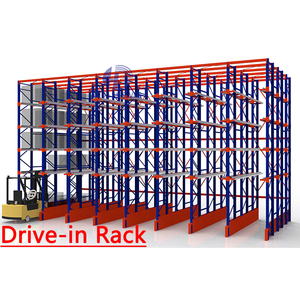
High Density Heavy Duty Drive in Rack System Cold Chain
  • Temperature: Certified to -30°C Freezers
  • Profile: Double-flanged continuous rails
  • Seismic: Anchor calculated baseplates
Heavy Duty Drive In Rack Bolted Guide Rails Bolted Rails
  • Floor Rails: Thick-walled angle guide track
  • Upright Protectors: Reinforced bull-nose wraps
  • Color: RAL Standard safety orange/blue
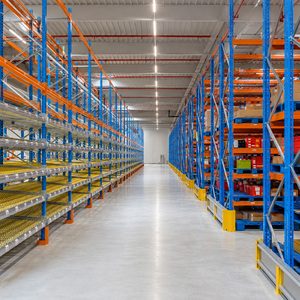
Porta Paletes Q235B Steel For 3PL Fulfillment Hubs 3PL Logistics
  • Structural Type: Selective & Drive-In hybrid
  • Beam Connector: 3-5 lug heavy claw design
  • Pitch Adjustment: 50mm / 75mm incremental
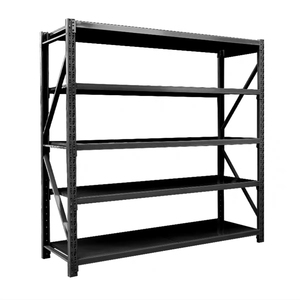
Long Span Medium Duty Warehouse Storage Shelves Medium Duty
  • Deck Type: Solid steel plate or wire mesh
  • Assembly: Completely boltless interlocking
  • Flexibility: Manual SKU picking pick-levels
Get Catalog
Structural Engineering Authority

Anatomy of Industrial Drive-In Racking Systems: Mechanics, Physics & Volumetric Efficiency

Drive-in pallet racking systems represent the pinnacle of static high-density warehouse storage, engineered specifically for operations characterized by low SKU variety and immense pallet volumes. Unlike conventional selective pallet racking—which requires operational access aisles between every rack run and yields a cubic space utilization rate of only 35% to 45%—drive-in systems eliminate redundant transit corridors. Forklift trucks navigate directly inside the physical racking bays to deposit and retrieve pallets, elevating total volumetric cube utilization to an impressive 75% to 85%.

From a structural mechanics perspective, eliminating traditional horizontal load-carrying beams across aisle faces transforms the static framework into a complex series of continuous vertical cantilevers. To prevent sway buckle and out-of-plumb progressive fatigue under full working loads, our engineering relies on specialized structural components:

Omega-Profile Upright Columns Cold-roll formed with 11–13 fold stiffness points from Q235B/Q355B high-tensile steel, resisting compound torsional bending stresses.
Heavy-Duty Support Rails Custom continuous C-section or flared guide rails stamped with rounded lead-in edges to center pallets safely during forklift deposit.
Portal Top Tie & Rear Bracing High-rigidity overhead transverse trusses and back X-bracing frames transferring torsional shear directly into warehouse structural slabs.
Impact-Absorbing Guide Tracks Floor-anchored hot-rolled angle steel guides protect upright bases from side-impact damage during high-frequency material handling.

Drive-in racking operates predominantly on the Last-In, First-Out (LIFO) inventory turnover principle, making it ideal for non-perishable batch manufacturing, chemical storage, beverage production, and seasonal agricultural commodities. When engineered with entry points on both sides, the configuration transforms into a Drive-Through system supporting First-In, First-Out (FIFO) material flows, indispensable for temperature-controlled cold chain logistics where batch expiration tracking is mandatory.
25+
Years Engineering Experience
30,000m²
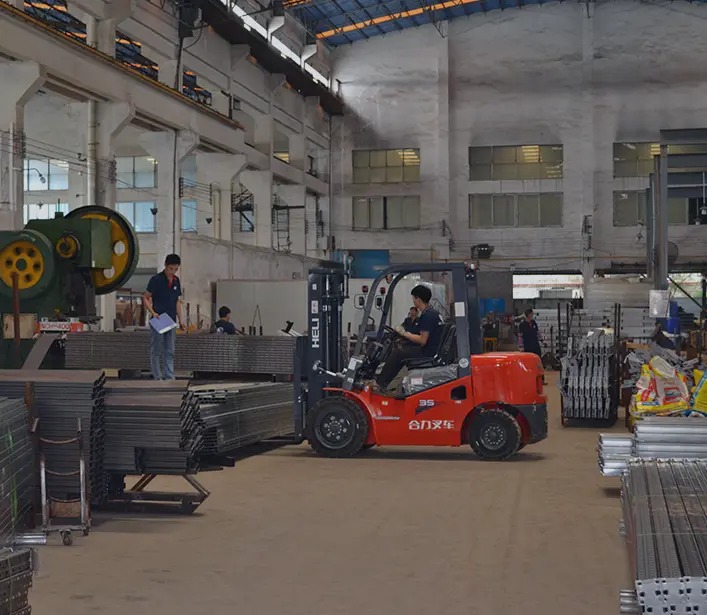
Modern Manufacturing Facility
30,000Tons
Monthly Structural Steel Capacity
120+
Export Destination Countries
Strategic Sourcing Whitepaper

Future Procurement Trends in High-Density Warehouse Storage

Navigating global supply chain volatility, decarbonization imperatives, and automated material handling demands over the 2025–2035 investment cycle.

Engineering Decision Matrix

High-Density Storage Systems: Comparative Engineering Guide

Compare mechanical characteristics, space efficiency, throughput dynamics, and capital investment requirements across premier industrial racking formats.

Storage System Type Cube Utilization Stock Rotation Pallet Selectivity Relative CAPEX Best Industry Application
Drive-In Pallet Racking 75% – 85% LIFO 15% – 20% (Lane-level) Economical Cold Storage, Beverage bottling, Chemical bulk, High batch-run FMCG
Drive-Through Racking 70% – 80% FIFO 15% – 20% (Lane-level) Moderate Agricultural harvest buffers, Expiry-sensitive ingredients, Dairy
Radio Shuttle Racking 80% – 90% FIFO or LIFO Lane Selective High Automation Blast Freezers (-30°C), High-throughput FMCG distribution, Raw meat hubs
Push-Back Cart Racking 65% – 75% LIFO 2–6 Pallets deep Moderate Medium SKU volumes, Staging areas in dispatch bays, Commercial 3PL
Selective Pallet Racking 35% – 45% Any (Unrestricted) 100% Direct Access Lowest Baseline Retail E-commerce DCs, Spare parts, Multi-SKU bonded warehouses
Automated High-Bay (ASRS) 85% – 95% WMS Optimized 100% Computerized Capital Intensive Mega-scale pharmaceutical hubs, Gigafactory lithium-cell aging vaults
Get Catalog
Traceable Manufacturing Excellence

From Prime Coiled Steel to Container Delivery: 10-Stage Factory Flow

Every structural element is cold-formed, punched, welded, pre-treated, and coated in-house within our 30,000 square meter Guangzhou production campus.
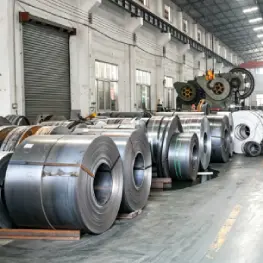
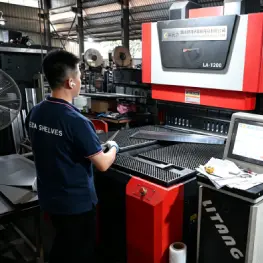
Raw materials steel coils
Stage 01
Mill-Certified Steel
Direct procurement of Baosteel/Shougang Q235B/Q355B coils with chemical composition and tensile elongation test verification.
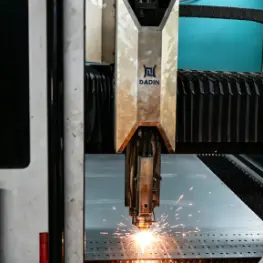
Precision steel slitting and cutting
Stage 02
Precision Slitting
Automated high-speed coil slitting to micron-level edge straightness tolerances, eliminating edge burrs prior to continuous cold forming.
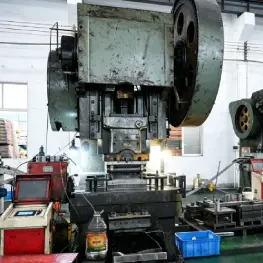
Automated column punching line
Stage 03
CNC Pitch Punching
Multi-station hydraulic CNC punching ensuring exact 50mm or 75mm tear-drop or butterfly hole spacing across uprights over 12 meters length.
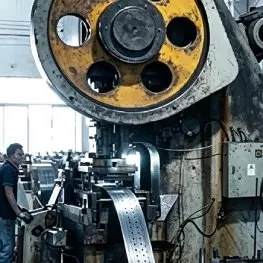
Cold bending and forming
Stage 04
Multi-Pass Cold Rolling
Continuous 18–24 roller forming stands produce cold-work hardened structural Omega uprights and structural boxed step-beam profiles.
Profile forming inspection
Stage 05
Laser Flying Cut-off
Continuous online servo-controlled shearing guarantees cut-length tolerances within $\pm 0.5\text{mm}$, essential for vertical plum tolerances.
Polishing and deburring
Stage 06
Robotic Deburring
Automated robotic grinding removes thermal spatter, sharp edge points, and weld flash to safeguard workers and pallet timber during usage.
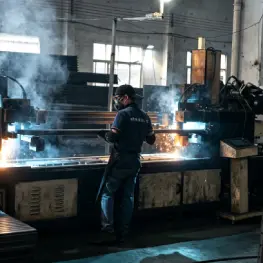
Robotic beam welding
Stage 07
Robotic GMAW Welding
Automated dual-torch pulse MIG welding connectors to beams, providing full throat penetration with zero porosity and ultra-consistent bead profiles.
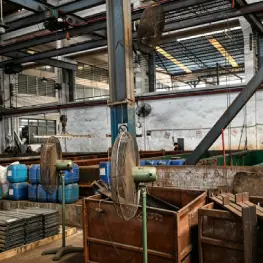
Pickling and phosphating tank
Stage 08
Pretreatment Bath
Full immersion 9-stage degreasing, hot acid pickling, and zirconium phosphating creates an impermeable nanotech conversion coat against corrosion.
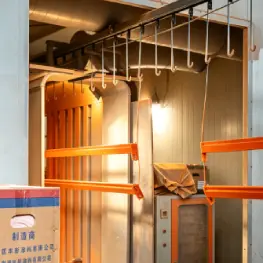
Electrostatic powder coating booth
Stage 09
Thermoset Powder Coat
Gema Swiss automatic electrostatic spray guns deposit 60–90 micron TGIC-free polyester powder, cured at 200°C for superior impact resilience.
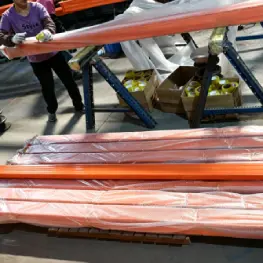
Quality control and container shipping
Stage 10
QC & Ocean Bundling
Batch mechanical bend testing, magnetic coating thickness audit, and customized maritime steel dunnage framing for 100% damage-free sea freight.
International Compliance

Audited Quality Management & Structural Safety Accreditations

Our engineering computations and factory processes are rigorously scrutinized by independent third-party notified bodies, safeguarding your enterprise capital investment.

CE Certified Factory
CE EN 15512:2020 Reg. No. 2435-CPR-8605159
ISO 9001 Quality System
ISO 9001:2015 QC Cert. No. 18624Q00169R0M
RoHS Environmental Compliance
RoHS Directive Clean Lead & Heavy-Metal Free Finish
AS4084 Standard Compliant
AS4084-2023 & RMI Australian & US Standards
Procurement Knowledge Base

Frequently Asked Engineering & Sourcing Questions

Direct answers from our senior racking structural engineering team addressing load capacities, building clearances, seismic factors, and installation protocols.

How do you verify warehouse concrete slab suitability for drive-in racking loads?
Drive-in systems generate intense concentrated point loads through baseplates, as single upright columns carry multi-tiered cantilever pallet lines without intermediate cross beams. Our structural engineers require your concrete slab thickness (typically 180mm to 250mm minimum), compressive strength rating (e.g., C25/30 or C30/37), sub-base compaction coefficient, and reinforcement mesh details. We calculate the exact punching shear stress and provide enlarged, laser-cut heavy baseplates (e.g., $150 \times 200 \times 8\text{mm}$) secured with high-grade M12–M16 mechanical expansion or chemical anchors to distribute point loads safely.
What is the primary mechanical distinction between Q235B and Q355B steel in racking?
Q235B possesses a nominal yield strength of $f_y = 235 \text{ MPa}$, offering excellent ductility, formability, and cost-efficiency for low to medium bay heights. Q355B (equivalent to European S355 and American ASTM A572 Grade 50) delivers an elevated yield strength of $f_y = 355 \text{ MPa}$—over 50% stronger. By specifying Q355B on heavily loaded bottom upright segments and top portal beams, we can reduce overall profile wall thickness while dramatically boosting buckling resistance, resulting in lighter freight shipping weights and superior seismic performance.
How does drive-in racking mitigate forklift impact risks inside drive channels?
Because forklifts physically operate inside the narrow storage lanes, impact protection is paramount. Our engineering incorporates three layers of physical defense: (1) Floor-mounted heavy structural angle or C-channel guide rails that restrict forklift lateral deviation to within $\pm 20\text{mm}$; (2) Reinforced wrap-around upright column protectors fabricated from 6mm hot-rolled steel featuring high-visibility safety polyurethane finishes; and (3) Flared entry horn brackets on pallet rails that guide misaligned pallets safely onto the load bed.
Can a drive-in racking installation be converted into an automated shuttle system later?
Yes, provided the system is engineered from day one with shuttle compatibility in mind. Standard drive-in pallet rails have a simple L-angle or flanged lip profile unsuitable for automated shuttle wheels. However, if you notify our CAD design team during the conceptual phase, we will construct the upright matrix and bay depths to standard shuttle dimensions and utilize modular bracketry. Future conversion merely requires unbolting the continuous drive-in rails and installing precision radio shuttle galvanized guide tracks, cutting total modernization costs by 60%.
What pallet types are suitable for drive-in racking, and does bottom runner orientation matter?
Pallet construction and orientation are critical. Drive-in systems require pallets to rest on two cantilever side rails rather than full front-to-back beams. Consequently, pallets must be placed with their bottom bottom runners perpendicular to the pallet rails or possess robust perimeter bottom boards (e.g., Euro pallets $800 \times 1200\text{mm}$ or GMA standard $40 \times 48\text{ inch}$). Two-way notched timber pallets with weak bottom runners can deflect or collapse when suspended on cantilever rails. We inspect your pallet specifications and can supply pallet support bridges if mixed pallets are used.
How are components packaged for long-distance ocean shipping to eliminate corrosion?
Export shipments endure high sea-freight humidity and salinity. We utilize a multi-stage packing methodology: upright frames and beams are nested with non-abrasive high-density polyethylene (HDPE) corrugated buffer sheets between finished powder-coated surfaces, strapped with heavy polyester banding onto dedicated steel lifting skid bases. Bundles are fully enclosed in VCI (Vapor Corrosion Inhibitor) stretch wrap and moisture desiccant bags. Every 40ft High Cube container is mathematically loaded using 3D stuffing software to prevent transit shift and maximize ton-per-container volume.

Plan Your High-Density Storage Transformation

Connect directly with our senior racking structural engineering department. Provide your warehouse floor plan (DWG/PDF), clear internal ceiling height, pallet dimensions, and SKU profile for a complimentary 3D layout simulation, seismic computation, and turnkey quote within 24 hours.