Industrial Pallet Racking & Warehouse Storage Systems
Precision-manufactured in our 30,000 m² Guangzhou production facility. Tested against FEM, EN 15512, and AS4084 structural load standards.
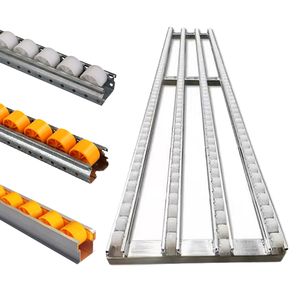
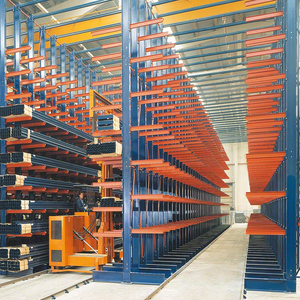
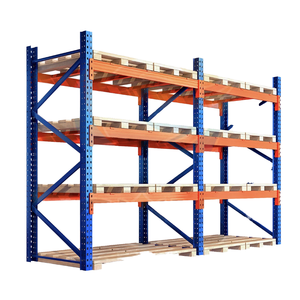
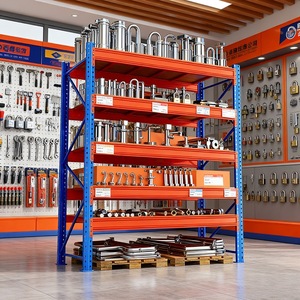
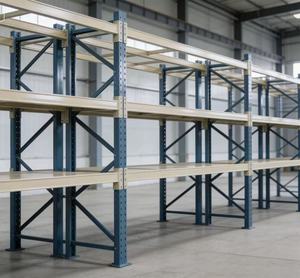
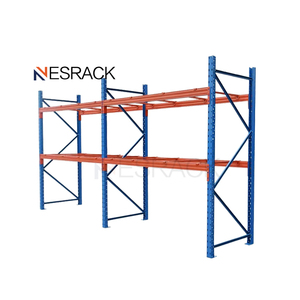
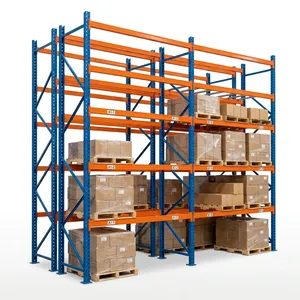
Strategic Engineering of Double Deep Pallet Racking in Modern Logistics Facilities
As global real estate pressures escalate, international warehouse design demands maximum volumetric utilization without completely forfeiting pallet selectivity. Double deep pallet racking represents an elite compromise between pure selective pallet racks (100% immediate access, but ~35% warehouse cubic utilization) and compact systems like drive-in or radio shuttle storage. By placing two pallet loads deep in a back-to-back layout (four pallets deep per dual-entry bay), double deep systems systematically eliminate one out of every three forklift operating aisles. The outcome is a structural density gain of 30% to 45% compared to single-depth racking, while preserving 50% immediate pallet selectivity.
Structural Performance Standard: All HEDA Shelves double-deep frames and box-beam assemblies are engineered to EN 15512:2020 and RMI MH16.1 specifications, maintaining a minimum safety factor of 1.5 under maximum certified static loads and complying with elastic buckling resistance criteria under ISO 9001:2015 controlled fabrication.
Kinematic Interaction: Pantograph vs. Telescopic Reach Mechanism
Deploying a double deep system requires a profound technical understanding of lifting kinematics. Because inner pallets must be retrieved over the top of empty outer beam positions, specialized material handling equipment is mandatory. Facilities typically deploy either a pantograph-style scissor double-reach truck or a mast-integrated telescopic fork reach truck. Under dynamic operations, lifting a 1,000 kg to 1,500 kg unit load at an extended reach of 1,200 mm introduces substantial torsional and eccentric bending moments on both the forklift mast and the structural support beams.
Consequently, double deep racking beams must be engineered with higher section modulus ($W_x$) and strict vertical deflection thresholds limited to $\leq L/200$ (or even $L/300$ for elevated positions exceeding 8 meters) to prevent dynamic sway, operational snagging, or premature fatigue wear on beam connectors.
System Performance Comparison: Double Deep vs. Alternative Warehouse Typologies
| Racking Architecture | Pallet Selectivity | Floor Footprint Utilization | Required Aisle Width | Forklift Equipment Complexity | Capital Expenditure Index |
|---|---|---|---|---|---|
| Selective Pallet Racking | 100% Direct Access | 35% - 40% | 3.0m - 3.5m (Standard Counterbalance) | Low (Standard Counterbalance / Reach) | Baseline (1.0x) |
| Double Deep Pallet Racking | 50% Two-Deep Access | 55% - 65% | 2.8m - 3.2m (Double Reach Truck) | Medium (Pantograph / Telescopic Mast) | 1.15x - 1.25x (High ROI) |
| Drive-In / Drive-Through | <15% (LIFO / FIFO Bulk) | 65% - 75% | No internal aisles (Drive-through lanes) | Low-Medium (Standard Mast width check) | 1.4x - 1.6x |
| Very Narrow Aisle (VNA) | 100% Direct Access | 50% - 60% | 1.6m - 1.9m (Turret Truck / Wire Guided) | Very High (VNA Man-up / Turret Trucks) | 2.2x - 2.8x |
| Semi-Automated Radio Shuttle | Channel Selective (LIFO/FIFO) | 75% - 85% | 3.0m (Single loading/unloading face) | Medium + Lithium Shuttles & RF Controllers | 2.5x - 3.5x |
Cold-Formed Structural Steel Metallurgy: Q235B vs. Q355B Uprights
Structural reliability in high-density storage starts with the raw steel coil chemistry. HEDA Shelves utilizes certified Q235B and high-tensile Q355B hot-rolled strip steel, roll-formed into continuous closed-open omega profile uprights. The yield strength ($\sigma_y$) of Q355B exceeds 355 MPa, providing exceptional load-to-weight ratios that allow frame capacities exceeding 24,000 kg per upright bay. Precision-punched diamond or teardrop holes at 50mm or 75mm increments ensure interlocking beam connectors grip securely through gravitational self-locking action, fortified by high-tensile spring steel safety locking pins resisting shearing forces up to 10 kN.
Guangzhou Heda Shelves Co., Ltd. - Global Manufacturing Authority
Founded in 2001, HEDA Shelves operates a modern 30,000 square meter industrial manufacturing base in South China, producing over 30,000 metric tons of certified racking monthly for export across 120+ countries.
25+ Years Racking Engineering
Over two decades of structural design competence, handling complex projects across cold chain logistics, automotive distribution, FMCG manufacturing, and dangerous chemical storage facilities worldwide.
Complimentary CAD & 3D Modeling
Our dedicated engineering department creates complete structural drawings, 3D renderings, and floor-slab load simulations within 24 hours of receiving site schematics and pallet dimensions.
CE & ISO 9001:2015 Verification
Every structural profile conforms to CE Certificate No. 2435-CPR-8605159, ISO 9001:2015 Quality System Registration No. 18624Q00169R0M, and rigorous European RoHS surface safety standards.
Full OEM/ODM Customization
Custom beam profiles, dual-thickness upright gauges (1.5mm to 2.5mm), custom electrostatic RAL powder coating, and private label branding to match global client procurement guidelines.
Container-Optimized Logistics
Precision component bundling and nesting algorithms achieve maximum 20GP and 40HQ container cube utilization, minimizing ocean freight rates per pallet location across all target ports.
7-Tank Corrosion Pre-Treatment
Pickling, degreasing, and zinc phosphating pre-treatments guarantee high surface adhesion for our electrostatic epoxy-polyester coatings, resisting marine climate salt spray and monsoon dampness.
10-Stage Precision Manufacturing Workflow
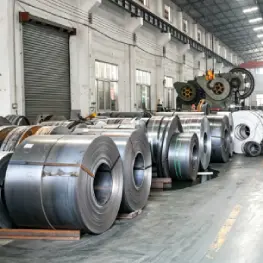
01. Certified Steel Coils
Spectrometric tensile and composition testing of steel strips.
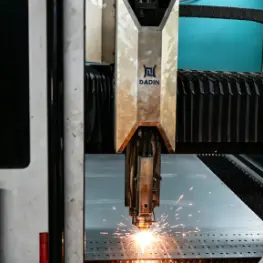
02. Precision Slitting
Laser and high-speed CNC shearing with ±0.5mm tolerance.
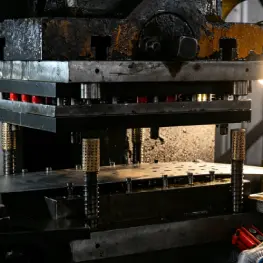
03. Automatic Punching
Continuous hydraulic stamping for accurate hole pitches.
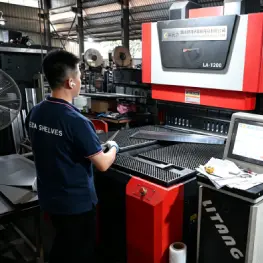
04. Cold Roll-Forming
Multi-roller forming lines preventing internal stress buildup.
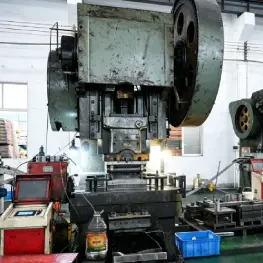
05. Beam Profiling
Interlocking box beams welded for maximum torsional rigidity.
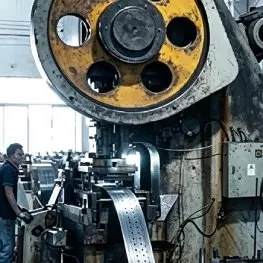
06. CNC Polishing
Automated edge radius de-burring for smooth, safe installation.
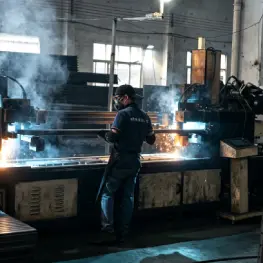
07. Robotic Welding
CO2 gas-shielded automated welding of beam connector brackets.
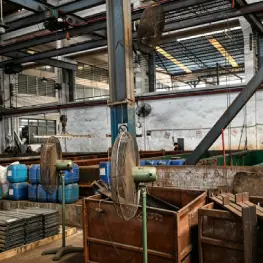
08. Acid Pickling & Phosphating
Eliminates oil, scale, and rust to guarantee 100% paint bonding.
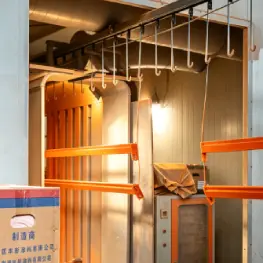
09. Electrostatic Coating
60-90μm high-molecular epoxy powder cured at 200°C.
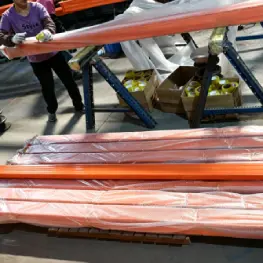
10. Final QC & Bundling
Micrometer thickness checks, weight test, and sea-freight crating.
Future Procurement Trends in Double Deep Racking Systems (2025–2030)
The international warehousing sector is experiencing a generational shift driven by high-density automation, aggressive energy management, and stringent sustainability standards. Global supply chain leaders and third-party logistics (3PL) conglomerates must structure their capital expenditure (CapEx) around four dominant technological trends transforming the double deep storage landscape.
1. Automated Guided Reach Trucks (AGV-R) & AMR Integration
Manual reach truck operations at elevated double-deep storage positions (heights exceeding 8.5 to 11 meters) face diminishing productivity curves due to driver visibility restrictions and positioning delays. Modern facilities are rapidly adopting Automated Guided Vehicles (AGVs) equipped with 3D LiDAR, dual-pantograph hydraulic masts, and optical pallet-pocket recognition cameras. Future-proof double-deep racking procurement requires tighter manufacturing tolerances (±1.0mm frame plumbness per 1,000mm elevation) and specialized guide-rail profiles or magnetic in-floor navigation corridors to facilitate continuous 24/7 autonomous pallet induction.
2. Cold Chain Footprint Minimization & Cubic Conservation
Refrigerated and frozen food distribution facilities operate under intense energy consumption constraints, where chilling costs correlate directly with total building volume. Double deep pallet racking has emerged as the premier layout architecture for sub-zero (-18°C to -25°C) logistics centers. By converting wasted aisle space into active storage bays, cold store operators lower their thermal dissipation area per pallet position by 22% to 28%. Procurement guidelines now consistently specify low-temperature impact-resistant steel grades, galvanized baseplates, and freeze-rated polyurethane powder coatings to prevent embrittlement and corrosion.
3. Structural Health Monitoring (SHM) & Impact Sensor Networks
Because double-deep reach trucks navigate tighter clearances while supporting long-moment loads, structural impact risks on front upright columns are statistically higher than in wide-aisle configurations. Forward-looking procurement specifications incorporate wireless IoT vibration and strain sensors permanently affixed to frame bottom zones. These sensors instantly alert facility managers via warehouse management system (WMS) dashboards whenever an upright absorbs an impact exceeding 500 Joules, streamlining preventative maintenance and reducing catastrophic collapse risks.
4. Carbon Border Adjustment Mechanism (CBAM) & Green Steel Sourcing
With international carbon border tariffs tightening across Europe and North America, multinational enterprises demand verifiable Environmental Product Declarations (EPDs) from Chinese exporters. Top-tier manufacturers like HEDA Shelves are transitioning toward electric arc furnace (EAF) processed steel, non-toxic heavy-metal-free thermosetting powders, and closed-loop water treatment in chemical pretreatment tanks, substantially lowering Scope 3 embodied carbon per metric ton of exported racking.
Standardized 4-Step Global Project Delivery
From initial structural site audit to customs-cleared sea-freight delivery, our standardized workflow guarantees transparent milestones and uncompromised quality.
Structural Audit
Review of warehouse architectural CAD layouts, clear ceiling heights, slab core samples, seismic coefficients, and forklift reach specifications.
CAD & 3D Modeling
Generation of comprehensive load-deflection profiles, pallet layout schemes, bay cross-sections, and structural calculations within 24 hours.
Precision Fabrication
Automated roll-forming, robotic welding, 7-tank anti-corrosion chemical treatment, and electrostatic powder coating under ISO 9001:2015 QC.
Global Dispatch
Protective packaging, container-stuffing density optimization, bill of lading documentation, and local installation blueprint packages.
Frequently Asked Questions for Double Deep Racking Procurement
In-depth answers to critical architectural, financial, and mechanical questions asked by global warehouse engineering and logistics consultants.
Accelerate Your Warehouse Capacity with Certified Engineering
Submit your warehouse layout, pallet dimensions, and operational throughput targets. Our senior racking structural engineers will generate a complimentary CAD floor plan, 3D simulation, and itemized CIF/FOB cost analysis within 24 hours.