Q1 How do Q235B and Q355B steel grades differ in structural racking engineering?
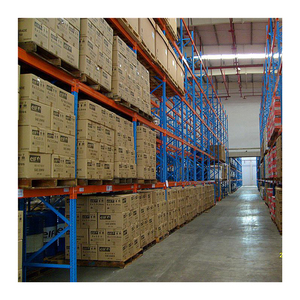
Q235B steel offers a minimum yield strength of 235 MPa and ultimate tensile strength between 370–500 MPa, making it the globally adopted cost-effective standard for standard selective pallet racks and light-to-medium cantilever arms. Q355B (equivalent to European S355 or ASTM A572 Grade 50) delivers a significantly higher yield strength of 355 MPa. We specify Q355B for high-bay upright columns exceeding 9 meters, seismic moment frames, and heavily loaded structural mezzanine beams (1,000+ kg/m²), allowing reduced member self-weight while comfortably resisting extreme axial compression and buckling forces.
Q2 Which international structural safety and quality certifications are mandatory for project auditing?
Reputable warehouse racking projects must comply with the European standard EN 15512 (Steel static storage systems – Adjustable pallet racking systems – Principles for structural design) and FEM 10.2.02. In the United States, racks must meet ANSI MH16.1 (Specification for the Design, Testing and Utilization of Industrial Steel Storage Racks by the RMI). HEDA Shelves holds third-party audited CE Certification No. 2435-CPR-8605159, ISO 9001:2015 Certification No. 18624Q00169R0M, and RoHS compliance certificates. Full mill test reports, steel chemical assays, and structural load deflection calculation reports are supplied with every project dossier.
Q3 What exact technical information is required to receive a free 2D CAD layout and formal quotation?
To produce an optimized CAD proposal within 24 hours, our engineering design office requires:
(1) Warehouse architectural drawings indicating clear height under roof trusses, column grids, fire shutter positions, and emergency egress pathways;
(2) Pallet dimensions (Length × Width × Height, including pallet overhang) and gross maximum weight per loaded pallet;
(3) Number of distinct SKUs and required pallet positions;
(4) Handling equipment specifications—specifically forklift model, mast collapsed height, maximum lift height, and minimum right-angle stacking aisle width (Ast);
(5) Warehouse floor slab thickness and concrete compressive strength (e.g., 200mm slab, 25–30 MPa rating).
Q4 How does electrostatic powder coating compare with hot-dip galvanizing for industrial racking?
For standard ambient warehouses (temperatures from 0°C to 50°C, relative humidity under 75%), thermosetting electrostatic epoxy-polyester powder coating (60–80 microns) delivers excellent impact toughness, scratch resistance, and color versatility (RAL codes for aisles and load beams). For outdoor lumber yards, chemical washdown facilities, open-sided transit sheds, or blast-freezer cold chain storage (-25°C to -30°C where condensation is severe), hot-dip galvanizing (HDG) per ISO 1461 is recommended. HDG forms a metallurgical zinc-iron alloy barrier exceeding 70–85 microns, offering lifetime cathodic rust protection in extreme climates.
Q5 How does your engineering team design racking systems for high-risk seismic zones?
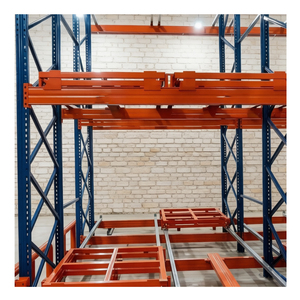
Seismic design requires dynamic spectral analysis based on project site geographical coordinates per regional seismic hazard maps (e.g., Eurocode 8, ASCE 7, or IS 1893). Our engineers verify ground acceleration coefficients, soil site classes, and ductility reduction factors. We incorporate enlarged heavy-duty base plates with multiple heavy M12/M16 chemical or wedge expansion anchors, increase steel profile gauge thicknesses, integrate vertical cross-bracing and top horizontal plan-bracing towers, and reinforce beam-to-column connector moment resistance to prevent rack collapse during lateral earthquake oscillations.
Q6 How do you maximize ocean container packing density and protect components during sea transit?
Ocean freight often accounts for a major portion of landed racking expenditure. We utilize computerized 3D nesting container loading software to sequence upright frames, nested box beams, and accessories inside 40ft High Cube (40HQ) containers, regularly achieving 24–26 metric tons per container. Upright frames are bundled with protective corrugated paper and heavy-duty steel bands; beam connectors are foam-wrapped to prevent metal-on-metal abrasion; small components (safety pins, row spacers, shims, anchors) are packed in reinforced wooden crates with desiccant packs to prevent moisture condensation during trans-oceanic routes.
Q7 What support do you offer for installation at the destination warehouse?
Every international shipment includes a complete structural assembly manual, certified engineering blueprints with numbered component match-marks, and step-by-step video instructions. Base shims, anchor bolts, and frame assembly hardware are clearly tagged. For large distribution centers, multi-tier mezzanine floors, or automated shuttle installations, HEDA Shelves can dispatch bilingual on-site installation supervisors to direct local mechanical contractor teams, perform final laser alignment inspections, and sign off on safe operational commissioning.
Q8 What deflection limits are used for beam loading and structural safety factors?
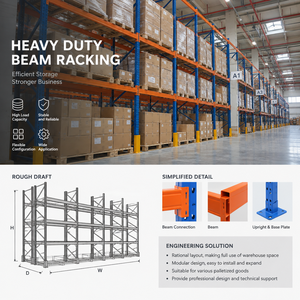
In strict accordance with EN 15512 and FEM 10.2.02 codes, the maximum allowable vertical deflection for horizontal pallet load beams under full uniformly distributed load (UDL) is limited to $\delta \le L/200$, where $L$ is the clear span distance between upright columns (or $L/300$ for automated handling systems). The structural safety factor applied against material yield and ultimate tensile failure is a minimum of 1.5 to 1.95. Every beam level must be secured with two mechanical spring-steel locking clips that require a minimum upward force of 5.0 kN to disengage, eliminating accidental dislodgment by forklift forks.