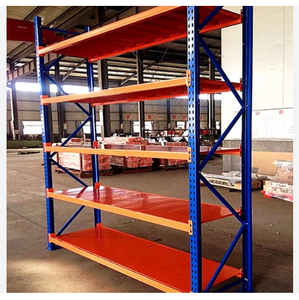
 Heavy Duty
Mracking 4/5 Tier Heavy Duty Adjustable 500kg-3000kg Steel Storage Rack Shelf
- Capacity: 500kg to 3,000kg UDL / Tier
- Pitch adjustment: 50mm / 75mm tear-drop hole pitch
- Finish: Anti-corrosive electrostatic powder coat
Engineered for extreme structural reliability, high density, and operational throughput. Explore our high-demand pallet racking, vertical sheet metal roll-outs, automated drive-in bays, and heavy tooling racks built direct from China's primary manufacturing hub.
Heavy Duty
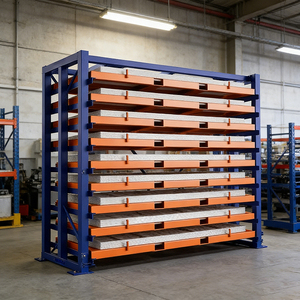 Roll-Out Trays
 Sanitary Grade
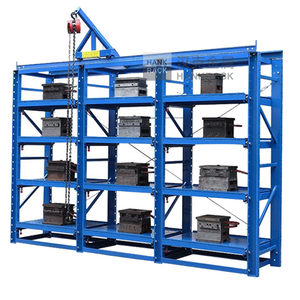 Tooling Storage
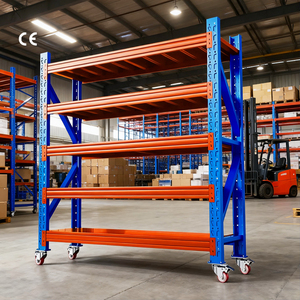 Mobile Flexible
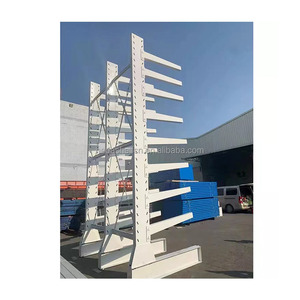 Long Goods
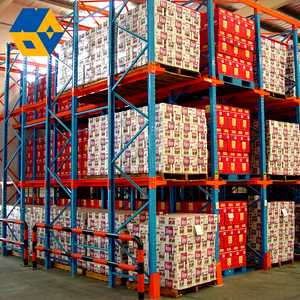 High Density
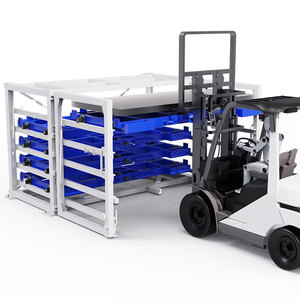 Collapsible
Operating from our comprehensive modern industrial manufacturing base in Guangzhou, China, we combine 25+ years of mechanical structural engineering with massive capacity to deliver certified, damage-proof racking systems worldwide.
Our facility runs 18 dedicated continuous cold-roll forming lines equipped with multi-station CNC punching cassettes. We achieve an upright perforation tolerance within ±0.1mm, ensuring infallible beam-to-column connector engagement, seamless load transfer, and instant site installation.
Full production compliance with European Standard EN 15512:2020 (Steel static storage systems), CE Certification No. 2435-CPR-8605159, and ISO 9001:2015 Quality Management System No. 18624Q00169R0M. Complete third-party mill test certificates (MTC) supplied with every heat number.
Components undergo an automated 10-stage surface pretreatment including alkaline degreasing, ultrasonic water rinsing, zinc phosphating, and deionized neutralization before receiving an 80–120μm electrostatic thermosetting epoxy-polyester powder coat, exceeding 1,000 hours of salt spray exposure.
Full in-house process control guarantees structural consistency and eliminates hidden subcontractor defects.
Prime Baosteel/Shougang Q235B & Q355B coils verified via tensile & spectrometer analysis.
Precision multi-blade longitudinal slitting maintains exact profile width tolerances.
Continuous CNC web-punching ensures uniform pitch repeatability across full 12m upright lengths.
Progressive 24-station cold-roll tooling eliminates internal structural stress and micro-cracking.
Automated dual-torch robotic MIG/MAG submerged welding for interlocking box beam profiles.
Multi-claw welded beam end-connectors tested to resist critical torsional yield loads.
Acid pickling, zinc phosphating, and multi-rinse baths remove all mill scale and surface grease.
Swiss Gema automated powder spray booths deliver high film uniformity across all internal angles.
200°C polymerization tunnel ensures full chemical cross-linking and impact resistance.
Dunnage protection, steel banding, and CAD-planned loading maximize 40HQ cube-out capacity.
As warehouse real estate costs surge globally and automated material handling enters mainstream adoption, enterprise buyers are migrating away from generic catalogue shelving toward high-precision structural racking systems engineered for automation, longevity, and sustainability.
Global procurement heads now specify automated storage tolerance criteria upfront. Traditional manual racking allows deflection rates up to L/200, but automated 4-way radio shuttle and crane AS/RS configurations mandate tighter tolerances (L/300 to L/400) to avoid optical sensor fault triggers and automated vehicle hang-ups. Procurement is shifting to manufacturers capable of sub-millimeter factory calibration.
With industrial land acquiring premium pricing in tier-1 logistics hubs across Asia, Europe, and the Americas, buyers are investing in high-bay vertical architectures reaching 15m to 30m clear heights. Rack-supported building structures (clad-rack warehouses) are replacing conventional brick-and-mortar facilities, slashing construction timelines by 40% and optimizing capital tax depreciation.
Forward-thinking purchasing directors evaluate total landed cost per pallet position. China's top racking exporters achieve superior economies of scale by bundling specialized nesting profiles that compress freight volume in 40ft High Cube containers. A properly packed container reduces international shipping charges by $4.50 to $8.00 per pallet location.
| Racking Architecture | Pallet Selectivity | Density Ratio | Throughput Velocity | Forklift / Automation Compatibility | Target Operational Scenario |
|---|---|---|---|---|---|
| Selective Pallet Racking | 100% Immediate | Baseline (40–45%) | Fast / High Cycle | Standard Counterbalance, Reach Truck | Multi-SKU 3PLs, E-Commerce fulfillment, FMCG |
| Drive-In / Drive-Through | Low (Last-In, First-Out) | High (70–80%) | Moderate / Batched | Counterbalanced, Reach with Guide Rail | Cold storage, beverage bottling, bulk agricultural crops |
| Radio Shuttle System | Semi-Selective (FIFO/LIFO) | Ultra-High (85–90%) | Very Fast (Auto-Move) | Shuttle Cart + Standard Forklift Fleet | Food processing, pharmaceutical raw materials, deep freeze |
| Push Back Racking | Cart LIFO (2–6 Deep) | High (65–70%) | Rapid Lane Retrieval | Standard Forklift (No rack entry needed) | Medium SKU velocity, buffer storage, dock staging |
| Heavy Duty Cantilever | 100% Frontal Access | Specialized (Linear) | Rapid Crane / Side Load | Side Loader, Four-Way Forklift, Crane Hook | Extrusions, steel rebar, timber bundles, piping tubes |
| Rack-Supported Mezzanine | Multi-Tier Manual Pick | 200–300% Floor Multiplier | Simultaneous Tier Picking | Conveyor, Vertical Cargo Lift, Hand Pallet Jack | Garment sorting, small electronic spares, automotive parts |
Modern racking equipment is no longer simple rolled steel; it is a critical structural load-bearing frame subject to severe cyclic loads, seismic ground accelerations, and aggressive ambient environments. Here are the core technological developments driving modern fabrication.
Each custom installation undergoes rigorous digital simulation utilizing ANSYS and RFEM structural analysis software. Engineers model Euler buckling limits, beam-end connector moment-rotation stiffness, and base plate concrete anchor shear resistances. This optimizes steel wall thickness without sacrificing the safety factor (minimum 1.50 according to RMI specifications).
To reduce overall warehouse foundation loading and shipping weight while expanding load margins, upright roll forming has adopted hot-rolled pickled and oiled (HRPO) Q355B micro-alloyed steel featuring a yield strength of ≥355 MPa. This yields 40% higher structural stiffness than commodity Q195/Q215 grades, providing resilience against fork-truck chassis collisions.
For installations situated in high-risk seismic regions (such as the Pacific Rim and Mediterranean zones), systems integrate energy-absorbing horizontal and diagonal K-bracing or X-bracing assemblies. Specially calculated floor anchor patterns with high-embedment chemical capsules accommodate dynamic lateral shear loads.
Direct, engineer-verified answers to critical technical, logistics, compliance, and custom design questions asked by international buyers and project engineers.
All racking systems engineered and exported from our facility comply rigorously with European Standard EN 15512:2020 (Steel static storage systems – Adjustable pallet racking systems – Principles for structural design) and FEM 10.2.02. For North American projects, calculations align directly with RMI (Rack Manufacturers Institute) MH16.1 specifications. We provide structural verification certificates, seismic load evaluations, and complete Mill Test Certificates (MTC) detailing steel yield and tensile data with every order.
We employ a dual protective approach. For high-humidity coastal climates, our standard production utilizes an automated 10-stage chemical immersion pretreatment (degreasing, acid pickling, zinc phosphating, and passivation) followed by an 80–120μm thermosetting polyester powder coating baked at 200°C. For walk-in freezers down to -30°C or outdoor corrosive environments, we manufacture heavy-gauge hot-dip galvanized profiles conforming to ISO 1461, ensuring zinc coating weights exceeding 500g/m² for zero-maintenance lifespan over 20 years.
To deliver an optimized CAD layout within 24 hours, our engineering department requires: (1) Architectural warehouse footprint drawing in DWG or PDF showing interior column grids, building clear height, dock doors, and obstruction points; (2) Pallet specifications: Width × Depth × Height (inclusive of product overhang) and maximum gross weight per pallet; (3) Forklift model, maximum lift height, and minimum right-angle stacking aisle requirement (AST); and (4) Site geographic location for local seismic and wind code compliance.
Structural steel is heavy and prone to transit vibration friction if improperly bundled. Our shipping department utilizes custom timber dunnage cradles, corrugated edge protectors, plastic stretch wrap, and heavy-gauge polyester/steel strapping. Long uprights are bundled with nested geometry to eliminate dead air, maximizing container volume and ensuring uprights and beams arrive with pristine coating finishes. We routinely achieve 98%+ 40HQ container cube-out utilization.
Yes. We are a direct manufacturer equipped with customizable roll-forming lines and in-house tooling workshops. We can adjust hole punching patterns (50mm European pitch, 75mm standard pitch, or 76.2mm teardrop pitch), modify beam connector tab configurations, and match any requested corporate color via our Gema powder coating line using standard RAL or Pantone color codes with zero MOQ penalties on full container contracts.
Our standard manufacturing lead time for standard pallet racking orders between 1 to 5 containers (40HQ) is 15 to 21 calendar days post-drawing approval and deposit confirmation. Large-scale distribution center installations spanning 20+ containers are typically scheduled in staggered shipments of 4–6 containers per week to facilitate continuous site erection without congesting the client's receiving yards.
Send your warehouse dimensions and storage requirements today. Our senior structural engineers will prepare an optimized 2D/3D CAD layout, load capacity calculation report, and a detailed FOB/CIF pricing proposal within 24 business hours.