High-Density Industrial Storage & Dynamic Pallet Solutions
Engineered in compliance with European EN 15512 and American RMI standards. Our heavy-duty racking configurations unlock up to 85% volumetric utilization across cold stores, third-party logistics hubs, and advanced manufacturing terminals.
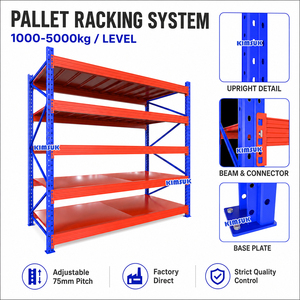
Heavy Duty Rack Laminated Aluminum Warehouse Rack Shelving Storage Rack Steel Shelf Units Plate Warehouse Etagere De Rangement
Built with cold-formed interlocking box beams and multi-bend uprights. Provides complete non-palletized flexibility for dense box sorting and assembly staging.
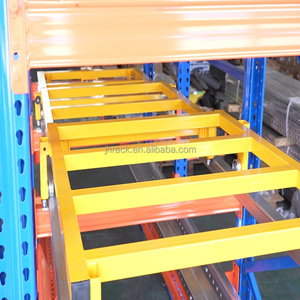
Wholesale Low Price Push Back Heavy Duty Shelving Warehouse Storage Shelf Rack System Facilities Rack With Pallets Racking Unit
Telescopic rolling carts on inclined steel rails offer high-density pallet consolidation with rapid single-aisle access, cutting forklift transit time by up to 40%.
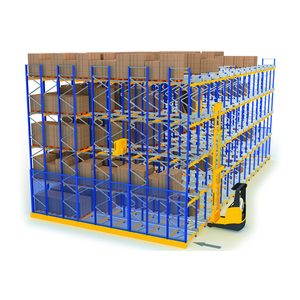
Durable Shuttle Heavy Duty Rack System Asrs 4-Way Shuttle Racking Automated Radio Shuttle Racking System for FIFO & LIFO
Ultra-dense autonomous carriage navigating inside deep racking channels. Eliminates forklift rack entry, maximizing operator safety and lane utilization.
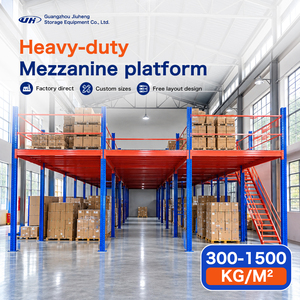
Steel Mezzanine Warehouse Storage System Heavy Duty Multi Level Rack Platform Industrial Shelving Space Saving Solution
Multiplies clear overhead vertical space into fully operational picking platforms, packing zones, or executive offices without requiring civil reconstruction.
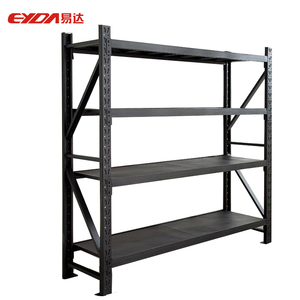
Supermarket Warehouse Light-Duty 4 Tier Steel Storage Rack 5 Boltless CE Certified Corrosion Protection Pallet Rack Low Price
Ergonomic rapid-assembly storage featuring corrosion-resistant electro-powder coating, designed for micro-fulfillment centers, e-commerce staging, and light stockrooms.
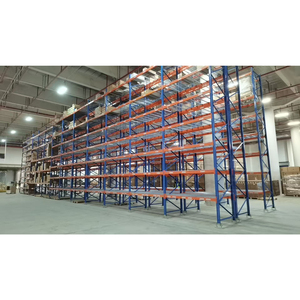
Robust Longspan Shelving Systems Warehouse Organization Heavy Duty Shelves Competitive Price Stock Ready
Medium-to-heavy industrial hand-load shelving for bulky items, automotive parts, and cartons. Seamlessly bridges heavy pallet racks and light modular bins.
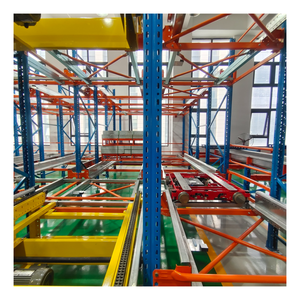
Smart Design High Density Warehouse Racking System Heavy Duty 4 Way Pallet Rack for Cold Room Storage Racks Asrs Racks System
Maximizes refrigerated cubage to shrink cooling losses by up to 35%. Specially engineered with specialized steel chemistry to prevent cold-temperature embrittlement.
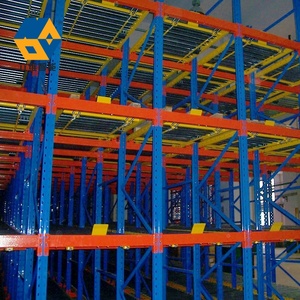
Heavy Duty Gravity Flow Pallet Racking Roller Tracks Warehouse Storage Gravity Roller Shelf Rack
Automatic pallet progression propelled by gravity over calibrated roller tracks. Ideal for food, pharmaceutical, and high-throughput beverage distribution terminals.
Engineering White Paper: Strategic Physics of High-Density Warehouse Cubing
In the macroeconomic landscape of escalating industrial real estate lease rates, conventional selective pallet racking—which historically dedicates 60% to 68% of warehouse floor footprint exclusively to operational forklift aisles—is undergoing rapid obsolescence. Global logistics operators, cold-chain distributors, and high-velocity manufacturers are transitioning aggressively to high-density volumetric storage architectures.
High-density racking is not merely a steel fabrication category; it is an integrated spatial optimization science. By compressing or eliminating operational aisles through dynamic mechanical carts (Push-Back), continuous sloped roller tracks (Gravity Flow), or autonomous robotic shuttles (Radio Shuttle AS/RS), modern warehouse facilities achieve volumetric storage efficiencies exceeding 80% to 88% of total building cube capacity.
$$E_v = \frac{\sum (V_{\text{pallet}} \times N_{\text{stored}})}{A_{\text{footprint}} \times H_{\text{clear}}} \times 100\%$$
Where $A_{\text{footprint}}$ is the net internal slab area and $H_{\text{clear}}$ is the usable crane/sprinkler clearance height. While standard selective racking yields an $E_v$ between 28% and 34%, automated 4-way radio shuttle channels consistently elevate volumetric efficiency to 72% – 84%, directly amortizing industrial land CAPEX over double or triple the pallet holding positions.
Structural Metallurgy & Cold-Roll Forming Dynamics
Structural integrity under cyclic static and dynamic seismic loading requires strict metallurgy protocols. As an authoritative manufacturer based in Guangzhou, China, HEDA Shelves sources premium continuous-cast structural coil conforming to GB/T 700 Q235B and high-yield Q355B (equivalent to ASTM A36 and A572 Grade 50, or European EN 10025 S355JR). Profile engineering utilizes precision 16 to 24-station multi-stage cold roll-forming lines.
This progressive cold-forming profile induces work-hardening along the bend radiuses, generating an engineered stiffening effect that raises section modulus ($Z_x$) while lowering deadweight tonnage. Upright columns feature teardrop or omega slot punches pressed via automated CNC tooling at a calibrated 50mm or 75mm pitch, maintaining a punching hole-pitch tolerance within ±0.1mm across a 12-meter continuous column extrusion.
Architectural Selection Matrix: High-Density Racking Configurations
Choosing the ideal high-density structural paradigm requires balancing SKU fragmentation, pallet velocity, rotational inventory rules (FIFO vs. LIFO), and capital expenditure amortization.
| Racking Topology | Space Density | Selectivity | Inventory Flow | Forklift Aisle Demand | Cold Store Suitability |
|---|---|---|---|---|---|
| Radio Shuttle System | Ultra-High (85%+) | Lane-Dependent | FIFO or LIFO Flexible | Peripheral Aisles Only | Optimal (−30°C Rated) |
| Gravity Flow Racking | Ultra-High (80%+) | Face-Accessible | Strict FIFO Protocol | Loading Face + Picking Face | High Performance |
| Push-Back Cart Rack | High (70%–75%) | Lane-Selective | Strict LIFO Protocol | Single Access Aisle Only | Moderate to High |
| Drive-In / Drive-Thru | High (65%–75%) | Batch Selective | LIFO (Drive-In) / FIFO | Forklift Enters Rack Channel | Standard Industry Practice |
| Structural Mezzanine | Floor Multiplier (200%+) | 100% Hand Pick | Omnichannel / Dynamic | Stairwell & Pallet Drop Zone | Conditioned Area Picking |
| Selective Pallet Racking | Baseline (40%–45%) | 100% Direct | Arbitrary / Universal | 3.0m – 3.5m Standard Aisle | High Energy Cost per SKU |
Why Global Supply Chains Partner with HEDA Shelves
Headquartered in Guangzhou, South China, Guangzhou Heda Shelves Co., Ltd. represents over two decades of uncompromising structural manufacturing, stringent ISO quality loops, and verified containerized export logistics.
25+ Years Industrial Expertise
Founded in 2001, our veteran structural design teams have engineered custom pallet racking, drive-in systems, and automated warehouses across 120+ sovereign nations, resolving complex high-density storage challenges.
Free 3D & CAD Engineering
We calculate beam deflection limits, rack stability, and forklift turning radiuses before production. Every client receives verified AutoCAD layouts, 3D BIM models, and structural calculation sheets within 24 hours.
Verifiable Global Certifications
Fully certified under CE Certificate No. 2435-CPR-8605159, ISO 9001:2015 Quality Management No. 18624Q00169R0M, and European RoHS environmental directives, ensuring audit compliance for multinational 3PLs.
Turnkey OEM & Custom Fabrication
Operating an integrated 30,000m² manufacturing complex with 30,000 tons monthly throughput. We offer tailored profile roll forming, specialized beam connector hooks, custom RAL powder finishes, and private branding.
10-Stage Precision Heavy Steel Fabrication Workflow
Every upright frame, load-bearing beam, and dynamic roller rail undergoes rigorous in-line quality controls from raw coil arrival to containerized sea freight bundling.
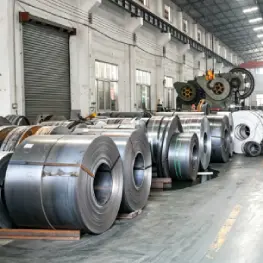
Raw Material Verification
Spectrometry analysis and yield tensile testing on certified Baosteel Q235B/Q355B coils.
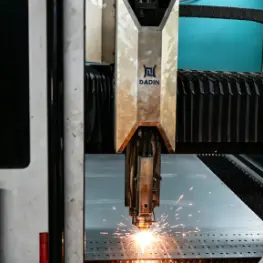
Precision Steel Cutting
Automated CNC slitting lines ensure dimensional accuracy within ±0.5mm across strip lengths.
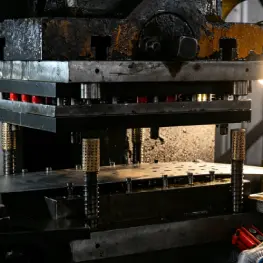
Automated CNC Punching
High-speed 50-ton mechanical presses produce uniform 50mm/75mm adjustment pitch holes.
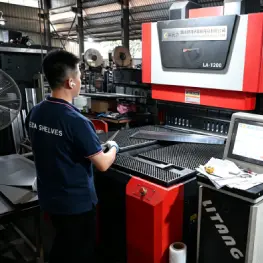
Cold Bending Forming
Cold work-hardening processes maximize section stiffness and upright resistance to buckling.
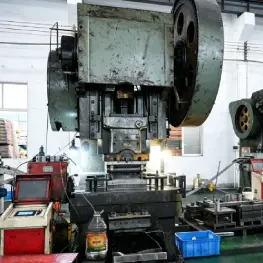
Profile Roll Forming
Continuous 24-station roll-forming lines shape heavy interlocking box beams and upright profiles.
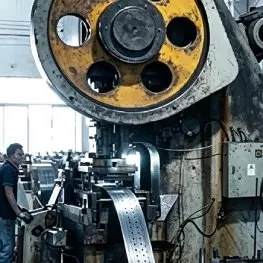
Edge Polishing & De-burring
High-speed automated mechanical deburring guarantees clean edges and operator handling safety.
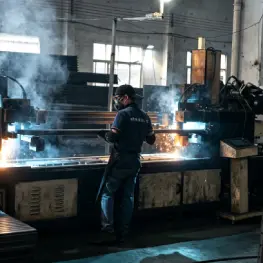
Robotic CO2 Shielded Welding
Japanese OTC robotic arms weld 3-claw and 4-claw beam connectors with deep penetration fillets.
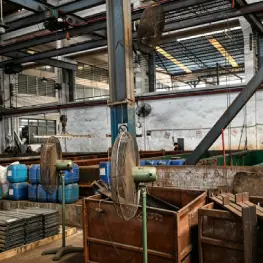
Pickling & Phosphating
Multi-stage acid wash and zinc-phosphating bath removes mill scale and establishes an anti-corrosion barrier.
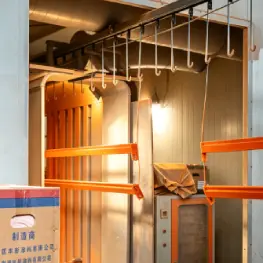
Electrostatic Powder Coat
Automated Gema powder spray guns apply a durable 60–80μm epoxy polymer finish cured at 200°C.
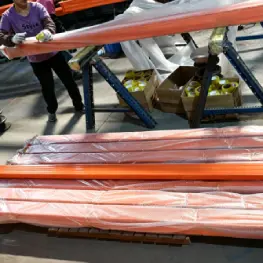
QC, Bundling & Loading
Full optical alignment checks, bubble wrapping, steel dunnage strapping, and containerization.
Emerging Sourcing & Procurement Trends in Heavy Racking
Global supply chain leaders are rethinking their warehouse capital expenditure. Sourcing managers are evaluating total lifecycle durability, carbon reduction, and rapid automation retrofitting.
Scope 3 & Green Steel Sourcing
European and North American enterprises increasingly require Environmental Product Declarations (EPD). Modern procurement favors suppliers utilizing scrap-fed Electric Arc Furnace (EAF) steel and zero-solvent powder coating lines.
Automation-Ready Racking Modules
Buyers are moving away from rigid, single-purpose installations. Modern specifications mandate dual-use channel geometries capable of serving manual reach trucks today, while accommodating AGVs or radio shuttles in the future.
Seismic & Environmental Resilience
Dynamic finite element seismic analysis under ASCE 7, IS 1893, and Eurocode 8 is now standard. In coastal and equatorial belts, duplex coatings (hot-dip galvanized sub-layer + thermoset powder coat) protect structural uprights against salt air.
Direct-from-Source Engineering
Supply chain volatility has accelerated direct factory procurement from tier-1 Chinese manufacturers. Eliminating middlemen allows regional enterprises to acquire custom-engineered heavy industrial systems with up to 30% landed cost savings.
Technological Frontiers Transforming High-Density Intralogistics
The boundary between static steel racking and dynamic robotics has dissolved. Industrial storage is now an integrated, cyber-physical platform engineered around precision mechanical clearances, sub-millimeter tolerances, and IoT sensor arrays.
Digital Twin & FEA Stress Mapping
Advanced engineering integrates ANSYS structural finite element simulations to test frame deflection under non-uniform pallet loading, seismic shear resonance, and floor slab settling before any steel is rolled.
4-Way Autonomous Fleet Robotics
Modern shuttle carriers operate in lateral and transverse axes across high-density storage cubes. Integrated with warehouse vertical lifts, they provide true multi-level AS/RS capabilities at a fraction of stacker crane costs.
Continuous IoT Structural Monitoring
Embedded strain gauges, laser deflection sensors, and baseplate impact nodes deliver real-time warnings to warehouse management platforms, preventing catastrophic progressive collapse from accidental forklift collisions.
Frequently Asked Questions by Global Engineering Buyers
In-depth answers addressing structural engineering thresholds, international certifications, anti-corrosion protection, and containerized global logistics.
Our structural design calculations comply rigorously with European standard EN 15512:2020 (Steel static storage systems – Adjustable pallet racking systems – Principles for structural design) and American RMI (Rack Manufacturers Institute) MH16.1 specifications. Under these standards, allowable beam deflection under full working load is constrained strictly between $L/200$ and $L/300$ (where $L$ is the clear span distance). Every upright frame is engineered with safety factors that exceed 1.5 against ultimate yield strength, and baseplate anchoring calculations account for concrete pull-out, shear, and rotational overturning moments.
Surface degradation is prevented through our automated 9-tank chemical pretreatment system. Every cold-rolled component undergoes ultrasonic degreasing, acid pickling to eliminate surface oxides, and a zinc-phosphate conversion bath that forms a crystalline micro-barrier. Electrostatic powder coating applies pure thermoset polyester-epoxy powders at a cured thickness of 60 to 80 microns (tested via ASTM D3359 cross-hatch tape adhesion). For coastal zones (C3–C4 corrosive atmospheres), open-air canopies, and sub-zero refrigerated rooms, we supply continuous hot-dip galvanized (HDG) steel components conforming to ISO 1461, ensuring over 20 years of rust-free service life.
To produce an engineered, code-compliant warehouse layout within 24 hours, our engineering office requires:
1. Architectural warehouse drawings (DWG/PDF format) displaying column grids, fire exits, and building clear height ($H_{\text{clear}}$).
2. Concrete floor slab specifications: thickness (typically 150mm–250mm), reinforcement mesh, and compressive strength (e.g., C25/30 or 3,000–4,000 PSI).
3. Pallet parameters: outer dimensions (Width × Depth × Height including cargo overhang) and maximum gross weight.
4. Forklift specifications: model, mast closed height, maximum lift height, and minimum right-angle aisle stacking width ($A_{\text{st}}$).
5. Temperature conditions (ambient vs. chilled/cold room) and local seismic hazard zone designations.
While traditional drive-in racking features a lower initial equipment CAPEX, it forces forklifts to physically enter deep structural channels, resulting in high structural impact rates, slow turnaround speeds (often 3 to 5 minutes per pallet cycle), and restricted lane depths (rarely exceeding 6 to 8 pallets safely). Conversely, a semi-automated radio shuttle racking system maintains static lane depths of 20 to 50 pallets. Forklifts operate only along the outer access face, reducing transit cycles by over 50%, virtually eliminating column collision damage, and cutting cold-chain warehouse volume requirements by up to 35%.
Export packaging is engineered for high-cube (40ft HQ) container space maximization. Upright frames are packaged with protective bubble wraps, edge cardboards, and high-tensile steel strapping. Horizontal load beams are nested and bundled with wooden dunnage separating individual layers to eliminate contact friction. Small parts, anchor bolts, baseplates, and row spacers are packed into reinforced, shrink-wrapped wooden crates. Our container stuffing plans routinely exceed 92% cube utilization, minimizing landed freight costs per pallet position.
Yes. Every overseas shipment is accompanied by numbered erection drawings, structural assembly manuals, and video installation guides. For large-scale projects, we dispatch certified HEDA field installation supervisors to manage local rigging teams, verify anchor bolt torque calibration, and conduct final verticality inspections. All shipments can be accompanied by independent third-party mill test certificates (SGS, TÜV, or Bureau Veritas) validating steel chemical composition, tensile yield limits, and powder coat salt-spray test compliance.
Request an Engineered Layout & Landed Project Estimate
Connect directly with HEDA Shelves' senior intralogistics engineering desk. We provide comprehensive AutoCAD layouts, 3D volumetric renders, and factory-direct FOB/CIF price proposals tailored to your facility parameters.
- Free 24-Hour AutoCAD Layout
- EN 15512 & RMI Calculations
- Complete Export Ocean Freight Logistics
- Direct Manufacturer Pricing Advantage