Flagship Heavy Duty Industrial Racking Systems
Precision cold-rolled profiles engineered for extreme pallet payload capacities, high dynamic warehouse velocity, and complete international compliance across FEM, RMI, and AS standards.
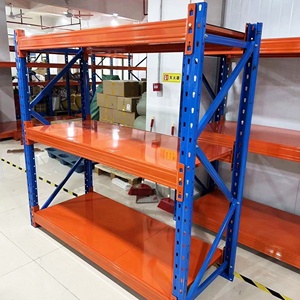 Load: Up to 2,000 kg/Tier
2000kg 5 Layer Adjustable Steel Selective Pallet Rack
- Structure: Boltless Interlock Box Beam
- Material: Q235B High-Grade Steel
- Access: 100% Pallet Selectivity
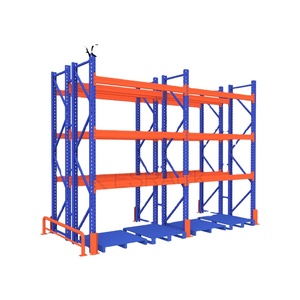 Specialty Non-Standard
Custom Heavy Duty Industrial Steel Carpet Roll Racking
- Configuration: Long-Span Cradle Beams
- Application: Textiles & Cylindrical Goods
- Customization: Full OEM/ODM Profiles
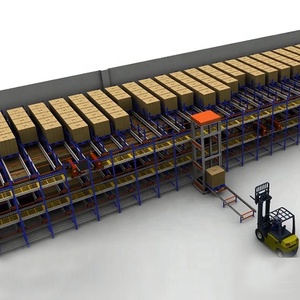 Semi-Automated ASRS
Automatic Radio Shuttle Heavy Duty Rack System
- Operation: Wireless Autonomous Shuttle
- Inventory: FIFO / LIFO Logic Supported
- Certification: CE Certified / Cold-Store Ready
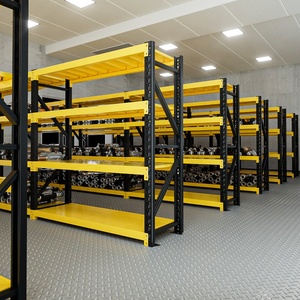 Medium to Heavy Pick
Industrial Warehouse Storage Shelving Unit
- Decking: Solid Steel Plate / Wire Mesh
- Pitch: 50mm Incremental Adjustability
- Finish: Epoxy Anti-Scratch Powder
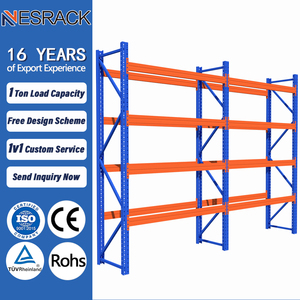 Multi-Tier Heavy-Duty
Heavy Duty 5-Layer Industrial Steel Storage Rack
- Frame: Omega Upright Cold-Bent Profile
- Safety: Safety Pins & Base Anchors
- Assembly: Modular Boltless Interconnection
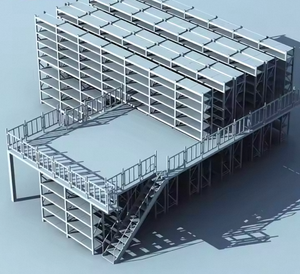 Vertical Footprint Multiplier
Multi-Level Mezzanine Rack Platform System
- Deck Load: 300 to 1,000 kg/sqm
- Flooring: Cold-Rolled Perforated / Steel
- Integration: Integrated Stairs & Slide Gates
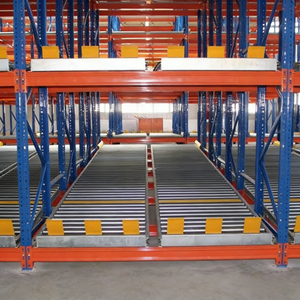 High-Density FIFO
Gravity Flow Pallet Dynamic Roller Rack System
- Rotation: Strict Gravity-Fed FIFO
- Control: Brake Rollers & End Separators
- Density: Up to 60% Space Reclamation
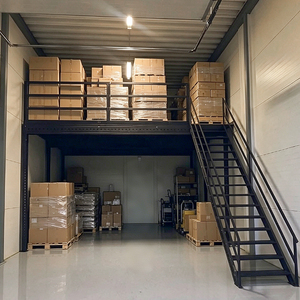 Integrated Structural Rack
Heavy Duty Storage Mezzanine Floor Platform
- Design: Rack-Supported Structural Floor
- Utility: Combined Bulk Pallet & Picking
- Safety: Complete Handrail & Kickplate Specs
Engineering Standards, Metallurgy, and Structural Load Mechanics
A comprehensive procurement guide analyzing cold-formed structural steel performance, cross-aisle deflection limits, seismic dynamic factors, and automated distribution center scalability.
Modern industrial supply chains demand uncompromising structural integrity, modular volumetric scalability, and rigorous safety margins. When global logistics enterprises, third-party logistics (3PL) providers, and multi-tier cold-chain distribution centers seek the best heavy duty industrial racking manufacturers and suppliers in China, procurement criteria have evolved far beyond gross weight metrics. Sourcing decisions now hinge on certified structural engineering, high-tensile metallurgical consistency, robotic roll-forming precision, and compliance with harmonized international testing frameworks including FEM 10.2.02, RMI MH16.1, EN 15512, and AS 4084-2023.
Core Structural Engineering Takeaway: High-yield Chinese racking fabrication combines prime hot-rolled strip steel with continuous automated cold-roll forming. This manufacturing process produces specialized Omega upright profiles and multi-hook connector lugs that minimize residual stress, preventing brittle fracture failures even under dynamic impact loads exceeding 10 kN at ground level.
1. Structural Metallurgy: Q235B vs. Q355B Hot-Rolled Steels
The foundation of structural warehouse rack reliability is the metallurgical chemistry and mechanical yield strength of the raw structural coils. While low-end commodity manufacturers utilize uncertified non-prime strip steel with unpredictable elongation and inclusion rates, China's leading tier-one manufacturers source certified coils exclusively from Baosteel, Shougang, and Ansteel.
For standard heavy-duty selective pallet racks handling 1,000 kg to 2,500 kg per beam level, Q235B carbon structural steel (with minimum yield strength $R_e \ge 235 \text{ MPa}$ and elongation $A \ge 26\%$) delivers an optimal balance of ductility and tensile strength. However, for extreme clear heights exceeding 12 meters, automated radio shuttle runs, or seismic high-risk zones, our structural calculations employ Q355B low-alloy high-strength steel ($R_e \ge 355 \text{ MPa}$). The higher yield stress of Q355B allows for lighter profile gauge without sacrificing moment resistance, mitigating gross dead loads on concrete foundations while maximizing seismic elasticity.
2. Beam Deflection Limits & Structural Safety Coefficients
International engineering mandates enforce strict beam deflection thresholds to avoid pallet dislodgement, localized weld tear-out, and premature metal fatigue under sustained static loads. Under full working payload, the maximum vertical deflection allowable across standard industrial storage beams is governed by the $L/200$ deflection criterion (where $L$ denotes the clear distance between upright columns). For sensitive automated picking corridors, gravity roller systems, and robotic crane interfaces, the tolerance tightens to $L/300$ or $L/350$.
Every beam-to-column connector welded by precision robotic arms features an integrated cold-stamped 3-prong or 4-prong hook configuration. This mechanical interlock creates a semi-rigid joint characteristic whose moment-rotation curve is mathematically analyzed using the portal frame analysis method. The mechanical locking pin ensures that upward forklift displacement forces of at least 5,000 N cannot disengage the beam connector from the column perforated slot.
| Racking Architecture | Pallet Selectivity | Floor Space Utilization | Optimal Load Rating (Per Tier) | Stock Rotation Logic | Safety Engineering Category |
|---|---|---|---|---|---|
| Selective Pallet Racking | 100% Direct Access | 40% – 45% Floor Usage | 1,000 kg – 4,500 kg | FIFO (First-In, First-Out) | Universal FEM 10.2.02 |
| Double-Deep Racking | 50% Direct Access | 55% – 60% Floor Usage | 1,000 kg – 3,000 kg | LIFO (Last-In, First-Out) | Reach Truck Critical |
| Automatic Radio Shuttle | Channel Selective | 75% – 85% High-Density | 500 kg – 2,000 kg | Programmable FIFO / LIFO | ASRS EN 15512 Class |
| Gravity Pallet Flow | Lane Selective | 65% – 75% High-Density | 300 kg – 1,500 kg | Strict Mechanical FIFO | Self-Braking Speed Control |
| Rack-Supported Mezzanine | Tiered Multi-Access | Up to 200% Usable Area | 300 – 1,000 kg/m² (Floor) | Hybrid Bulk & Manual Pick | Structural Eurocode 3 / AISC |
| Heavy Duty Cantilever | 100% Direct Frontal | Linear Storage Layout | 1,000 kg – 5,000 kg / Arm | Variable Batch Pick | Overhung Bending Rigidity |
Why Guangzhou Heda Shelves Co., Ltd. Leads China’s Racking Sourcing
Combining over two decades of in-house manufacturing, full-cycle automated processing, and verified structural certification for global distribution projects.
Operating a specialized 30,000 square meter fabrication facility staffed by over 300 experienced engineers and skilled technicians, Guangzhou Heda Shelves Co., Ltd. controls the entire production chain under an ISO 9001:2015 certified quality regime (Certificate No. 18624Q00169R0M). Every production run conforms to European CE verification (No. 2435-CPR-8605159) and RoHS environmental standards.
Unlike trading intermediaries, HEDA Shelves maintains an uninterrupted, in-house cold roll-forming process. Uprights, box step-beams, structural channels, diagonal bracing trusses, and interlocking deck panels are fabricated on automated computer-controlled production lines. High-precision laser cutting, 24-station automated column punching, and dual-axis robotic welding units ensure that beam tolerances are kept within ±0.5 mm, eliminating site assembly misalignments.
End-to-End Vertical Control
From initial decoiling and continuous automated roll forming to robotic welding, pickling, phosphating, and electro-powder application, every stage is audited in-house.
Free 24-Hour CAD & 3D Modeling
Our engineering design department generates comprehensive warehouse CAD layouts, structural calculations, and 3D walkthrough renderings tailored to your forklift fleet within 24 hours.
Monsoon & Coastal Corrosion Defense
An 8-stage pre-treatment process utilizing chemical pickling and zinc phosphating prior to Swiss Gema electrostatic powder deposition guarantees over 500 hours of continuous salt-spray resistance, securing racking integrity in humid tropical coastal climates.
10-Stage Precision Manufacturing Workflow
Quality assurance is embedded systematically into our production cycle to eliminate structural failures before raw steel reaches the shipping container:
Coil Inspection & CNC Punching
Certified steel slit coils undergo tensile testing, ultrasonic flaw detection, and high-speed CNC progressive perforation for consistent hole pitch.
Cold Forming & Profile Rolling
Custom 18-to-24 pass roll mills bend upright sections and interlocked seam-welded box beams without micro-fissures along the bend radius.
Robotic Welding & Phosphating
Robotic arms join beam connectors. Components are cleaned through immersion degreasing, ultrasonic rust removal, and dense micro-crystalline zinc phosphating.
Electrostatic Coating & QC Audit
Automated powder spraying cures at 180°C to 200°C. Batch drop tests, coating thickness checks, and bundle crating prepare items for maritime export.
Strategic Procurement Forecast: Trends Transforming Industrial Racking (2025–2030)
Global warehouse real estate costs continue to rise, driving facility managers away from horizontal square footage and toward high-cube vertical density. When structuring multi-year racking investments, procurement managers must evaluate four core industry shifts:
Convergence with AMR & Pallet Shuttles
Traditional static drive-in racks are rapidly being superseded by deep-lane radio shuttle runs and Autonomous Mobile Robot (AMR) interfaces that maximize density while eliminating forklift impacts inside racking bays.
Cold-Chain & Deep-Freeze Hardening
With pharmaceutical and fresh-food cold chains expanding globally, racking materials must withstand sub-zero embrittlement down to -30°C. Hot-dip galvanization and low-temperature ductile alloys prevent cold-shortness failure.
Digital Twin Racking & RFID Tracing
Future-ready storage columns now incorporate laser-etched matrix IDs and pre-slotted upright recesses for structural deflection telemetry and sensorized load tracking.
Seismic Resilience & Ductility Codes
Stringent updates to AS 4084 and RMI 2023 enforce larger baseplate footings, dual-anchor expansion studs, and cross-bay bracing struts designed to dissipate non-linear ground accelerations safely.
Optimizing Total Cost of Ownership (TCO) & Maritime Freight Packing
A critical blind spot in international racking sourcing is container cube utilization. Steel racking components are dense, long, and bulky. Without engineering-led freight planning, overseas buyers often end up paying for ocean freight on empty space.
HEDA Shelves tackles this through modular nested nesting engineering. Upright frames are either delivered fully bolted or knocked-down for on-site bolting, maximizing container capacity in standard 40ft High Cube (40HQ) containers. By calculating precise center-of-gravity distributions and utilizing custom steel dunnage with protective corner edge-protectors, we load between 24 and 26 metric tons per 40HQ container without exceeding container payload limits. This reduces landed freight costs per pallet location by up to 28% across trans-oceanic lanes to Europe, the Americas, the Middle East, Southeast Asia, and South Asia.
Frequently Asked Questions on Sourcing Heavy Duty Racking from China
Addressing the technical, regulatory, structural, and logistical questions most frequently posed by industrial buyers and warehouse project consultants.
How do you verify structural steel thickness and prevent under-gauging during manufacturing?
Every steel batch received at our Guangzhou factory comes with certified Mill Test Certificates (MTC) stating chemical composition and mechanical properties. Our Quality Assurance inspectors utilize calibrated ultrasonic thickness gauges and digital micrometers across multiple points of the profile web and flanges to ensure that delivered steel falls within tight ±0.08 mm tolerances, fully adhering to EN 10025 and GB/T 700 benchmarks.
What specific warehouse data is needed to receive a free 24-hour CAD layout and engineering proposal?
To produce an exact CAD layout and structural load assessment, we require: (1) Architectural warehouse CAD drawings or dimensioned sketches indicating clear ceiling heights, column grids, and access doors; (2) Pallet specifications including overall dimensions (width, depth, height) and maximum gross weight; (3) Operating forklift specifications, specifically mast collapsed height, maximum lift elevation, and turning radius (Aisle Aisle Requirement); and (4) Site seismic and environmental parameters.
Can HEDA Shelves manufacture customized racking profiles compatible with existing warehouse installations?
Yes. As a direct manufacturer with in-house tooling and custom roll-forming capabilities, we provide comprehensive OEM/ODM engineering. If you need to expand existing European teardrop, speedlock, or diamond-punched installations, our engineers can replicate upright hole pitch, beam connector prongs, and step profiles to ensure complete mechanical compatibility and structural load transfer.
How does your powder coating withstand marine logistics and humid tropical environments?
We apply an 8-stage industrial surface pre-treatment comprising hot spray degreasing, clean-water rinses, chemical acid pickling to eliminate scale, and crystalline zinc phosphating. Finished components are electrostatically coated using premium polyester resin powders and cured in a 200°C convection tunnel oven. This yields a non-porous 60 to 90 micron thermoset coating that resists chipping, chemical degradation, and coastal humidity.
What is the typical production lead time and maritime delivery schedule for a multi-container project?
Standard fabrication for 2 to 5 full container loads (FCL) of selective or drive-in pallet racking is typically completed within 15 to 20 working days. Automated radio shuttle systems and custom structural mezzanines require approximately 25 to 30 days due to electrical commissioning and specialized platform fabrication. Our proximity to Guangzhou and Shenzhen maritime hubs enables rapid vessel departure to major ports globally.
Ready to Engineer Your High-Capacity Storage Facility?
Consult directly with our senior structural racking engineers today. Receive a tailored warehouse CAD design, structural load calculation, and factory-direct quotation within 24 hours.
Contact Us