Hot-Dip Galv
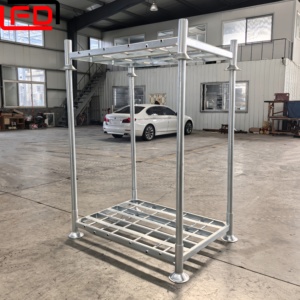
Precision-engineered selective systems and modular warehouse equipment conforming to European CE norms and seismic safety factors for modern distribution centers.
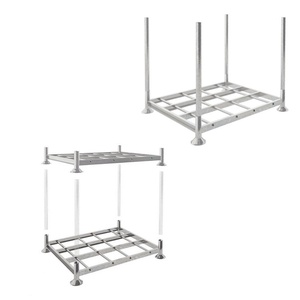
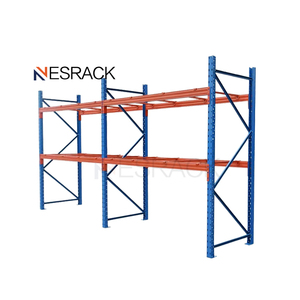
An in-depth structural overview detailing cross-sectional geometries, cold-roll mechanical properties, load-deflection ratios, and safety protocols under EN 15512 and FEM 10.2.02 codes.
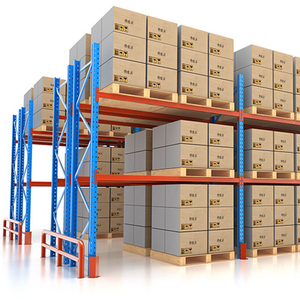
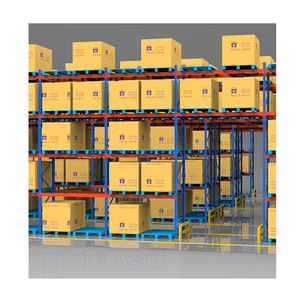
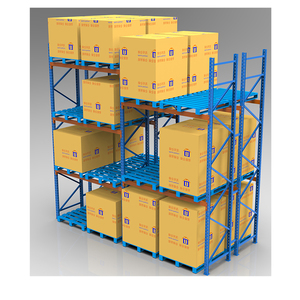
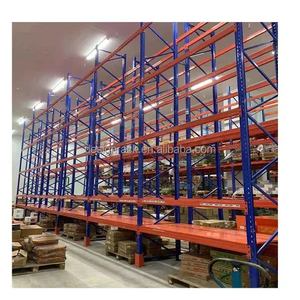
In modern high-velocity logistics, the single deep selective pallet racking system serves as the foundational architecture across third-party logistics (3PL) hubs, FMCG fulfilment centers, and cold-chain infrastructure. Unlike high-density bulk configurations such as drive-in or gravity flow setups, single deep racking establishes an unhindered direct access ratio of exactly 100%. Every single pallet footprint is independently reachable by standard counterbalance, reach, or articulated forklift trucks without the necessity to relocate adjacent storage units.
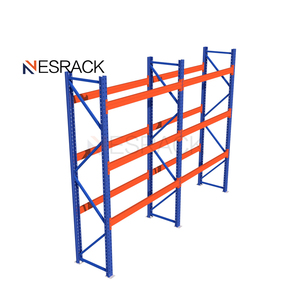
From an applied structural mechanics perspective, structural integrity depends directly on the continuous interaction between three principal elements: the cold-rolled cold-formed Omega upright profile, the dual-C interlocked or welded box beam assembly, and the multi-claw mechanical beam-to-column connector. At HEDA Shelves, all load-bearing profiles are designed from high-tensile certified structural steel coils (grades Q235B and Q355B according to GB/T 700 and EN 10025 equivalents), maintaining yielding limits beyond 235 to 355 MPa to safeguard against local buckling under peak dynamic and seismic reactions.
The upright column features an 11-to-13 fold continuous cold-formed Omega section. Multi-angle cross-sectional stiffening ribs drastically increase the column's cross-sectional moment of inertia ($I_x$ and $I_y$), mitigating torsional-flexural buckling under axial eccentric loadings. Standard pitches are configured at 50mm, 75mm, or 76.2mm precision CNC tear-drop or diamond punched increments.
Beams utilize double C-sections continuously seam-welded via automated high-frequency robotics to form a rigid structural tube box. Under uniformly distributed loads (UDL), structural deflection is stringently engineered never to exceed the deflection limit of L/200 (one-two-hundredth of clear beam span) or an absolute maximum cap of 10mm, conforming rigorously to EN 15512 safety protocols.
Connectors feature 3, 4, or 5 precision cold-stamped claws engaging directly into the column perforations. Each connection is safeguarded with spring-steel automated locking pins capable of resisting upwards accidental shear dislodgement forces exceeding 5,000 N caused by erratic vertical lift-truck operations.
| Racking Architecture | Pallet Selectivity | Space Area Utilization | Inventory Rotation | Forklift Compatibility | Average Investment Capex |
|---|---|---|---|---|---|
| Single Deep Selective Racking | 100% Direct (Unrestricted) | 35% - 42% Floor Efficiency | FIFO or LIFO (Any SKU) | Counterbalanced, Reach, VNA | Lowest Baseline CAPEX |
| Double Deep Selective | 50% Direct (Requires 2-Deep Reach) | 50% - 58% Floor Efficiency | LIFO per Bay Channel | Pantograph Reach Trucks | Moderate (+20-30% on trucks) |
| Drive-In / Drive-Through | Lane Dependent (Low SKU Mix) | 65% - 75% High Density | Strict LIFO (FIFO if Drive-thru) | Standard Counterbalance | Moderate (High Steel Weight) |
| Radio Shuttle Cart Racking | Semi-Automated Channel Access | 75% - 85% Maximum Density | Programmed FIFO & LIFO | Standard Reach / Counterbalance | High (Cart automation cost) |
Analyzing procurement transitions from conventional manual storage toward automated forklift integration, seismic risk adaptation, and low-carbon metallurgical finishes.
Global warehouse real estate costs, driven by rapid urbanization and cross-border e-commerce demands, have fundamentally transformed how procurement heads, supply chain vice presidents, and EPC engineering directors evaluate warehouse racking suppliers. Purchasing managers no longer view selective racking as passive structural steel shelves; it is evaluated as an integrated critical component of automated intralogistics.
Enterprise tenders now mandate comprehensive structural verification, verifiable factory certifications (such as the mandatory CE structural designation under Construction Products Regulation EU 305/2011), and finite element analysis (FEA) models that incorporate concrete slab flexure and seismic zoning.
Global logistics hubs situated along active tectonic belts (e.g., California, Italy, Turkey, New Zealand, Indonesia, and Northern India) demand full dynamic load response modeling. Structural bids require verified baseplate anchorage sizing and bracing configurations tailored to specific seismic zone coefficient ratings.
The explosive transition toward Autonomous Mobile Robots (AMRs) and Automated Guided Vehicles (AGVs) requires single deep racking to meet tighter manufacturing tolerances. Clear span beam deflections, base anchor embedments, and lower ground clearance heights must precisely align with optical sensor fields.
Rapid growth in pharmaceutical cold distribution and cryogenic food hubs has shifted specification standards away from painted surfaces toward Hot-Dip Galvanized (HDG) or zinc-aluminum-magnesium coatings capable of enduring sub-zero temperatures (-35°C) without coating embrittlement.
International ocean freight volatility demands that manufacturers optimize bundle nestability. Upright frames with bolted diagonals and modular split connectors reduce overseas 40HQ container dead volume by up to 34%, dramatically lowering landed logistics costs per pallet position.
From traditional manual stacking to Very Narrow Aisle (VNA) optimization, digital twinning, and integrated structural health monitoring.
The single deep selective pallet rack has undergone continuous evolutionary engineering over the past two decades. What began as simple structural angle steel has developed into an engineered cold-formed system balancing minimal steel mass against maximum allowable load capacity. Modern installations leverage high-accuracy automated roll-forming lines with continuous in-line laser positioning to achieve perforation spacing accuracy within ±0.2mm across continuous 15-meter upright spans.
The contemporary evolution focuses on three breakthrough dimensions:
By pairing precision single deep selective racking with wire-guided or mechanical rail-guided Very Narrow Aisle (VNA) forklifts, operational aisle widths shrink from conventional 3,200mm–3,800mm reaches down to a tight 1,650mm–1,850mm. This transformation amplifies total building cubic storage capacity by over 45% while retaining complete 100% pallet selectivity.
Modern distribution facilities are integrating micro-strain gauges, optical beam-deflection sensors, and wireless impact-detection nodes directly into critical aisle-end upright protectors. These nodes transmit real-time data to warehouse management systems (WMS), issuing alerts if lift-truck collision thresholds are breached.
Forward-thinking exporters have phased out traditional solvent-borne paints in favor of 10-stage phosphating followed by zero-VOC heavy-duty thermosetting polyester powder electrostatic baking. The resulting 60–80 micron cured coat resists impact abrasion, prevents rust creep in coastal ports, and meets RoHS global compliance directives.
Guangzhou Heda Shelves Co., Ltd. (established in 2001) is an industry-leading manufacturer and exporter of heavy-duty pallet racking and warehouse logistics equipment.
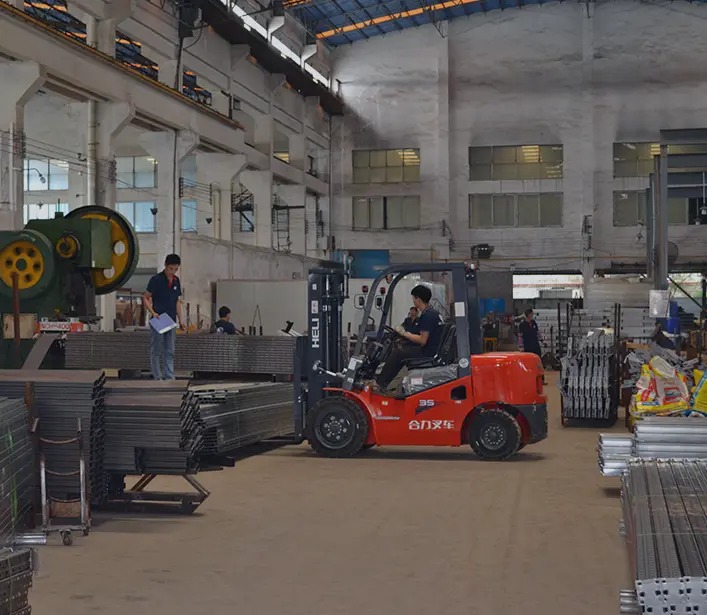
Every upright, cross beam, and connector undergoes an automated, traceable production process.
Every batch of primary Baosteel or Shougang cold-rolled steel coils undergoes spectral and ultrasonic tensile verification to confirm chemical composition and mechanical yield integrity.
18-station automated cold-forming lines roll the Omega column profiles, while computerized multi-stage inline punches place teardrop holes within an exact tolerance of ±0.1mm.
Components complete a 10-step pickling, degreasing, and phosphating sequence before receiving a 180–200°C electrostatic thermosetting powder coat to resist chipping, rust, and salt spray.
Random samples undergo hydraulic load test audits to confirm failure limits surpass safety factors before export bundle bundling into 20GP or 40HQ shipping containers.
Detailed answers to structural, compliance, and logistics questions from warehouse operations managers, procurement officers, and structural engineers.
Collaborate directly with our certified structural racking engineers. Receive a fully optimized CAD warehouse layout, complete 3D structural model, and transparent factory-direct pricing tailored to your logistics requirements.