Featured Industrial Pallet Racking & Specialized Shelving Systems
Direct from our 30,000 m² automated manufacturing facility, every system is engineered to comply strictly with European standard EN 15512, ensuring optimal structural elasticity, high load ratings, and long-term durability under demanding industrial duty cycles.
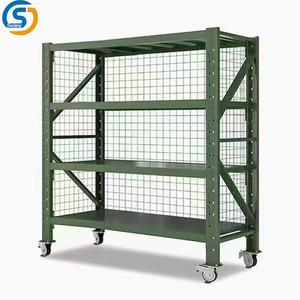
Warehouse Shelf Rack Metal Shelf Rack Assembly Shelves for Warehouse Heavy Duty Assemble Pallet Racking with Wheels
Heavy-duty mobile caster integration engineered for rapid reconfigurability in manufacturing assembly cells, order-consolidation staging, and flexible maintenance buffers.
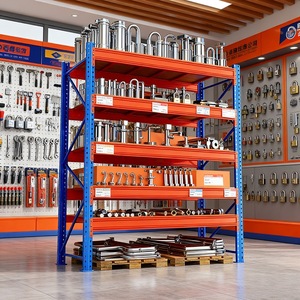
Warehouse Pallet Rack Beam-Type Shelving 5 Layer 1000-5000kg Heavy Duty Iron/Metal Storage Rack for Garage & Warehouse
Continuous roll-formed box beams paired with 75mm/50mm pitch adjustable uprights, engineered to eliminate flex and withstand severe forklift impact vibrations.
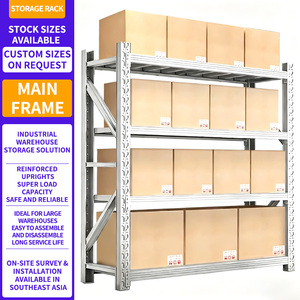
Factory Customized 500kg Per Layer Adjustable Warehouse Pallet Storage Racking for Logistics Warehouse Storage Shelving
Tailor-fitted sectional depths and beam configurations designed for dynamic multi-SKU retail fulfillment centers, e-commerce buffer centers, and regional hubs.
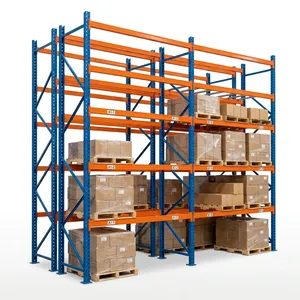
3000kg Adjustable Steel Pallet Rack Heavy Duty Boltless Shelving Anti-Rust Foldable Warehouse Storage
Precision cold-stamped interlocking teeth provide rigid beam-to-column engagement without structural hardware, delivering rapid deployment and high structural load thresholds.
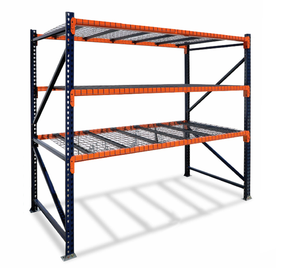
Adjustable 5 Layer Heavy Duty Corrosion Protected Steel Warehouse Racking System with Mesh Shelves and Pallet Rack
Fitted with welded steel wire mesh decking for NFPA-compliant overhead sprinkler penetration, preventing carton falling and facilitating versatile non-standard pallet loading.
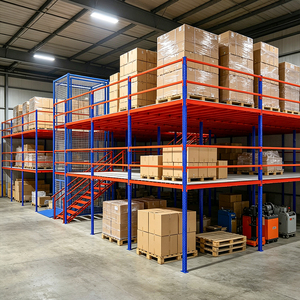
Warehouse Mezzanine Racking System Multi Level Steel Platform Shelving for Industrial Logistics Pallet Storage with Staircase
Vertical floor space multiplier utilizing heavy upright columns to support walk-on steel platforms, industrial handrails, safety kickplates, and integrated stair modules.
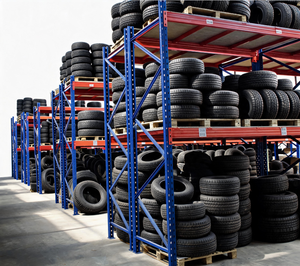
Yueyang Heavy Load Multi Layer Heavy Duty Cold Rolled Steel Epoxy Powder Coated Racking Warehouse Industrial Storage Racking
Fabricated using prime cold-rolled steel coils with a multi-phase pre-treatment bath, finished with thermoset epoxy-polyester powder for hostile chemical and coastal environments.
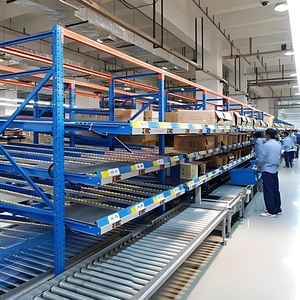
Factory Price Carton Flow Rack Adjustable Wheel Track Shelving for Warehouse Order Picking
Engineered gravity-assisted aluminum roller tracks optimize pick-path ergonomics, ensuring flawless first-in, first-out stock rotation for fast-moving items.
Structural Integrity Standards: Decoding CE Certification (EN 15512) for Heavy Pallet Shelving
Evaluating structural deformation thresholds, metallurgical properties of high-tensile cold-rolled steel, and seismic anchor engineering in international warehouse racking procurement.
1. The Regulatory Rigor of CE Certification (CPR 305/2011 & EN 15512)
In structural racking procurement, standard industrial trade guarantees are insufficient to protect against catastrophic rack collapse caused by dynamic forklift impact or seismic ground shifts. For storage equipment exported to Europe, North America, the Middle East, and South Asia, structural compliance hinges upon Regulation (EU) No 305/2011 (Construction Products Regulation - CPR) and the harmonized technical framework codified under EN 15512:2020 (Steel static storage systems - Adjustable pallet racking systems - Principles for structural design).
Our manufacturing protocols at Guangzhou Heda Shelves Co., Ltd. operate under continuous Factory Production Control (FPC) audit regimes, holding CE Certification No. 2435-CPR-8605159 and ISO 9001:2015 Quality Management System Certification No. 18624Q00169R0M. Unlike decorative or light-duty shelving, heavy-duty pallet racking functions as a semi-permanent load-bearing steel structure. Every upright profile, column-to-base plate weld, and beam-end connector hook is subjected to limit-state structural verification, ensuring a safety factor of 1.4 to 1.5 against structural failure under full design load capacity.
Critical Engineering Principle: Beam deflection limits under EN 15512 are strictly bounded by δ ≤ L / 200 for standard clearance operations, and δ ≤ L / 300 where Automated Guided Vehicles (AGV) or turret-truck narrow-aisle cranes require extreme horizontal precision to prevent pallet snagging and dynamic mast binding.
2. Cold-Formed Steel Metallurgy: Q235B vs. Q355B Tensile Dynamics
Racking structural resilience begins at the coil level. We employ certified prime continuous-cast low-carbon steel coils, selecting Q235B (yield strength $f_y \ge 235 \text{ MPa}$, ultimate tensile strength $370\text{--}500 \text{ MPa}$) for standard ambient selective racking beams, and Q355B ($f_y \ge 355 \text{ MPa}$, tensile strength $470\text{--}630 \text{ MPa}$) for extended-height high-bay upright columns, heavy-duty cantilever arms, and mezzanine platform joists. The chemical composition is strictly monitored for phosphorus and sulfur content ($P \le 0.035\%$, $S \le 0.035\%$) to guarantee exceptional ductility and roll-forming workability without internal micro-fissuring at the profile bends.
| Engineering Property | Standard Commercial Racks | HEDA Shelves CE-Grade Selective | High-Density Shuttle / VNA System |
|---|---|---|---|
| Primary Structural Steel Grade | Commercial Grade Q195 / Scrap Mix | Prime Certified Q235B Low-Carbon | High-Yield Structural Q355B / S355MC |
| Minimum Yield Strength ($f_y$) | 195 MPa | ≥ 235 - 250 MPa | ≥ 355 - 420 MPa |
| Beam Connection Geometry | 3-Prong Friction Engagement | 4 or 5-Claw Mechanical Interlock | Precision Welded Multi-Tooth Lug with Retaining Pin |
| Upright Forming Profile | Open C-Channel (Low Torsion Resistance) | Multi-Fold Omega (Ω) Section (11-13 Bends) | Engineered Closed/Tubular Cold-Formed Omega |
| Surface Pretreatment & Coating | Basic Degreasing + Flash Spray | Hot Pickling + Phosphating + 80μm Epoxy | Chemical Dip-Bath Pretreatment + 100μm Pure Polyester |
| Salt Spray Corrosion Resistance | < 96 Hours (White Rust Occurs) | ≥ 500 Hours (ASTM B117 Tested) | ≥ 1,000 Hours / Galvanized HDG Available |
3. Upright Omega Section Modulus and Energy Dissipation
A standard open C-channel upright fails rapidly under eccentric torsional loading. To resolve this, our engineering department designs roll-formed Omega (Ω) profiles featuring 11 to 13 continuous mechanical return bends. This complex geometry increases the structural moment of inertia ($I_x, I_y$) and cross-sectional radius of gyration, minimizing the effective slenderness ratio ($\lambda$). Under acute seismic ground motion or minor lateral forklift brush, these profiles dissipate kinetic energy through controlled elastic flexure rather than sudden localized buckling, preserving rack structural integrity and operational safety.
Future Procurement Trends in Industrial Storage Racking (2025–2030)
Anticipating the technological convergence of robotics, automated pallet interfaces, sustainable metallurgical life-cycles, and escalating warehouse footprint costs.
Integration with AS/RS & Autonomous Mobile Robots (AMRs)
Traditional manual forklift aisles are being replaced by high-density automation. Racking procurement now demands tight rail tolerances (±1.0mm per 10-meter run) to accommodate 4-way radio shuttles, continuous vertical lifts, and autonomous floor-running AMRs without guidance jamming or sensor misreadings.
Shift to Very Narrow Aisle (VNA) and Vertical Cubic Maximization
With industrial land costs and warehouse lease rates increasing exponentially across major global logistics hubs, supply chain directors are shifting from 3.5-meter counterbalanced forklift aisles to 1.7-meter VNA layouts, extending rack heights past 16 meters to maximize vertical storage density.
Low-Carbon Steel Metallurgy and CBAM Regulatory Preparedness
Environmental footprint verification is fast becoming a mandatory procurement metric. Buyers subject to the European Carbon Border Adjustment Mechanism (CBAM) are prioritizing steel fabricators that utilize scrap-electric arc furnace (EAF) steel and zero-VOC electrostatic powder curing lines.
Procurement Transformation: Moving from Commodity Purchasing to Total Cost of Ownership (TCO)
Global procurement heads are discarding simple "price-per-ton" metrics in favor of multi-factor TCO analysis. An initially inexpensive racking system manufactured with inconsistent steel tolerances or subpar powder coating leads to severe operational degradation: beam deflections that trip laser-guided forklifts, corrosion requiring early structural replacements, and expensive installation delays caused by misaligned hole pitches. High-performing logistics enterprises choose suppliers that guarantee dimensional repeatability through automated continuous roll-forming lines.
Racking Engineering Across Hostile Industrial Environments
Engineered solutions tailored to cold-chain blast freezers, aggressive chemical warehouses, and heavy-capacity raw materials distribution centers.
Sub-Zero Cold Chain Infrastructure (-25°C to -40°C)
Standard carbon steel undergoes brittle failure transitions in sub-zero freezer warehouses. HEDA Shelves utilizes aluminum-killed fine-grain steels with verified Charpy V-notch impact energy absorption at -30°C, paired with hot-dip galvanized or specialized cryogenic powder finishes that prevent condensation-driven rust peeling.
High-Humidity Coastal Ports & Monsoon Zones
Facilities across Chennai, Chittagong, Karachi, Colombo, and Southeast Asia face continuous atmospheric salt mist and extreme humidity. Our eight-stage pre-treatment wash incorporates hot iron-phosphating and heavy conversion coatings that anchor our electrostatic finishes against blistering and undercut oxidation.
Heavy Industrial & Hazardous Chemical Depots
Designed for intermediate bulk containers (IBCs) and heavy 55-gallon steel liquid drums. We integrate structural box-channel cross ties, drop-in galvanized drip containment trays, and rigid impact-resistant column guards capable of deflecting 15 kN dynamic base impacts.
Guangzhou Heda Shelves Co., Ltd.: 25+ Years of Precision Storage Engineering
Established in 2001, we have expanded into a recognized global exporter of engineered racking systems, supporting tier-1 3PLs, government logistics projects, and fast-growing industrial operations across 120+ countries.
The 10-Stage Precision Manufacturing Workflow
Structural reliability requires controlled in-house fabrication. Unlike traders who broker components from disparate workshops, our fully integrated manufacturing line in Guangzhou controls every production stage from raw steel coil to containerized ocean bundling:
Slitting & Punching
Continuous steel coil inspection, high-speed slitting, and CNC multi-head synchronized upright punching maintaining precise ±0.2mm hole pitch tolerances.
Roll Forming
24-station continuous roll-forming mills yielding high-stiffness Omega columns and dual-flange interlocked box beams with minimal residual internal stress.
Welding & Pretreatment
Six-axis robotic MIG welding of beam end connectors, followed by an automated 8-tank acid pickling and chemical phosphating surface prep line.
Coating & Export Stowing
Automatic electrostatic powder application cured in a 180°C hot-air circulation tunnel, followed by sea-freight protective bundling and container stowage.
Ocean Freight Optimization Advantage: Our export engineering department utilizes advanced 3D container packing software to maximize 20GP and 40HQ container cube utilization past 92%, protecting painted components with closed-cell cushioning and significantly lowering landed freight cost per pallet position.
Frequently Asked Technical & Procurement Questions
In-depth answers to the core structural, compliance, and export questions encountered by logistics consultants, warehouse architects, and global procurement teams.
Every project undergoes rigorous finite element structural modeling using advanced structural analysis software. Calculations adhere strictly to EN 15512 and RMI (Rack Manufacturers Institute) guidelines. We evaluate frame buckling loads, beam bending moments, shear stress at connector welds, and base-plate bearing pressure on the concrete slab. Physical coupon tensile tests and destructive stub-column compression tests are conducted regularly to confirm steel yield limits.
To provide an engineered 2D layout and 3D visualization within 24 hours, our engineering office requires: (1) Warehouse architectural drawings in DWG or PDF showing wall lines, column grids, overhead trusses, and loading dock doors; (2) Building clear height to the lowest overhead obstruction (HVAC, lighting, or fire sprinklers); (3) Pallet dimensions (Width × Depth × Loaded Height) and maximum unit load weights; (4) Forklift truck specifications, specifically minimum operating aisle width (AST) and maximum mast reach; (5) Facility floor slab thickness and concrete compressive strength.
Yes. For installations in seismic zones (such as parts of California, Japan, the Philippines, New Zealand, or Northern India), our engineers implement design principles conforming to Eurocode 8 and ASCE 7. This includes widening base plate footings, utilizing heavy-duty chemical wedge anchor bolts, integrating rear cross-bracing towers, and increasing upright steel gauge to withstand dynamic ground shear and seismic base moments.
Every export consignment from Guangzhou Heda Shelves Co., Ltd. is accompanied by a comprehensive documentation dossier: (1) Certified Mill Test Certificates (MTC) verifying raw material chemical and mechanical properties; (2) CE Certificate of Conformity referencing standard EN 15512; (3) Detailed structural installation erection drawings with color-coded component markers; (4) Certified Bill of Lading, Commercial Invoice, Packing List with container stowage plans, and Certificate of Origin (Form E, Form R, or COO).
Components pass through an automated pre-treatment line that includes degreasing, clean-water rinsing, acid pickling to eliminate scale, and chemical iron-phosphating to deposit an inert micro-crystalline conversion layer. Next, an automated electrostatic powder-coating booth deposits an 80 to 110 μm layer of thermoset epoxy-polyester powder, followed by baking in a 180°C to 200°C curing oven. For extreme environments, full hot-dip galvanizing (HDG) per ISO 1461 is available.