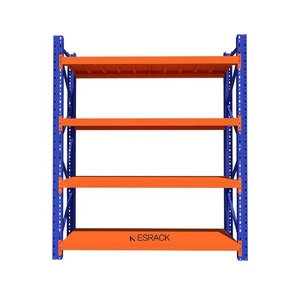
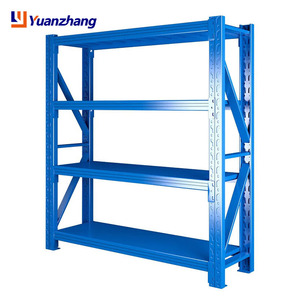
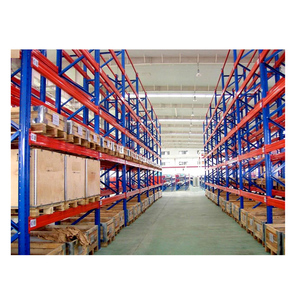
Explore our factory-engineered configurations, cold-formed from certified high-tensile structural steel to ensure zero-deflection performance across heavy-duty industrial, archival, and multi-tier picking applications.
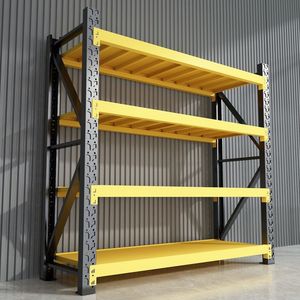
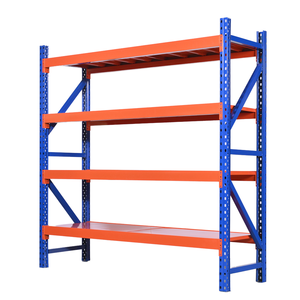
In modern high-throughput intralogistics ecosystems, Long Span Shelving (Wide Span Racking) serves as the mission-critical link bridging low-capacity light boltless shelving and high-bay automated pallet racking. Unlike conventional slotted angle frames that suffer from structural elasticity and dynamic fatigue under cyclic multi-point hand loading, industrial-grade long span systems engineered by Guangzhou Heda Shelves Co., Ltd. leverage closed-profile omega upright posts cold-roll-formed from hot-rolled micro-alloyed structural steels (grades Q235B and Q355B conforming to GB/T 700 and EN 10025 standards).
A frequent vulnerability in commercial racking procurement is the uncalculated deflection ratio ($L/d$). Under rigorous European Racking Standards (specifically EN 15512:2020 for steel static storage systems and EN 15620 for tolerances, deformations, and clearances), the maximum elastic deflection of a horizontal shelf beam under uniformly distributed load (UDL) must not exceed 1/200th of the clear bay span ($L/200$), and in seismic or automated integration zones, $L/250$. HEDA Shelves integrates step beams and tubular box beams roll-formed with a continuous seam-welded interior return flange, effectively dissipating concentrated torsional stress generated when personnel manually slide heavy carton dies or machinery components across the shelf deck.
For warehousing facilities situated in South Asian coastal logistics zones (such as Nhava Sheva, Mundra, Chattogram, and Colombo) or tropical environments characterized by relative humidity fluctuating between 75% and 95%, untreated cold-rolled steel undergoes rapid galvanic corrosion and subsurface pitting. HEDA Shelves addresses this environmental degradation through an automated 12-stage chemical pretreatment line consisting of hot alkaline degreasing, industrial pickling to strip mill scale, and micro-crystalline zinc phosphating. This substrate preparation guarantees an adhesion rating of Class 0 (ISO 2409 cross-hatch tape test). Electrostatic deposition of pure thermosetting polyester-epoxy powder at 60–80 μm dry film thickness (DFT), baked at continuous 200°C curing schedules, yields salt-spray resistance exceeding 500 hours (ASTM B117) without film peeling or blister development.
| Engineering Attribute | Light-Duty Longspan | Medium-Duty Longspan (YZ Spec) | Heavy-Duty Longspan / Mini-Rack | Verification Standards |
|---|---|---|---|---|
| Payload Capacity (UDL) | 150 kg – 300 kg / level | 300 kg – 800 kg / level | 800 kg – 1,500 kg / level | EN 15512:2020 / ANSI MH16.1 |
| Upright Section Profile | 50 × 37 × 1.2 mm Ω-Section | 55 × 47 × 1.5 mm Ω-Section | 70 × 50 × 1.8-2.0 mm Ω-Section | Cold Roll-Formed GB/T 6725 |
| Pitch Adjustment Increment | 50 mm Pitch | 50 mm / 75 mm Pitch | 50 mm / 75 mm Pitch | CNC Punch Tolerances ±0.05 mm |
| Decking Material Options | Pre-galvanized drop-in steel pan | Electrostatic powder-coated steel pan / Wire mesh | Heavy-gauge drop-in steel pan / Solid timber / Mesh | Fire sprinkler drainage compatible |
| Safety Pin Locking | Gravity spring drop-pin | Self-locking spring steel clip (zinc-plated) | Bolted M8 shear pin / Spring steel dog-leg | Prevents accidental beam dislodgement |
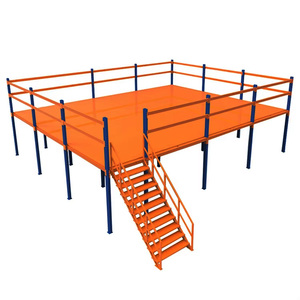
As industrial real estate prices and cubic warehousing costs escalate, long span shelving offers an intrinsic vertical pathway: transformation into Rack-Supported Mezzanines. Because our upright sections possess uniform moment-of-inertia profiles and calculated column buckling thresholds under Euler-Johnson formulations, standard ground-level frames can be engineered with splice-joint column extensions, bridging beams, cold-formed C-section floor joists, and galvanized perforated steel walkways. This modularity allows logistics managers to expand storage footprints vertically by 200% to 300% without incurring municipal building structural permit delays or civil construction costs.
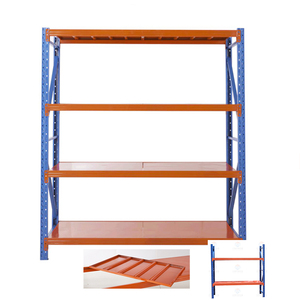
Global supply chain shocks and automated warehousing mandates are redefining how supply chain leaders and procurement directors select, validate, and contract storage rack infrastructure.
Modern distribution centers are shifting away from pure manual handling. Procurement specifications increasingly require long span shelving base profiles to accommodate autonomous mobile robot (AMR) undercarriages, anti-glare shelf facings for machine-vision navigation, and pick-to-light LED channel integration directly into step-beam profiles.
With ESG mandates and CBAM (Carbon Border Adjustment Mechanism) tariffs tightening across the EU and North America, multinational 3PL operators are demanding certified low-carbon recycled content steel profiles without compromising yield strength ($R_e \ge 355 \text{ MPa}$), necessitating lighter, high-stiffness micro-flanged profiles.
Insurance underwriters (such as FM Global) now mandate that open-shelf systems feature certified transverse and longitudinal flue spaces (>50% open area via heavy wire mesh decking) to facilitate high-velocity ESFR sprinkler suppression penetration, alongside zone-specific dynamic seismic anchor calculations.
From automated robotic forming cells to digital twin integration, long span manufacturing is transitioning from passive steel metalwork to advanced industrial engineering.
Modern roll-forming tools use dynamic computerized multi-pass reduction lines (up to 24 rolling stations) guided by Finite Element Analysis. This eliminates residual tensile stress in the profile corners, ensuring that posts retain absolute dimensional perpendicularity over heights exceeding 6 meters.
Traditional two-claw beam clips are being phased out in favor of multi-prong tapered wedge hooks stamped from 3.0mm cold-rolled alloy plates. The gravitational wedging action locks the beam tighter against the upright column as payload increases, eradicating bay sway under dynamic hand operations.
Warehouse projects require full integration into Building Information Modeling (BIM) software (such as Autodesk Revit). Standardized parametric 3D models allow direct clash-detection against sprinkler piping, lighting trusses, and structural building columns before single-piece metal cutting begins in the factory.
Every upright post, step beam, and drop-in deck panel is fabricated in-house under strict ISO 9001:2015 quality surveillance, ensuring metallurgical and dimensional uniformity.
Ultrasonic gauge check & chemical composition spectroscopic analysis.
High-speed slitting line ensuring zero edge burrs and parallel coil width.
High-precision continuous CNC punch line stamping 50/75mm pitch holes.
Multi-stage cold reduction rollers form rigid Ω-shape upright profiles.
Fiber laser systems cutting custom beam lengths to ±0.3mm tolerance.
CO2 shielded automated robotic arms weld beam connectors and baseplates.
Acid wash, ultrasonic rinse, and hot micro-crystalline zinc phosphating.
Electrostatic reciprocal spray guns delivering uniform 60-80 μm finish.
Controlled 200°C polymerization curing oven for hard, scratch-proof coat.
Corrugated wrapping, air-cushion interleaves & heavy steel strap bundling.
Operating continuously since 2001, HEDA Shelves represents a vertically integrated manufacturing powerhouse engineered specifically to eliminate middlemen margins and provide direct factory engineering to overseas procurement operations.
Strategically based in Guangzhou, South China, our facility features 300+ engineering professionals and specialized machinery producing 30,000 metric tons of certified racking monthly, ensuring high-volume orders ship within 14-21 business days.
Procurement documentation is supported by CE Certification (Certificate No. 2435-CPR-8605159), ISO 9001:2015 Quality Management System (No. 18624Q00169R0M), and full RoHS compliance documentation verifiable through international registries.
We optimize nested upright bundle geometries and stepped-beam stacking software to achieve 98%+ volumetric efficiency inside 40HQ containers, drastically reducing the landed logistics freight cost per pallet position or shelf meter.
Within 24 hours of receiving site blueprints, clear heights, and column grid details, our application engineers furnish full 2D AutoCAD equipment layouts, 3D visual renderings, and complete structural loading calculations at no charge.
Critical technical clarifications covering structural capacity ratings, installation support, monsoon moisture mitigation, and container delivery across international destinations.
Long Span Shelving is engineered specifically for manual picking and hand-loaded non-palletized inventory, featuring shelf clear widths typically between 1,200 mm and 2,500 mm and shelf capacities ranging from 200 kg to 1,200 kg per tier. In contrast, Selective Pallet Racking utilizes heavy C-profile or boxed cross-beams engineered to support standard ISO/GMA timber pallets (typically 1,000 kg to 3,000 kg per pallet position) accessed exclusively by counterbalance, reach, or VNA forklifts. Both systems can be synergized within the same facility or integrated into a rack-supported mezzanine.
Export shipments traveling through equatorial and humid maritime lanes are vulnerable to "container sweat." HEDA Shelves applies a multi-barrier defense: First, all raw steel undergoes 12-stage automated hot pickling and micro-crystalline zinc phosphating before receiving a 60–80 μm electrostatic polyester-epoxy coating. Second, bundled materials are wrapped in moisture-resistant vapor-corrosion-inhibiting (VCI) films and multi-ply corrugated paperboard. Third, military-grade silica gel desiccant bags are distributed throughout every 20GP or 40HQ container to maintain internal relative humidity below the oxidation threshold.
To generate an actionable layout, our structural engineering team requires: (1) Warehouse architectural drawings (DWG, DXF, or PDF format) indicating clear building heights, interior column centers, roll-up doors, and fire suppression risers; (2) Maximum carton or product dimensions ($W \times D \times H$) and weight per unit; (3) Desired shelf levels per bay; (4) Subfloor specifications (concrete slab thickness, compressive strength, and rebar structure); and (5) The project installation city and discharge port for CIF freight calculations.
Yes. We routinely manage containerized deliveries from South China ports to major global destinations including Nhava Sheva (JNPT), Mundra, Chennai, Kolkata, Chattogram, Karachi, Port Qasim, Colombo, and Jebel Ali. For landlocked regions like Nepal and Bhutan, transit manifests are coordinated through Kolkata or Visakhapatnam. We furnish certified commercial invoices, packing lists, Bills of Lading, Certificates of Origin (Form E, Form A, or Non-Preferential), CE Compliance Declarations, and mill test certificates (MTC).
Yes. Provided our engineers are informed during the initial specification phase, the base upright sections will be selected with structural reserve factors capable of supporting future column splicing, overhead mezzanine beam loadings (dead loads + live loads ranging between 300 kg/m² and 1,000 kg/m²), handrail attachments, and cantilevered staircases. This engineering foresight protects initial capital investments by eliminating the need to scrap existing racking during facility expansions.
Submit your warehouse floor plan, ceiling clear heights, and payload requirements. Receive a certified 2D CAD layout, 3D visualization, and comprehensive project quotation within 24 hours.