Industrial Grade Storage Systems
Explore our CE-compliant, ISO 9001:2015 manufactured warehouse racks designed for maximum spatial optimization, heavy load bearing, and seamless intralogistics efficiency.
Whitepaper 1. Executive Engineering Summary: The Dynamics of Industrial Racking
Modern global logistics and industrial supply chain operations demand unprecedented levels of architectural optimization, structural reliability, and compliance with stringent international safety standards. As industrial real estate costs continue to escalate globally—increasing by an average of 8.4% year-over-year in prime logistics hubs—the efficiency of warehouse volumetric utilization has shifted from an operational operational metric to a core financial driver. High-density, engineering-certified industrial warehouse racking serves as the backbone of modern intralogistics systems.
This technical report examines the mechanical parameters, material science advancements, structural design standards (including European EN 15512 and FEM 10.2.02 codes), and manufacturing rigor implemented by Guangzhou HEDA Shelves Co., Ltd. As a premier CE-certified manufacturer and global exporter, HEDA Shelves integrates advanced cold-roll forming technologies with automated robotic welding to deliver static and dynamic racking infrastructure engineered to withstand operational stress, seismic loads, and harsh climatic environments.
2. Structural Metallurgy & Mechanical Engineering Standards
The structural integrity of heavy-duty industrial shelving depends heavily on metallurgy, cold-forming profile geometry, and load-distribution dynamics. Uncertified steel profiles under heavy loads risk catastrophic mechanical failure, frame buckling, and elastic deformation exceeding critical tolerances. HEDA Shelves strictly utilizes prime structural steel grades—specifically Q235B and high-tensile Q355B structural carbon steel (equivalent to European S235JR and S355JR under EN 10025 standards).
Mechanical Yield & Tensile Properties
The structural frames are formed using precision multi-pass roll-forming machines, creating continuous upright profiles with optimized inertia moments. Below is the structural material comparison utilized across our product matrix:
| Steel Grade Standard | Yield Strength (Fy / MPa) | Tensile Strength (Fu / MPa) | Elongation (%) | Primary Structural Application |
|---|---|---|---|---|
| Q235B (SS400 / S235JR) | ≥ 235 MPa | 370 - 500 MPa | ≥ 26% | Light-to-Medium Duty Shelving, Horizontal Bracing, Shelf Panels |
| Q355B (S355JR / St52-3) | ≥ 355 MPa | 470 - 630 MPa | ≥ 22% | Heavy-Duty Upright Columns, High-Load Box Beams (>3000kg/level) |
| Cold-Rolled SPCC | ≥ 210 MPa | ≥ 270 MPa | ≥ 32% | Precision Accessories, Drawer Units, High-Surface-Finish Panels |
All structural components undergo finite element method (FEM) stress simulation analysis prior to production. This engineering verification ensures that column deflections under maximum specified working load limits (WLL) do not exceed the strict architectural threshold of L/200, ensuring complete operator safety and material handling compliance.
3. Global Procurement Trends in Heavy-Duty Storage (2025-2035)
The global procurement landscape for industrial warehouse equipment is undergoing a technological transformation driven by four core megatrends:
A. Seamless AS/RS and Automation Compatibility
Procurement directors are shifting away from standalone static racking toward automation-ready physical architecture. Pallet flow systems, Radio Shuttle racks, and Very Narrow Aisle (VNA) systems must now adhere to sub-millimeter installation tolerances (±1.5mm frame alignment) to allow automated guided vehicles (AGVs) and Autonomous Mobile Robots (AMRs) to extract and deposit loads without collision risks.
B. Environmental Pretreatment & Zero-VOC Finishing
Corporate ESG mandates require sustainable production cycles. Modern buyers explicitly specify anti-corrosion chemical pretreatment cycles that avoid toxic heavy metals. HEDA Shelves implements a 10-stage automated surface pretreatment process: Degreasing → Water Rinsing → Acid Pickling → Rinsing → Neutralization → Surface Conditioning → Phosphating → Final Rinsing → Drying → Electrostatic Powder Coating (60-90μm). This process guarantees salt spray resistance exceeding 500 hours per ISO 9227 standard without structural degradation.
C. Modular Flexibility & Boltless Interlocking Designs
Dynamic supply chains require rapid reconfiguration. Modern industrial facilities prefer teardrop, diamond-hole, or 50mm/75mm pitch beam adjustments that allow field technicians to alter beam heights without unbolting or structural welding, dramatically reducing downtime during SKU restructuring.
4. Technological Evolution of Industrial Racking Systems
Over the past two decades, warehouse rack manufacturing has evolved from basic structural angle-iron welding to advanced engineering cold-forming. Below is a comparative technological analysis detailing how storage density and operational throughput have improved across core structural archetypes:
| Racking Archetype | Volumetric Density Efficiency | Selectivity Ratio | Inventory Handling Principle | Structural Load Limit |
|---|---|---|---|---|
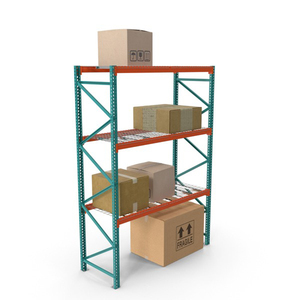
| Selective Pallet Racking | 40% - 50% | 100% Direct Access | FIFO (First-In, First-Out) | Up to 4,500 kg / Level |
| Drive-In / Drive-Thru Racking | 70% - 80% | 20% - 30% Low Selectivity | LIFO (Last-In, First-Out) | Up to 1,500 kg / Pallet |
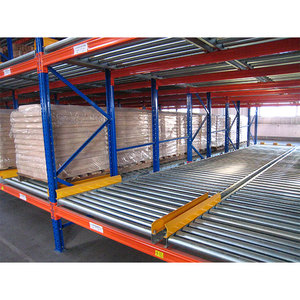
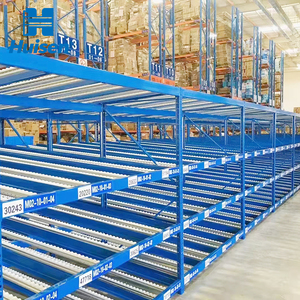
| Gravity Pallet Flow Racking | 75% - 85% | Medium Selectivity | Strict FIFO (Roller-Driven) | Up to 2,000 kg / Pallet Lane |
| Semi-Automated Radio Shuttle | 80% - 90% | High Volume / Lane Access | Programmable FIFO / LIFO | Up to 1,800 kg / Shuttle |
| Structural Mezzanine Systems | 200% Floor Area Multiplier | 100% Floor Access | Multi-Tier Manual / Conveyor | 300 - 1,000 kg / Sqm |
By leveraging dynamic systems like FIFO Gravity Flow or Radio Shuttle Racking, warehouse operators reduce fork-truck travel distance by up to 45%, lowering fuel/battery consumption while mitigating forklift impact risks against upright frames.
Why Global Supply Chains Partner With HEDA Shelves
Combining advanced factory automation, strict quality assurance, and end-to-end global trade management.
Verifiable CE & ISO Certification
Certified compliance under CE Factory Production Control (No. 2435-CPR-8605159) and ISO 9001:2015 Quality Management. Every batch is traceable back to raw coil mill heat numbers.
Free CAD Layout & 3D Engineering
Our structural engineering team provides complete warehouse spatial layout optimization, CAD architectural drawings, and 3D rendering within 24 hours—completely free of charge.
30,000 m² Advanced Production Base
Equipped with automated cold-roll forming lines, high-speed CNC punching presses, laser cutting cells, and robotic welding stations delivering over 30,000 metric tons of steel shelving monthly.
Container-Optimized Export Packing
Specialized packaging utilizing steel banding, corrugated corner protectors, and moisture-barrier film ensures 100% sea-freight protection and maximizes 40ft HQ container loading volume.
5. Frequently Asked Questions (Procurement & Technical Manual)
Detailed technical answers to common questions raised by procurement managers, logistics consultants, and structural engineers during the industrial shelving acquisition process.
What specific structural certifications do HEDA racking products carry for international compliance?
Guangzhou HEDA Shelves Co., Ltd. holds CE certification (No. 2435-CPR-8605159) under the Construction Products Regulation, proving structural steel compliance. We are certified under ISO 9001:2015 Quality Management Systems (Certificate No. 18624Q00169R0M). Our structural engineering design algorithms align with European standards EN 15512 (Steel static storage systems), FEM 10.2.02, and American RMI (Rack Manufacturers Institute) guidelines.
How do you prevent corrosion on steel shelving exported to humid or coastal regions?
All HEDA steel products undergo a 10-stage chemical pretreatment process incorporating acid pickling, rust removal, and dense phosphating prior to electrostatic powder coating. Coating thickness is maintained at 60–90 microns using thermosetting epoxy-polyester resin powder cured at 180°C–200°C. For extreme cold-room (-30°C) or outdoor/coastal applications, hot-dip galvanized (HDG) steel options complying with ISO 1461 are provided.
What engineering data is required from the client to generate a CAD layout design?
To produce a fully compliant CAD layout and formal quotation, our structural team requires: (1) Warehouse building floor plan drawing showing column grid locations, doors, and clear height under trusses; (2) Pallet dimensions including load height and total weight (WLL per pallet); (3) Forklift truck operational specs including outer turning radius and maximum lift height; and (4) Ambient operating temperature and local seismic code requirements.
What is the structural lead time and global shipping turnaround?
Standard manufacturing lead time for full container load (FCL) orders is typically 15 to 20 calendar days from formal technical CAD sign-off and deposit confirmation. Ocean freight transit to major Asian, European, Middle Eastern, and American ports ranges between 12 to 30 days depending on the destination shipping line and route.
Do you provide site installation supervision and structural testing manuals?
Yes. Every container shipment includes color-coded assembly manuals, detailed structural component lists, torque spec charts for baseplate anchor bolts, and step-by-step video installation guides. For complex projects like multi-tier rack-supported mezzanines or automated flow systems, HEDA dispatch structural field engineers on-site for erection supervision and load-testing verification.
Optimize Your Warehouse Storage Capacity Today
Connect directly with our senior structural engineers to receive a customized CAD racking layout, structural static calculation report, and factory-direct price quotation within 24 hours.
Get a Quote