Industrial Racking & Gravity Flow Systems
Precision-fabricated utilizing certified Q235B and Q355B cold-rolled steel, custom electrostatic powder coating, and calibrated dynamic roller profiles. Explore our 8 primary industrial configurations engineered for high-throughput fulfillment.
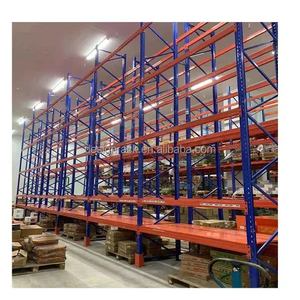 Heavy Duty
Heavy-Duty Single Deep Forklift Pallet Racks System Industrial Metal Steel Storage Racks
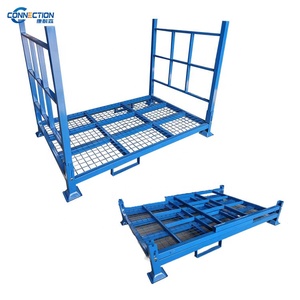 Modular Stacking
High Loading Capacity Steel Wire Mesh Pallet Foldable Stacking Rack Storage Tire Rack
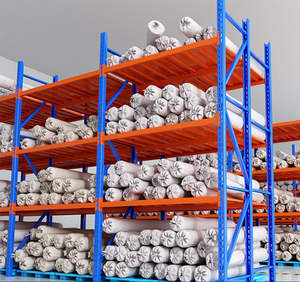 Roll Handling
Textile Industry Heavy Duty Steel 5-Layer Corrosion Protection Warehouse Shelf Storage Rack For Rolls Fabric
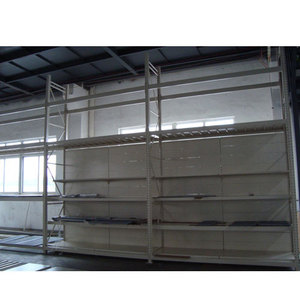 Commercial Dual
Integrated Heavy Duty Metal Shelving for Hypermarket Combined Racking and Shelving
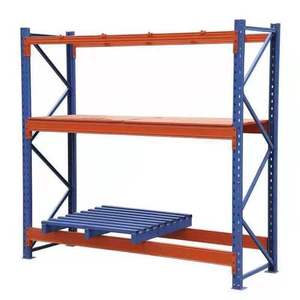 Universal Standard
Adjustable Pallet Rack Warehouse Storage Heavy Duty Shelving Pallets Racking
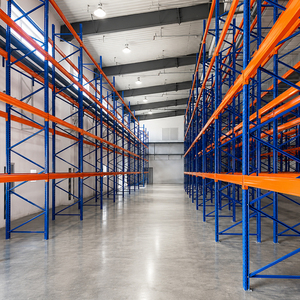 Electrostatic Coated
Steel Storage Rack System 1000kg Electrostatic Powder Coating Selective Pallet Racking With Steel Decking
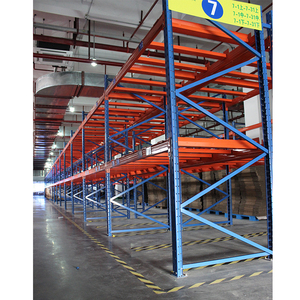 Engineered Custom
Custom Warehouse Racking System Steel Storage Rack Solution For Logistics And Manufacturing
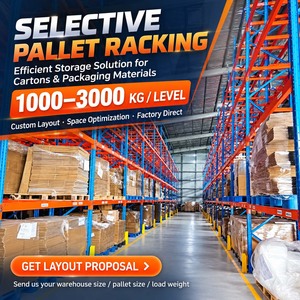 Aisle Optimized
Conventional Steel Pallet Racks for Forklift Access in Industrial Warehouses
Engineering Principles of Gravity Flow Racking Systems
A comprehensive metallurgical and kinematic examination of deep-lane FIFO storage architectures, dynamic brake roller engineering, and EN 15512 safety protocols.
1. Kinematics of Gradient & Roller Inertia
Gravity flow pallet racking operates on an inclined dynamic plane—typically calibrated between 2.5% and 3.5% (1.5° to 2.0°). The physical equation governing movement requires equilibrium between initial static friction, gravitational descent forces, and rotational inertia of the galvanized steel rollers:
- Descent Force Calculation: F_descent = m × g × sin(θ), balancing resisting friction F_f = μ × m × g × cos(θ).
- Dynamic Speed Controllers: Viscous centrifugal brake rollers are spaced every 1 to 2 pallet lengths, governing terminal velocity to a safe ≤ 0.3 m/s irrespective of pallet load variation (from 250 kg up to 1,500 kg).
- Entry Ramp Acceleration: Non-braked entry zones ensure consistent release even for slightly defective, sagged, or cold-stored timber pallets.
2. Structural Metallurgical Criteria
As a CE-certified manufacturer under Factory Production Control Certificate 2435-CPR-8605159, Guangzhou Heda Shelves Co., Ltd. enforces strict metallurgical and dimensional tolerances across all cold-formed structural members:
- Steel Grades: High-yield Q235B and Q355B (equivalent to European S235JR and S355JR) cold-rolled structural sheet conforming to EN 10025.
- Column Profiles: Multi-bend omega uprights (up to 120mm profile width) providing immense torsional stiffness against dynamic pallet roll impacts.
- Surface Treatment: 10-stage chemical pickling, ultrasonic degreasing, zinc phosphating, and electrostatic epoxy-polyester powder coating cured at 200°C for exceptional humidity and salt-spray defense.
3. Pallet Separation & Safety Mechanisms
The primary point of operational failure in inferior pallet flow systems is back-pressure accumulation at the discharge face. In a 20-pallet-deep lane, cumulative pressure against the front pallet can reach hundreds of kilonewtons:
- Automatic Pallet Separator: A mechanical trip lever locks the line of rear pallets 300mm behind the lead pallet, removing line pressure during forklift extraction.
- End-Stop Dampening: Heavy-duty polyurethane impact bumpers arrest the lead pallet precisely at the pick station without structural shock transfer.
- Return Mechanism: Once the lead pallet clears the pick face, the separator releases automatically, smoothly advancing subsequent loads.
Deep-Lane Warehouse System Comparison: Throughput vs Space Efficiency
| System Architecture | Pallet Flow (Gravity) | Radio Shuttle Racking | Drive-In Racking | Selective Pallet Rack |
|---|---|---|---|---|
| Inventory Rotation | Strict FIFO (100% Reliable) | FIFO or LIFO | Strict LIFO Only | Random Direct Access |
| Volume Utilization | 85% - 90% Floor Cubic Space | 80% - 88% Floor Cubic Space | 70% - 78% Floor Cubic Space | 35% - 45% Floor Cubic Space |
| Energy Consumption | Zero kWh (Pure Gravity Driven) | Battery charging for shuttles | High forklift operating hours | Moderate forklift drive times |
| Aisle Segregation | 100% Split: Loading vs Picking | Shared or dedicated aisles | Single drive-in access lane | Shared traveling aisles |
| Cycle Time / Throughput | Ultra-Rapid: Simultaneous flow | Semi-Rapid: Limited by shuttle speed | Slow: Risky deep-aisle navigation | Moderate: Immediate pick capability |
| Maintenance Overhead | Low (Passive kinematic rollers) | Moderate to High (Robotics, batteries) | High (Frequent upright collision repair) | Very Low |
Future Procurement & Technological Trends (2025–2030)
Global supply chain directors and warehouse logistics planners are transitioning toward resilient, energy-neutral, and automated dynamic handling networks.
Net-Zero "Dark Warehouse" Transition
Rising industrial electricity tariffs make the passive kinetic mechanism of gravity flow racks an indispensable ESG advantage. Unlike power-reliant automated storage, pallet flow systems circulate thousands of metric tons per day with zero electric motor usage.
Cold Chain Boom & Pharma Serialization
The global explosion of temperature-controlled biologics, vaccines, and frozen food logistics requires infallible batch tracking. Gravity flow's inherent First-Expired-First-Out (FEFO) and FIFO execution prevents spoiled stock and inventory write-offs.
AGV & AMR Autonomous Interface
New procurement demands require integration with automated guided vehicles (AGVs). Modern gravity discharge tracks feature micro-sensor brackets and millimeter-accurate pallet stops tailored for robotic side-fork grabs without human operator intervention.
Predictive Structural Health & IoT
Forward-thinking installations integrate low-power Bluetooth and piezoelectric sensors directly onto brake rollers and critical uprights, monitoring operational impacts, descent velocity, and load limits in real time for predictive maintenance.
Why Global Tier-1 Enterprises Partner with HEDA Shelves
Headquartered in Guangzhou, South China, Guangzhou Heda Shelves Co., Ltd. is an authoritative manufacturer delivering fully traceable, custom-engineered racking projects across Europe, North America, Southeast Asia, the Middle East, and South Asia.
Full In-House Industrial Value Chain
From raw steel coil verification to automated continuous profiling, computerized laser cutting, robotic welding cells, and electrostatic powder coating lines, 100% of manufacturing occurs within our 30,000 m² Guangzhou production base.
This complete vertical integration guarantees strict batch-to-batch metallurgical consistency, rapid OEM/ODM tooling customization, and verifiable dimensional precision down to ±0.5mm across complex upright and beam profiles.
Turnkey Engineering & Free 3D CAD
Our in-house engineering team provides comprehensive pre-sales project engineering at no initial cost. Utilizing finite element analysis (FEA), we calculate live/dead structural loads, slab loading capacity, seismic zone dampening (Zones 1 through 4), and optimal pallet lane configurations.
Clients receive complete CAD floorplans, 3D dynamic warehouse visualizations, load table data, and anchor-bolt stress verifications before any steel is processed.
Containerized Ocean Packaging
Exporting heavy industrial steel demands robust logistic packaging. Structural upright frames, box beams, and gravity roller beds are strapped with non-marking polymer bands, wrapped in scratch-resistant poly film, and fitted with custom corner protectors.
Every shipment is container-optimized to maximize 40ft HQ volume capacity, reducing landed freight cost per pallet location to global hubs such as Rotterdam, Hamburg, Los Angeles, Nhava Sheva, Jebel Ali, and Singapore.
Audited International Credentials
 CE Certified
Certificate 2435-CPR-8605159
 ISO 9001:2015
Quality System 18624Q00169R0M
 RoHS Compliance
Eco-Friendly Non-Toxic Powder
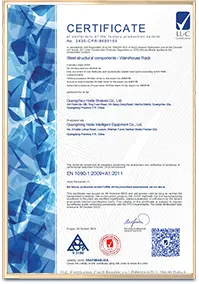 EN 15512 & FEM
Structural Standard Verified
10-Stage In-House Quality Production Pipeline
Every component manufactured at HEDA Shelves undergoes a documented 10-stage manufacturing and quality assurance checkpoint protocol prior to international release.
Certified Steel Coils
Spectral analysis and tensile yield testing of all incoming Q235B and Q355B coils to eliminate substandard alloy composition.
CNC Precision Slitting
Automated length-controlled slitting ensuring square, burr-free edges ready for high-speed continuous roll-forming.
Synchronous Column Hole Pitch
Multi-stage hydraulic presses punch teardrop and diamond adjustment holes with pitch accuracy guaranteed within ±0.1mm.
Multi-Station Roll Mills
Progressive cold-forming rollers shape complex multi-rib uprights and interlocking box beams for optimal structural yield.
Dynamic Roller Assembly
Galvanized roller beds fitted with sealed precision bearings, dynamic balancing, and calibrated internal eddy-current brakes.
Robotic Beam Joint Welding
Automated CO2 gas-shielded robot welding connects beam claw connectors with deep, uniform penetration and zero slag defects.
Pickling & Phosphating
Complete chemical immersion eliminates mill scale, oils, and oxides, depositing a protective crystalline zinc phosphate barrier.
Electrostatic Powder Coating
Automated reciprocal spray guns deposit 60-90μm epoxy-polyester powder, oven-cured at 200°C for exceptional impact durability.
Physical Stress Verification
Random sample beam deflection and roller friction tests under 125% rated maximum static and dynamic pallet weight loads.
Export Bundle Crating
Strapped and edge-shielded bundles cross-braced for sea transit, accompanied by detailed 3D installation blueprints.
Full Traceability from Mill to Site Delivery
Every upright, beam, and gravity roller module is heat-stamped and serialized, tying directly to raw coil chemical test certificates and factory QA sign-offs.
Frequently Asked Questions (FAQ) for Gravity Flow Rack Buyers
Essential operational, structural, and budgetary insights to guide supply chain managers, warehouse directors, and procurement executives.
Ready to Maximize Warehouse Storage Density with High-Efficiency Gravity Flow?
Contact our structural engineering team today to receive a customized warehouse feasibility analysis, structural load calculation, and complete 3D CAD design tailored to your logistics facility—guaranteed within 24 hours.
Inquire Now